

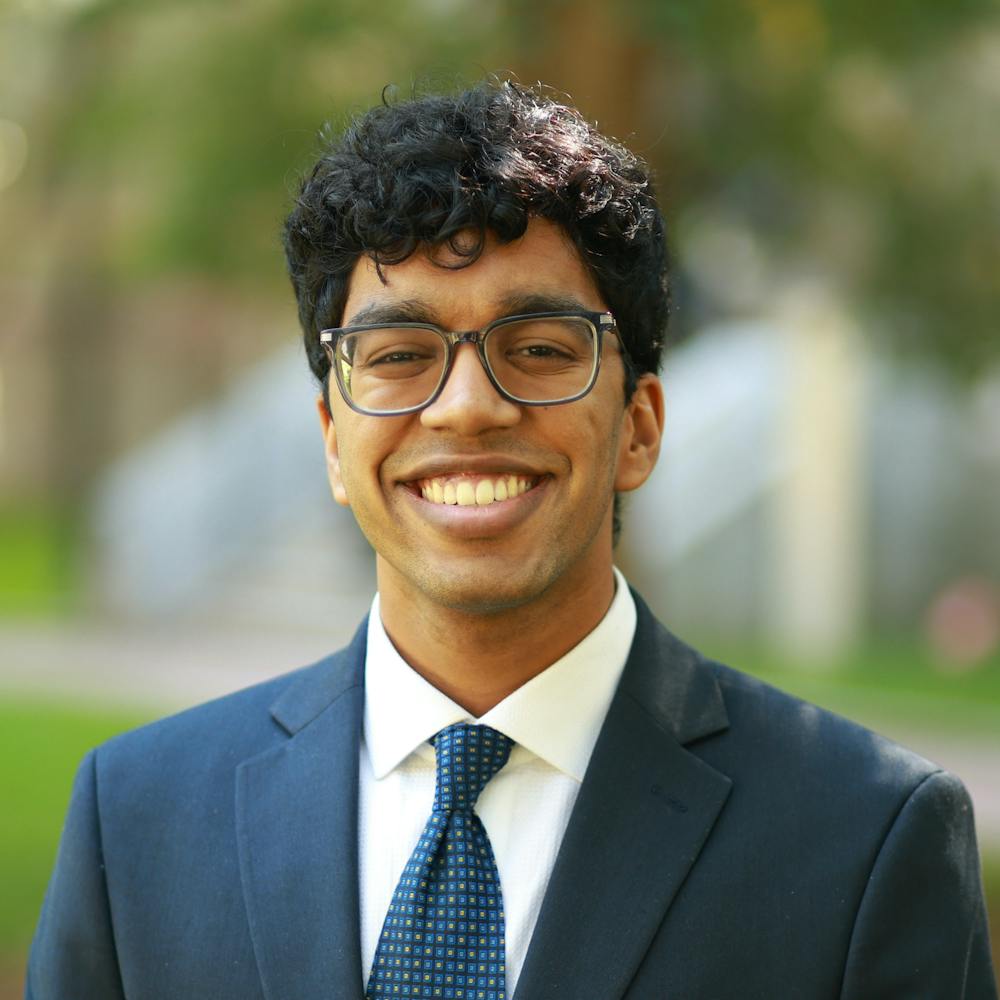
A Penn student just got a seat at the table on disability policy in Pennsylvania — and he’s the only undergraduate in the room.
Pennsylvania Gov. Josh Shapiro appointed College and Wharton senior Yaduraj Choudhary to the newly minted Advisory Commission on People with Disabilities. Choudhary is the youngest of the group’s 28 members.
Formed on July 8 by an executive order, the commission seeks to expand protections for Pennsylvanians with disabilities and autism. The body recommends policy changes, works with governmental agencies, and serves as a resource for people with disabilities and their families.
“Far too often, decisions have been made about people with disabilities, but not with them,” Shapiro said while announcing the appointments. Each term will last for two years.
For Choudhary, the appointment is a chance to bring a younger perspective he says is often missing from the decision-making process across the state.
As part of the Education, Youth, and Transitions work group, Choudhary said he hopes to educate people about disabilities and connect others with resources and training.
“A lot of youth are more comfortable raising their issues through someone of a similar age,” Choudhary said in an interview, clarifying that he was speaking in his individual capacity. “I want to be the person who helps bring these youth voices to the table — to the governing table — places where they’re not normally found.”
In the near future, Choudhary plans to reach out to disability groups on campus, in Philadelphia, and across the state, including the Disabled Coalition at Penn.
RELATED:
Faculty weigh how Penn should respond to Trump’s higher education reform letter
Three former mayors join panel discussing new program to connect Penn students with public officials
Josie Badger, the commission’s executive director, said that youth engagement was exactly what the body sought from Choudhary’s appointment. She added that the commission’s 28 members are meant to reflect the range of Pennsylvanians with disabilities, and that Choudhary fills a role the group had prioritized.
“We want to ensure that the voice of our next leaders are involved now, sharing what they’re going through, so that we do it better next time,” Badger said in an interview.
The full commission meets quarterly, while three topic-based groups — on physical and mental health, community integration and inclusion, and education and youth development — meet monthly to set priorities and identify barriers. Badger’s role as executive director, she said, is to act as the “middle person” between the commission, the governor’s office, and state departments.
Choudhary’s path to the commission was shaped by his own experience with disability. Born with hearing loss, he underwent five surgeries on both ears, often missing school to recover. The turning point came in sixth grade, when he began wearing a hearing aid and noticed how his classmates treated him differently.
“No one would ask me if I’m blind if I walk in wearing glasses,” he said. “But if I walked in wearing a hearing aid, kids were asking all sorts of things: ‘Are you deaf? What’s going on?’”
This experience convinced Choudhary that most of the stigma traced back to a lack of understanding. In 2020, while he was in ninth grade, Choudhary founded a nonprofit called 3 Tiny Bones. The organization’s name refers to the ossicles in the ear, the three smallest bones in the human body.
“Those were actually the bones I don’t have anymore in my ears, because they weren’t really present or fully formed because of the hearing loss,” he said.
Over the past six years, 3 Tiny Bones has grown its reach, running programs in schools and libraries, publishing explainers on the science of hearing, and pushing for legislation that expands sign language funding and requires hearing loss to be taught in health classes.
The work groups are still finalizing their priorities, which the commission will vote on at its fall board meeting, Badger said. One initiative already underway is a Disability Mentoring Day on Oct. 7 near the state Capitol, where roughly two dozen young people with disabilities will “have opportunities to meet professionals and state government leaders.”
Choudhary said his appointment marks a distinct next step in his advocacy — extending beyond local or online outreach. For him, the commission offers an opportunity to defend disability rights in a more tangible way.
What has not changed, however, is the question that has driven Choudhary since sixth grade: “How can I make sure that if there is a kid with hearing loss or any disability, they’re not treated any differently for it — that people understand they’re still, at their core, a person?”
RELATED:
Faculty weigh how Penn should respond to Trump’s higher education reform letter
Three former mayors join panel discussing new program to connect Penn students with public officials
Senior reporter Riana Mahtani covers national politics and can be reached at mahtani@thedp.com. At Penn, she studies political science. Follow her on X @Riana_Mahtani.


