

Last summer was the warmest on record for the United States.
Tied for the third warmest summer in Philadelphia, temperatures are expected to break even more records worldwide in 2027. Penn researchers are investigating the socioeconomic and health concerns associated with extreme heat, along with sustainable adaptation measures for both on and off campus.
In a recent survey conducted by Penn's Annenberg Public Policy Center, 75% of respondents across the United States said that heat had either a major or minor effect on their outdoor activities. 56% reported an effect on their exercise routines and sleep.
Penn Sustainability assists in developing and working toward Penn’s Climate and Sustainability Action Plan 4.0, which outlines goals for on-campus sustainability, including Penn’s commitment to carbon neutrality by 2042.
In an interview with The Daily Pennsylvanian, Penn Sustainability Director Nina Morris said that climate adaptation impacts not only the natural environment, but the built environment, human bodies, and animals.
“The approaches need to be as diverse as the impacts,” Morris said. “It requires people across our institution thinking about resiliency and how they can contribute to that.”
Penn Sustainability has sought ways to adapt to increased energy demand for cooling during heatwaves. These efforts include coordinating designated hot days called Red Days, when pre-planned interventions — such as reducing nonessential lighting — help reduce energy use.
Morris added that Penn Sustainability works “to reduce consumption” during blackouts and brownouts, events which can have “devastating impacts” for both Penn and the broader community.
RELATED:
Penn declares campus ‘Red Day’ as temperatures reach triple digits
Federal assistance can help communities struggling with extreme heat, Penn experts find
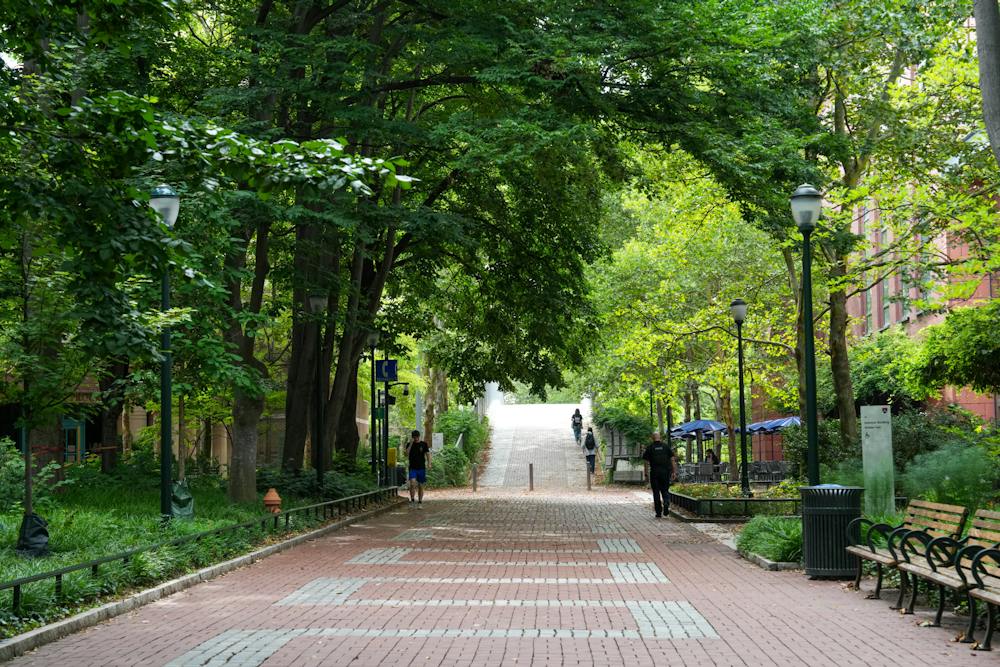
Penn Sustainability has also investigated Penn’s tree canopy as a solution for reducing “the feeling of extreme heat.”
Architecture professor Dorit Aviv — who directs the Thermal Architecture Lab at the Stuart Weitzman School of Design — integrates thermodynamics, materials science, and architectural design principles in her lab to research advanced cooling solutions that demand little or no electricity.
Most recently, Aviv helped install ThermoTerra, a cooling bench that debuted on Sept. 18. The bench contains circulating water that is chilled using solar power. It also uses low-carbon cement and takes advantage of the shade from trees that form part of its structure.
“Cooling technologies have an important role to play in helping Philadelphia residents adapt to rising temperatures,” Aviv wrote. “But resilience should not depend on air conditioning alone.”
She emphasized the importance of “highly scalable” strategies including exterior shading, improved insulation, and well-designed windows to minimize indoor heat exposure.
“These approaches can be incorporated into both new construction and existing buildings at relatively low cost,” Aviv wrote. She added that these measures can be complemented by more advanced technologies, including “radiant cooling and neighborhood-scale cooling infrastructure.”
Aviv previously worked with a North Philadelphia non-profit to install a solar-powered wooden bus stop that provides cooling.
However, on campus, where buildings are generally air conditioned, the “main challenge” during extreme heat events is “spending time outdoors and moving between buildings,” Aviv wrote.
“Providing shaded paths and outdoor spaces, access to drinking water, and limiting time outdoors during the hottest parts of the day can help keep students, staff, and faculty safe,” she continued.
“Heat related health impacts are often subtle,” cardiovascular medicine professor Sameed Khatana wrote. “Health effects can be seen a few days after an extreme heat event.”
Khatana contributed to a 2023 study on excess cardiovascular deaths associated with extreme heat, which found that extreme heat “was associated with 1651 excess cardiovascular deaths per year from 2008 to 2019.”
This past summer, in Khatana’s own practice, “patients reported issues related to lightheadedness and difficulty breathing” while outside on hot days. Many patients also “avoided outdoor physical activity, which is often their only source of exercise.”
While Khatana explained that emergency room physicians are trained to recognize “the worst health effects of extreme heat exposure,” he wrote that those effects can often “exacerbate pre-existing conditions.”
RELATED:
Penn declares campus ‘Red Day’ as temperatures reach triple digits
Federal assistance can help communities struggling with extreme heat, Penn experts find
Staff reporter Can Doga Bolukbasi covers science and health and can be reached at bolukbasi@thedp.com. At Penn, he studies biochemistry. Follow him on X @cdbolukbasi.


