

The Kislak Center recently hosted a two-day symposium celebrating the centennial of a French philosopher’s birth.
The Sept. 24-25 conference was held at Van Pelt-Dietrich Library Center in honor of Michel Foucault, and drew in researchers from across the country. The event was organized by Penn professors Daniele Lorenzini and Donovan Schaefer and marked the 50th anniversary of the philosopher’s landmark publication of “The History of Sexuality, Volume 1.”
Lorenzini previously edited some of Foucault’s posthumously published writings and is the author of “The Force of Truth: Critique, Genealogy, and Truth-Telling in Michel Foucault.”
“Foucault is taught and used by so many people in so many departments in the humanities and social sciences,” he said in an interview. “I saw this as a great opportunity to bring many people together from different departments at Penn.”
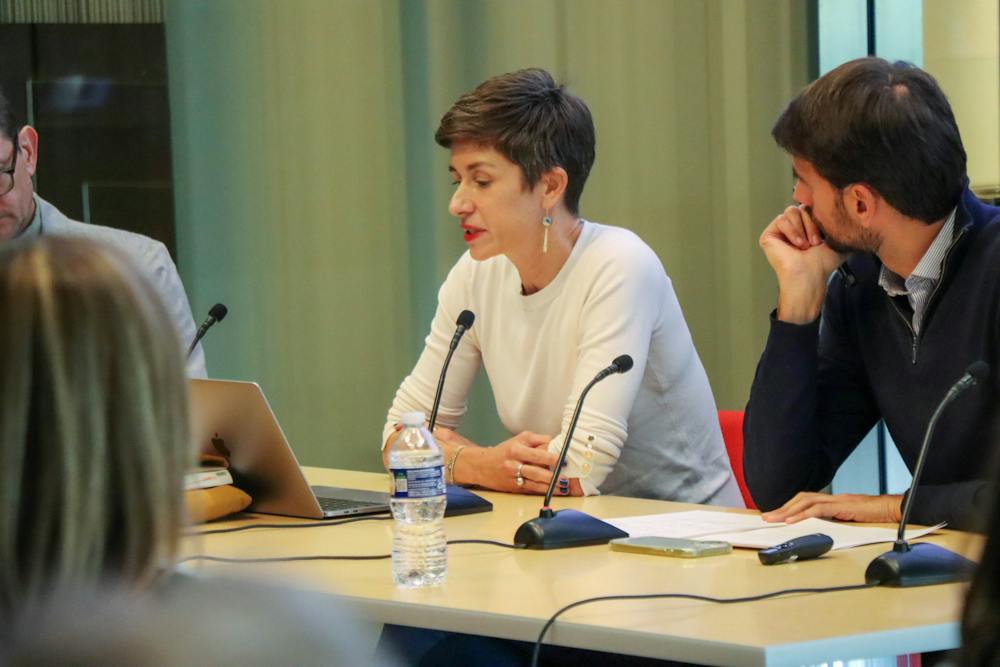
The symposium, titled “The Foucault Century,” included a variety of events from speaker sessions to an exhibition in the Lea Library. It also hosted around 130 attendees — including undergraduate, graduate, and Ph.D. students, as well numerous professors and experts.
The first day of the conference featured a public lecture from Rice University professor Niki Kasumi Clements, a session led by Lorenzini and University of Illinois Urbana-Champaign professor Verena Erlenbusch-Anderson, and a screening of two films focused on the philosopher.
Clements’ lecture, which Schaefer described as “the most unique thing that could have shown up at this conference,” included some of Foucault’s never-before-published documents.
The second day featured three sessions led by philosophy and Foucault experts, a viewing of the exhibit, and a final reflective discussion.
Lorenzini expressed that he was “most surprised about how generative Foucault’s thoughts still are” — noting that none of the event speakers presented work that he had already read.
RELATED:
Perry World House, Penn Climate host conference on global climate issues
Penn students discuss experiences as College Foundations pilot enters second year
“They all came up with new things and with new readings in ways that I feel contribute to the fact that Foucault remains very relevant for us,” he added.
David Halperin, a professor emeritus at the University of Michigan, presented on different perspectives and conversations surrounding Foucault. He focused on his upcoming paper, which defends Foucault from criticisms made against him in a 1997 essay by queer theorist Eve Kosofsky Sedgwick.
“He’s still somebody who’s very important to me as a thinker and as an example of how to live a queer life,” Halperin said in an interview. “I learned a ton of stuff that I didn’t know about him from a number of the papers so that was extremely stimulating and revealing.”
Emory University professor Lynne Huffer spoke about how Foucault’s thoughts can shape how we view the present. She highlighted that political depictions of 1968 Wharton graduate Donald Trump reflect Foucault’s concepts of grotesque power and the ancient Greek practice of “parrhesia” — which translates to “saying everything.”
“Foucault is such a creative, imaginative, counter-intuitive thinker that he makes our present strange,” Huffer said in an interview. “We think we know the present; we think that it’s familiar, and he makes it unfamiliar. To me, that's a really valuable thing because it makes us think differently.”
Lorenzini said that the turnout gave “the conference a completely different feel,” expressing hope that students left with “many more ideas to go back and read Foucault with the insights and the ideas” that they heard about.
“I have a better sense of who is interested in Foucault … and maybe there’s a way in which this can bring us to further events or bring together all of these people at Penn who are interested in his work, to have some synergies and some collaborations in the future,” he concluded.


