

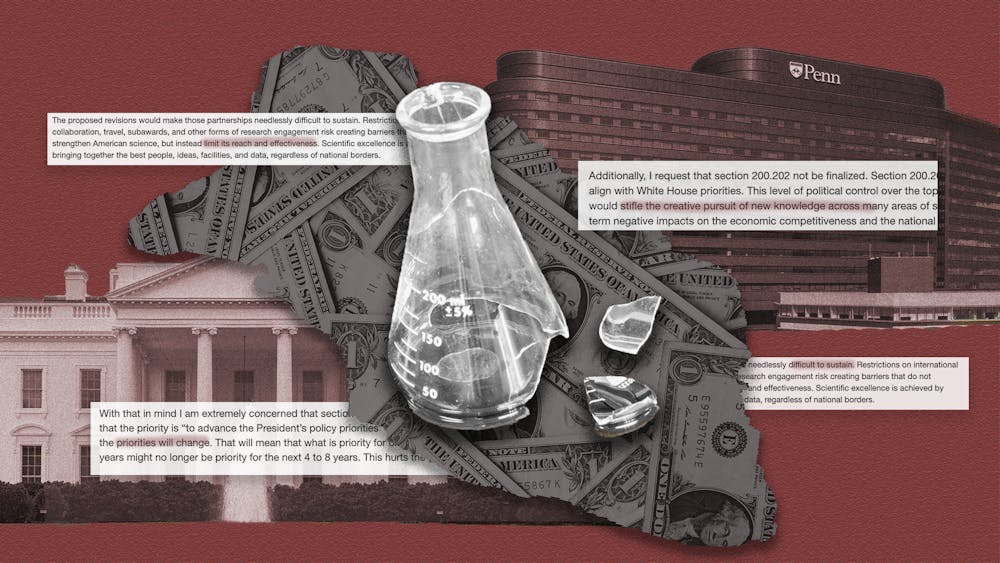
Penn researchers criticized the federal government’s proposed changes to scientific grant administration in interviews with The Daily Pennsylvanian.
In May, the Office of Management and Budget — a federal agency within the Executive Office of the President — published a proposal to improve “transparency, accountability, and oversight for Federal awards.” Ahead of a July 13 feedback deadline, over 50 Penn community members have publicly commented that the new rule would harm research efforts across the country.
Medicine, epidemiology, and medical ethics and health policy professor Scott Halpern told the DP that he was in “shock, frankly, that a political system would see fit to propose taking on unprecedented control of the scientific process.”
“It really is mind-boggling that politicians would find it appropriate to control the questions that get asked and the methods used to answer them given their complete — in most cases — naivete about what the scientific process entails,” he said.
Halpern was among those who submitted a public comment regarding the OMB’s proposal. The process is common during the rulemaking process, which federal agencies adhere to when enforcing regulations.
According to Regulations.gov, the website in which comments are made, agencies “consider comments the public submitted on their proposed rules” and “must respond to relevant and significant comments.”
Several sections of OMB’s proposal — titled the “Regulation for Federal Financial Assistance” and slated for enactment by Oct. 1 — align with various executive orders signed by 1968 Wharton graduate and President Donald Trump.
For instance, the rule references executive orders which stamp out federal diversity, equity, and inclusion programs and “gender ideology.” OMB’s proposal argues that “unlawful identity-based” DEI policies “wasted a great amount of taxpayer resources and caused great harm to public trust in government.”
The OMB has also recommended that federal agencies select “one or more senior appointees” who “conduct a pre-issuance review” of grants and can “terminate awards found to be inconsistent with program goals or agency priorities” — echoing language in Executive Order 14332, which called for heightened oversight of federal grantmaking.
OMB’s rule lists a series of standards a grant must meet, stating that awards must “advance the President’s policy priorities” and not “promote anti-American values.”
Biomedical Sciences professor Andrew Vaughan told the DP he was concerned about the proposed federal oversight over scientific grant approval.
“These political appointees — even if they have some degree of scientific expertise — there’s no way in hell they’re going to have scientific expertise over the entire package of grants that are going to come across their desk,” Vaughan told the DP.
According to the proposal, the revisions explain that “peer review remains advisory and does not replace agency discretion.”
“It essentially cuts out the legs of peer review,” Vaughan said.
Halpern characterized peer review as the “core of every aspect of science.”
“We rely on peers — meaning other scientists in a similar discipline — to adjudicate which questions are most important to ask, which methods are most appropriate to use, which grants are most appropriate and vital to the nation’s interest,” Halpern said.
The proposed rule also aims to “protect the national security interests of the United States” by prohibiting “the obligation or expenditure of Federal funds to support certain foreign collaborations.” This move would extend a 2011 law known as the Wolf Amendment — which bars NASA from bilateral coordination with China or Chinese-owned companies without FBI approval — to all government agencies.
“Colleagues are chosen not by the political views of the governments of the countries that they live in, but by their scientific expertise,” Halpern said. “This aspect of the OMB proposal would at least hinder that, if not abolish it entirely.”
OMB’s proposal would prohibit federal awards from covering publication costs and conference expenses unless “approved by the agency” or with “case-by-case” exceptions.
School of Veterinary Medicine senior research investigator Heather Rossi said that these rules could shift “collaborative communication” in the scientific community.
“If you were doing very multidisciplinary research, or if something very surprising came up with your research, it might make sense for you to go to a conference outside of your discipline to talk to other scientists to get a perspective about it or to make a direction shift,” Rossi stated. “You wouldn’t know that up front when you were writing the grant.”
Grants also fund support staff, Center for Epilepsy and Neurodevelopmental Disorders coordinator Renee Allen told the DP.
“There are people like me who aren’t doing science at all but are funded by these grants,” Allen said. “If there is a significant loss of grant money, that will have an effect on positions like mine.”
Halpern expressed concern about “losing an entire generation of scientists” should the proposal pass.
Physics and Astronomy professor Richard Stephens — a 1968 College graduate — mentioned a similar worry.
“If they wanted a good career, they stayed here. That’s no longer true,” he said. “People who are serious about learning science and having a scientific career will simply go elsewhere.”
Staff reporter Mariacristina Calcagno covers science and health and can be reached at calcagno@thedp.com. At Penn, she studies biochemistry and economics.


