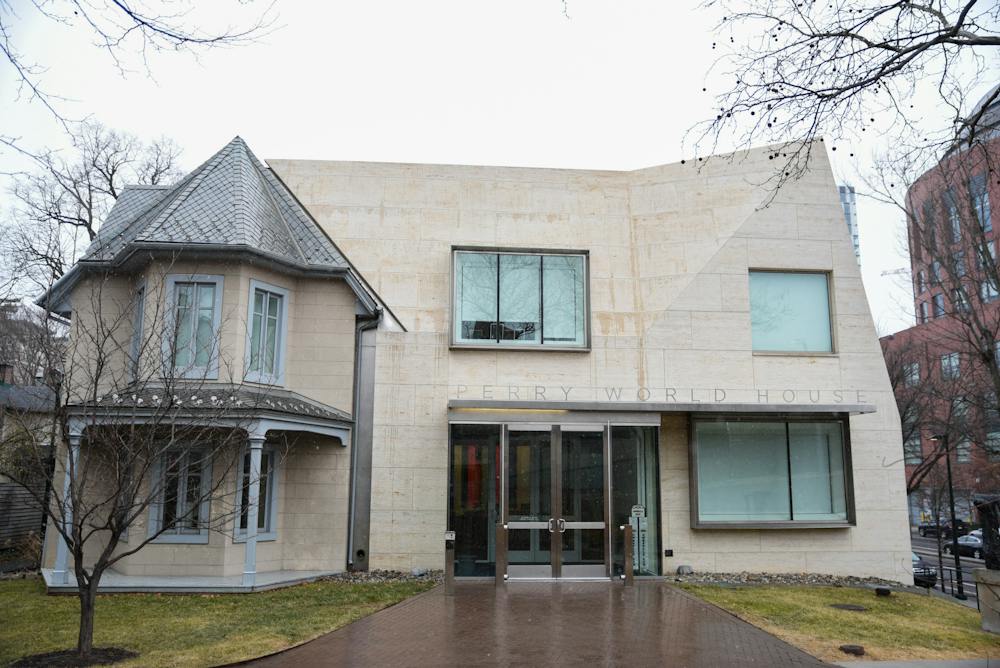
Penn held a day-long conference on public health and climate change last week.
The Sept. 18 event, co-hosted by Penn Climate and Perry World House, featured three sessions: global diplomacy in climate response, disease prevention, and urban infrastructure design for combating rising heat. The conference brought together a diverse group of experts from across campus.
Keynote speaker and former minister of Environment, Climate Change, and Technology in the Maldives, Aminath Shauna, spoke in the first portion of the conference. She described how climate preparedness came to be a “pressing issue” in the Maldives.
Shauna discussed her lived experience “witnessing and living everyday realities with the impacts of climate change,” including coastal erosion and fresh water shortages. She said that part of the solution to address misinformation around the issue is to “be smart about policymaking.”
It is difficult to imagine the Maldives “disappearing” from rising sea levels, she explained, after the renewed political effort to rebuild the country following its first democratic election in 2008.
“We wanted to continue to live here. We wanted to build a home for families here. We wanted to build a future for the next generation,” she said. “It contrasts the hope that we have for our country with the crisis we face from climate impacts.”
The next section of the event centered on the need for robust surveillance to defend against emerging pathogens.
Dean of the School of Veterinary Medicine and moderator Andrew Hoffman said that recent experiences with outbreaks such as COVID-19, Ebola, Zika, mpox, West Nile virus, and avian flu have “bolstered concern with preparedness.”
RELATED:
Perry World House panel celebrates Benjamin Franklin’s role at Constitutional Convention
Penn design students win national competition for ‘climate-resilient’ tennis court proposal
“We need to be better prepared for all of these things, and the best way to do that is to have a robust global and regional system of early warning and early detection of threats,” he said.
Greg Puley, the chief of the Climate and Innovation Section at the U.N. Office of the Coordination of Humanitarian Affairs, explained that these disasters are “increasingly predictable.”
“What we are aiming to do is leverage that space between early warning and actual onset of the disaster to provide assistance to communities in advance,” he said.
In the final speaker event, experts discussed the need for effective urban infrastructure amid rising temperatures.
Architecture professor Dorit Aviv explained that, currently, the way many cities are built causes streets to trap and re-emit solar radiation.
“We need cooling district systems,” she said.
Aviv advocated for managing the cooling of individual homes at the neighborhood level “to save energy and dump less heat back into the street.”
She added that updated codes and regulations are needed to prevent buildings from being constructed without external shading, which leads to greater heat absorption and re-emission into the street.
RELATED:
Perry World House panel celebrates Benjamin Franklin’s role at Constitutional Convention
Penn design students win national competition for ‘climate-resilient’ tennis court proposal
Staff reporter Ashley Wang covers science and health and can be reached at wang@thedp.com. At Penn, she studies economics.