

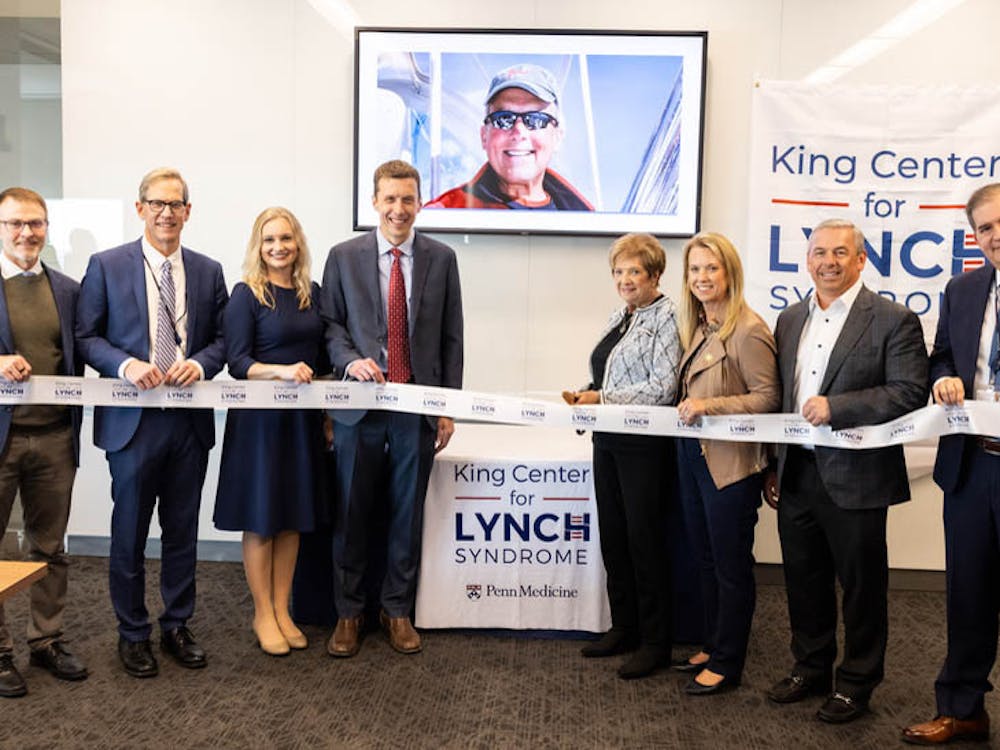
Penn Medicine recently launched the King Center for Lynch Syndrome following a $10 million donation.
Housed within the Abramson Cancer Center, the King Center will be first named and endowed center devoted to Lynch syndrome in the world. It will contribute to Penn Med’s growing capacity to treat the hereditary condition — as the number of patients who have come to the institution has nearly tripled over the past six years.
The center was created through a gift from Cynthia and the late Jeffery King — as well as Jason and Julie Borrelli. Julie Borrelli, the Kings’ daughter, also serves as chair of the Abramson Cancer Center Director’s Leadership Council.
Jessica Long, King Center director of education and outreach told The Daily Pennsylvanian that while the Abramson Cancer Center has clinically “taken care of people and families with Lynch syndrome for many years,” this donation established a “comprehensive center.”
The donation will also support the funding of “innovative research related to Lynch syndrome diagnosis and treatment,” and “a number of educational and outreach initiatives,” according to Long.
The condition affects “approximately 1 in 279 individuals — equating to nearly 1.2 million Americans — and is associated with increased cancer risk,” according to the press release.
She explained that Lynch syndrome is usually detected through a “very complex” process of tracking “multiple generations of cancer” in the patient’s family.
“Recognition of the age of onset, the number of cancers, and the pattern of cancers in a family can help clue us into the possibility of Lynch syndrome,” Long added. “Those complexities are what prevent some people from seeking genetic testing in the first place.”
RELATED:
Julia Borrelli named chair of Abramson Cancer Center Director's Leadership Council at Penn Medicine
Penn Medicine breaks ground on $401M Princeton Cancer Center set to open in May 2028
Long explained that when a patient is diagnosed with Lynch syndrome, specialized and personalized treatments are used to identify colon and uterine cancers at earlier stages to possibly prevent them from developing.
“Many people feel very empowered when we can give a name and an explanation to the history of cancer in the family,” Long told the DP. “Knowing that they can take proactive measures and have a comprehensive, personalized care plan to protect their health can also be reassuring.”
The gift adds to past philanthropic investments from the King family to support Lynch syndrome research and education at Penn Med, including endowing the Jeffery and Cynthia King Professorship of Lynch Syndrome Research and establishing the Borrelli Family Pilot Grant in Lynch Syndrome.
The support stems from Jeffery King’s personal experience with Lynch syndrome.
He was unaware “that he carried the mutation for Lynch syndrome until he was in his late 60s and battling his second Lynch-related cancer,” Julie Borrelli wrote in the release.
The King Center will host the 5th Annual Lynch Syndrome Symposium on March 10 — sponsored by the Borelli family.
The symposium aims to provide “professional continuing medical education at no registration cost” while “getting the word out to genetic counselors and other healthcare professionals about how to best take care of people,” according to Long.


