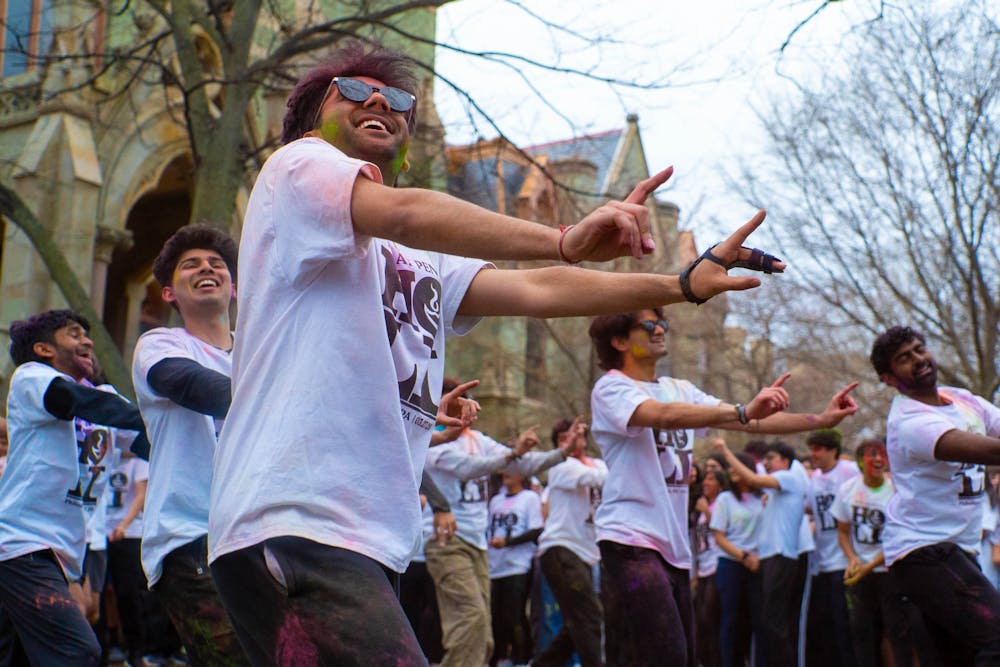
Penn Dhamaka won the Desi Dance Network national circuit last weekend, marking the first time the University’s all-male South Asian fusion dance team has secured the title.
The April 18 victory capped a season of consistent first- and second-place titles for Dhamaka. The national circuit was hosted by DDN Inc., a platform founded in 2014 to support South Asian performing arts through competitions and conventions.
For Dhamaka members, the win represents a culmination of long-term planning amid a highly competitive national landscape.
“It’s something we’ve all dreamed about,” College senior and Dhamaka co-captain Krishna Khawani told The Daily Pennsylvanian, describing the win as “the highest level of achievement that you can get in South Asian competitive dance.”
The DDN circuit operates through a season-long structure. According to College sophomore Aditya Bala, teams first submit audition videos to individual competitions. Each competition typically selects around eight teams to advance, ranking each based on performance.
Dhamaka’s set this year was built around a “Bill Nye the Science Guy” theme, invoking the elements of the science education TV show.
Bala said the concept had circulated among Dhamaka members since 2018 but had never been executed at scale, adding that alumni from multiple generations contributed to the final performance.
He told the DP that the team intentionally pursued a lighter and more upbeat theme for this season’s set, a shift from the “very dark” concepts explored in past years.
RELATED:
Hundreds of Penn students gather for annual Holi celebration
Penn’s sixth annual Climate Week to highlight global ‘climate hotspots’ with over 50 events
College senior Naeem Himani — Dhamaka’s artistic director and co-captain — said the team aimed to prioritize audience engagement and storytelling.
“Making the audience feel something was a huge objective,” Himani said. “Clean choreographies matter, but I noticed entertainment for the audience had gone down, and a lot of people weren‘t enjoying what they were watching.”
Engineering junior Gaurav Malhotra wrote to the DP that at the end of the performance, the dancers handed out globes with QR codes to the audience to raise funds — which he described as one of his most memorable moments.
“Seeing the crowd stand up, cheer, and actually believe in what we were trying to do … that was beautiful,” he wrote. “It felt bigger than just a performance.”
The performance incorporated multiple dance styles, including Bollywood, Bhangra, and hip-hop, alongside props, theatrical lighting, and interactive segments.
Bala told the DP that the team worked to integrate both technical choreography and a narrative foundation, including representations of the water cycle and environmental change.
“We had students go to Amy Gutmann Hall and engineer and make light-up dandiyas using materials there,” he said.
The team’s musical composition also played a central role in shaping the performance.
According to 2018 Perelman School of Medicine graduate Srihari Sritharan — who served as the set’s DJ — the mix was designed to combine nostalgic “throwback songs” with high-energy transitions, allowing audiences to “sing along to the songs they grew up with” before shifting into more modern and hip-hop elements.
“When it comes to making an impact at the national competition level, attention to every detail, down to song choice and set construction, can make the winning difference,” Sritharan wrote.
Preparation for the season required extensive time commitment, with practices intensifying in the weeks leading up to competitions.
“Given the fact that we’re at Penn, every single guy on the team is doing a million other things,” Khawani said, pointing to challenges in managing coursework, job recruiting, and other extracurriculars.
“To be competing at this highest level and be shooting to be the best comes with a lot of sacrifice,” he added.
Despite those demands, College and Wharton senior Krutin Devesh told the DP that the group prioritized communication and flexibility to accommodate other obligations.
“The balance came in terms of the support that the team gave one another,” Devesh said. “It was really just a balancing act that was grounded in communication and how close we are as a team.”
The members also described the team’s culture as a defining factor in its success. Bala, Khawani, Devesh, and Himani all characterized Dhamaka as a “brotherhood,” emphasizing the amount of time spent together in rehearsals and during travel for competitions.
The team also collaborated with Penn’s Arts House Dance Company for its final performance. The partnership builds on a longstanding relationship between the two groups, including an annual joint piece known as “Artsmaka,” which has been performed for more than a decade.
For the national stage, AHDC dancers contributed to segments of the performance, including hip-hop and contemporary pieces.
College and Wharton senior Sophia Jorgensen of AHDC wrote to the DP that the collaboration reflects a shared commitment to growth across dance styles, with both groups regularly teaching each other choreography.
“This team is unique,” Jorgensen wrote. “It is palpable how their shared love for dance created something stronger than any team dynamic I have ever seen.”
For members of Dhamaka, the win carried significance for South Asian performing arts on campus.
“It’s not that common to see guys dancing or giving so much time towards dancing, especially in the South Asian community,” Khawani said. “We want to show that it is possible to be successful in academics but also achieve so much in the arts. Things like that do matter.”
RELATED:
Hundreds of Penn students gather for annual Holi celebration
Penn’s sixth annual Climate Week to highlight global ‘climate hotspots’ with over 50 events
Senior reporter Ananya Karthik covers central administration and can be reached at karthik@thedp.com. At Penn, she studies communication and economics. Follow her on X @ananyaakarthik.