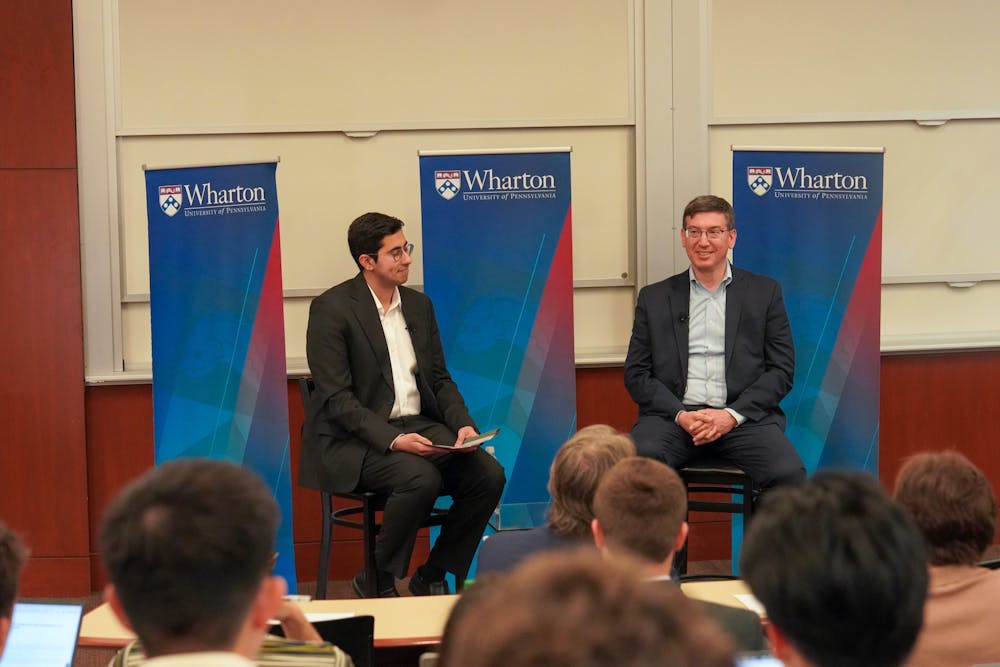
Penn hosted the founder of the Kleinman Center for Energy Policy and co-president of Apollo Asset Management, Inc. on Thursday.
The April 23 event was held at Steinberg-Dietrich Hall and featured 1994 College and Wharton graduate Scott Kleinman for a discussion about his career, the growth of Apollo, and his views on the future of finance. The fireside chat was hosted by the Wharton Undergraduate Private Equity & Venture Capital Club, the Kleinman Center for Energy Policy, the Wharton Alumni Connection Council, and the Investment Management Club.
Wharton senior and president of Wharton PEVC Muhammad Vakil — the event’s moderator and host — explained that Kleinman highlights students’ role as future Penn and Wharton alums who can give back to the University in an interview with The Daily Pennsylvanian.
He added that it was timely to host Kleinman to share his views on the future of energy policy, and how that intersects with geopolitics, and leadership in private markets that can bridge those gaps.
Wharton Vice Dean and Director of the Wharton Undergraduate Division Cait Lamberton, who introduced Kleinman during the event, expressed hope that students will “harness the power of business to solve the problems incident to society,” adding that Kleinman “has done exactly this.”
“There are many ways to stop short of doing so, but what he’s done at Penn and what he’s done elsewhere has created value that will continue to pay off for generations,” Lamberton said.
Kleinman founded the Kleinman Center in 2014 after observing a lack of policies governing how to “maximize” energy use and resources.
“Energy is the single biggest driver behind whatever climate outcomes you think you’re going to have — so it really is inextricably linked on that front,” he told the audience.
RELATED:
Penn alum discusses career as Missouri solicitor general in fireside chat
Former Biden advisor discusses government careers at Penn Carey Law event
Kleinman also discussed the future impact of artificial intelligence in the public equity field, explaining that mentorship is “critical” for the younger generation because it “can’t be replaced” by AI.
He also encouraged the audience to become “domain experts” in their field and to embrace AI to become more “powerful.”
“AI can do things better, faster, quicker, but they can’t do it without the domain expertise,” Kleinman said. “Finding ways to marry the two is where I’ve seen that superpower come to life.”
Kleinman, who has served as Apollo Asset Management’s co-president since 2018, joined as the company’s 13th employee in 1996. At the time, private equity was a “cottage industry” and “nothing was cookie-cutter about Apollo,” according to Kleinman. Apollo quickly grew and was the “first firm to build a private credit business under the same roof as a private equity firm.”
He attributed much of Apollo’s success to its employees, emphasizing that his team’s “contrarian perspective” has helped the company become a “global platform.” Kleinman added that each day was a “new adventure” and explained that he enjoyed working with a “like-minded” and “passionate” group.
When discussing his educational background, Kleinman attributed his exposure to finance to his father — a trader on Wall Street — who “sparked” his interest in the field. Kleinman told the audience that he “enjoyed every minute of learning” during his first job after graduation, as an investment banker for Smith Barney — a brokerage firm now called Morgan Stanley Wealth Management.
“Spending two years as an investment banking analyst gives you exposure to how markets work,” he explained. “That grit and that intellectual curiosity is what I really took away.”
Kleinman ended the conversation by offering advice to current students and engaging in a question-and-answer session.
First-year Wharton MBA and Lauder Institute student Lucy Shen expressed respect for Kleinman in an interview with the DP. She described him as an “embedded” member of the Penn community, adding that she was motivated to attend because there was “insight to be gleaned” about private markets and future careers.
College first-year Ellery Spikes echoed Shen’s sentiment, explaining that she attended the talk because she was “excited” to learn about the “intersection of infrastructure and energy transition” and aims to “exemplify” the leadership qualities Kleinman discussed.
Marc Rowan — the outgoing chair of the Wharton School’s Board of Advisors — co-founded the private equity firm Apollo Global Management, Inc., along with 1986 Wharton graduate Joshua Harris and investor Leon Black. A DP analysis found that Rowan, who earned a Wharton bachelor’s degree in 1984 and a Wharton MBA in 1985, remained in contact with convicted sex offender Jeffrey Epstein between 2013 and 2016.
According to email exchanges released by the Department of Justice in January, Rowan, Harris, and Black met with Epstein on several occasions related to their work at Apollo.
“In select instances, Mr Rowan provided information to Mr Epstein in connection with his tax work for Mr Black,” Rowan’s spokesperson wrote to the DP at the time. “While Mr. Epstein sought to do work with the Apollo co-founders other than Mr. Black, Mr Rowan had neither a business nor any other relationship with Mr Epstein. As previously stated, Apollo never did any business with Mr Epstein.”
In December 2023, Rowan circulated a list of reform questions to the University Board of Trustees, urging them to make “clear choices” that would define the direction of Penn’s future.
Nearly two years later, the White House distributed a proposed compact to Penn and eight other universities, offering preferential funding in exchange for signing onto sweeping governance and policy reforms. According to The New York Times, Rowan was a chief architect of the compact — which builds directly on the ideas he first outlined in his 2023 message to the Board of Trustees.
Penn rejected the White House’s proposed preferential funding compact, according to an Oct. 16, 2025 email to the University community.