

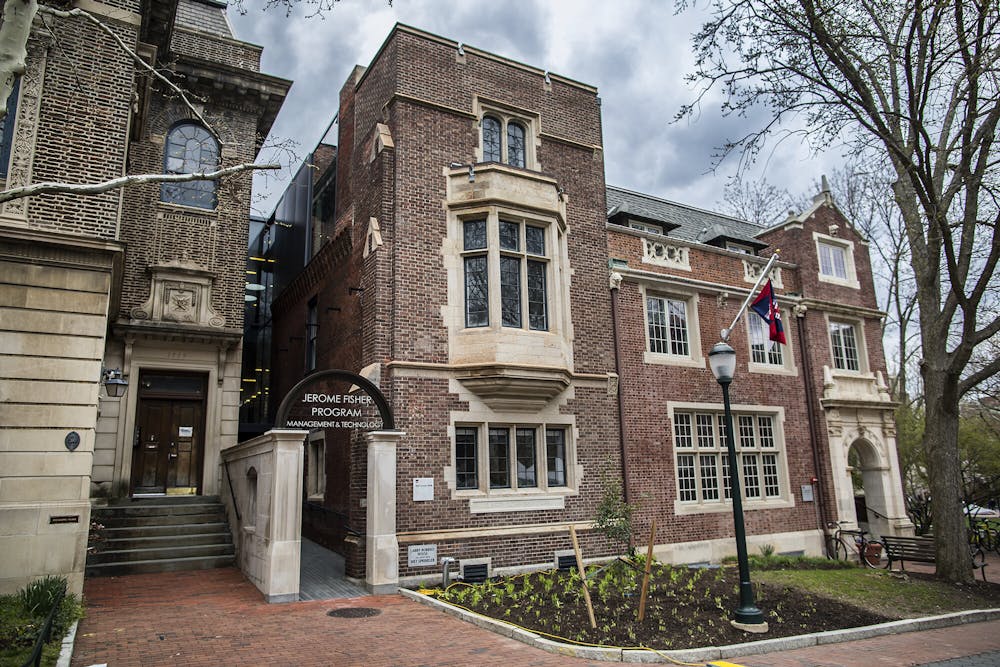
The Daily Pennsylvanian sat down with Wharton and Engineering senior Seher Taneja, a student entrepreneur building a veterinary startup to improve clinical decision-making.
Taneja’s startup, called Spoodle, received the Dave A. Liu and Lauren Wu Prize at the Jerome Fisher Program in Management and Technology Summit last month. Open to students, alumni, and industry leaders, the event features a startup competition judged by founders and investors, including namesake 1993 Wharton and Engineering graduate Dave Liu.
In a written statement to the DP, Liu explained that the prize was designed to identify founders working on problems with the potential to reshape how industries operate, rather than those building surface-level solutions.
“A strong idea usually sounds intelligent; a venture-scale idea starts to show evidence that the pain is real and the solution could become part of critical infrastructure rather than a nice-to-have feature,” Liu wrote.
Taneja, who is graduating next month from the M&T program with concentrations in computer science and finance, told the DP that Spoodle uses artificial intelligence to optimize how clinicians access and apply medical knowledge in real time. The current product centers on a retrieval-based model trained on veterinary publications and journals, designed to provide cited answers that can support decision-making during patient care.
“We are trying to do something not in the space right now,” Taneja said. “We’re building a custom rag model which is trained on site, on publications and journal data.”
The company’s current direction followed a pivot earlier this year. Taneja and her co-founder initially built a workflow and administrative solution for veterinary clinics — including tools for sharing medical records and managing front-desk operations — but later identified a fundamental gap within how veterinarians access information.
“We realized this January that this was not the real problem,” Taneja said.
RELATED:
Student-led venture pilots automated boba tea vending machine at Penn
Two Penn juniors receive award to launch cardiovascular disease awareness initiative
Her co-founder, 2023 College graduate JJ von Oiste, said the change in direction came from a closer look at how veterinary medicine operates in practice. He explained that clinicians often manage a wide range of cases without access to centralized expertise or structured knowledge systems.
“Veterinarians can’t trust generative AI models and the things that are currently out there, even as good as they are, because they aren’t designed for the profession,” von Oiste told the DP.
He added that building a product to fit into that environment required adapting to variations in how veterinarians approach clinical reasoning.
“The most technically intensive part about building Spoodle is integrating real-world feedback from the vets that are using it into the actual reasoning of the model,” von Oiste said.
Spoodle’s development was also shaped in part by 2010 School of Veterinary Medicine graduate Chris Feaster, who first connected with the founders through the alumni network before becoming a project advisor and the company’s first client.
Feaster, who has been a practicing veterinarian for more than a decade, said he was drawn to the team because of the field's broader technological gap.
“I think veterinary medicine, as a profession, lags behind human medicine and a lot of other professions, technologically, by many years,” Feaster said.
Feaster also emphasized the importance of widespread, unrestricted access to the product for veterinary professionals.
“I’m proud that they are going to be able to offer their product to veterinarians for free,” he said.
According to Feaster, the product addresses a core constraint in veterinary practice: limited time and fragmented access to information. With appointments often lasting around 20 minutes, clinicians must synthesize large amounts of information quickly while making decisions about diagnosis and treatment.
“Our time is very limited,” Feaster continued. “[With Spoodle] we can ask a medical question, we can get a cited medical answer and feel confident in that answer.”
Liu said Taneja’s venture stood out because it dealt with the type of problem his prize was designed to recognize.
“What stood out to me about Seher was that she was tackling a messy, structural problem rather than a superficial one,” Liu wrote.
He added that, at the student stage, early traction is less about scale and more about whether a founder has moved beyond theory and into real-world execution.
“A first client, pilot, or live deployment is often the strongest proof that the founder can sell, execute, and learn under real constraints,” Liu wrote. “In Seher’s case, the fact that Spoodle was already live in clinics made a real difference because it showed the venture had entered the arena of operational reality.”
For Taneja, the award comes at a moment of transition as she prepares to continue building Spoodle after graduation.
“Over the next five years, my goal is to be able to build a system that can change something which is wrong in the healthcare industry,” she said. “There are so many issues in the world, and if I can make some change, I would be so happy.”
RELATED:
Student-led venture pilots automated boba tea vending machine at Penn
Two Penn juniors receive award to launch cardiovascular disease awareness initiative
Staff reporter Advita Mundhra covers student life and can be reached at mundhra@thedp.com. At Penn, she studies cognitive science and economics.


