Until I came to Penn, I had never been tackled by a man with a gun or woken up at dawn by an armed group. The University itself deployed this violence against community members, including me, after we joined campus protests for Palestine in 2024. Penn’s Guidelines on Open Expression include protections against police brutality. Although these policies have been violated, they offer a foothold for our collective safety. The provost has now invited public comment on a proposal that would remove these protections for everyone on campus.
Who holds the power to decide whether Penn can violently attack protestors? The current guidelines attempt to prevent police brutality by making the vice provost for University Life the point of accountability (with exceptions for emergencies, such as shootings). If the VPUL wants to deploy police, they must consult with the Committee on Open Expression “whenever possible,” notify protestors ahead of time, and give a “full statement” to the University community afterward. The guidelines emphasize the importance of avoiding injury to demonstrators.
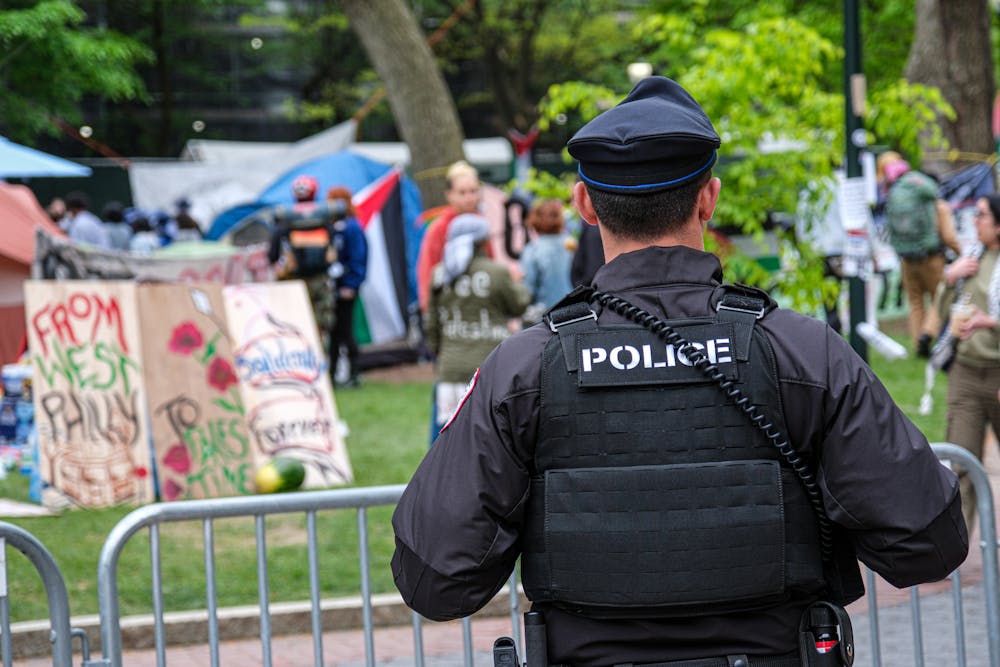
The new proposal abandons all of that. The language may seem boilerplate: “If law enforcement determines that an activity jeopardizes the health and safety of the University campus or community or may violate local, state, or federal law, they may have a legal duty to intervene.” This move actually enables police and administrators to act without accountability. They used “health and safety” as a justification after arresting me for sleeping at the Gaza Solidarity Encampment, and after tasing people who were just chanting outside of our building occupation. If administrators, trustees, or police want your movement gone for political reasons, they can simply claim it’s unsafe or illegal and proceed to use brute force against you. They wouldn’t need to prove anything.
In attacking the movement for Palestine, police officers dislocated people’s arms from their shoulders, inflicted concussions, pointed guns at students’ heads inside their home, put us in frigid cells under 24-hour lights, and more. When police slammed and tased protestors on May 17, 2024, VPUL Karu Kozuma did not give prior notice, prior delegation, or a post-facto report. Then, police and Kozuma positioned themselves as complainants in Penn’s disciplinary system, which is named the Center for Community Standards and Accountability. CSA used arrests, even without charges, to claim students broke the law. They recommended punishments that target our health care, education, and wages for food and rent.
In fall 2024, the guidelines played their limited role. I appealed my case to an official hearing panel. The panel found that participation in two protests — the Gaza Solidarity Encampment and the Fisher-Bennett Hall occupation on May 17, referred to as “Refaat Alareer Hall” — was not punishable in itself under Penn policy. After weeks of gathering evidence and witness testimonies, the panel of faculty and students considered Penn’s slew of accusations, including trespassing, “unreasonable interference,” discrimination, and weapons violations. The panel found the charges to be false. Its full report was so evidently clear in describing our movement’s benefits for community-building through open expression that, after Penn officials read the report, they violated policy again by refusing to share it with me.
My punishments were overruled. However, the disciplinary system makes hearings inaccessible to many of my peers in most cases. The hearing process is time-intensive and imposes significant psychological pressure on students. I have scheduling flexibility and a strong Jewish community. How many Penn students have the time to keep up with their existing obligations, line up a way to survive in case they lose their case, build a defense against several salaried officials and police, and deal with the canard of antisemitism accusations?
Police violence injures community movements and locks students into sanctions. The current guidelines’ protections helped me stay employed so I could keep supporting causes that matter, like Palestinian liberation. Effective organizing and mobilizing this week can enable many people (and unions) to fight for these protections long term, for all community members. In an era of United States Immigration and Customs Enforcement terror, our authorities could learn that this campus knows how to enforce consequences — legal, political, financial, and administrative — to prevent police from pointing guns at our heads.
This enforcement is necessary to the University’s stated obligations, including “serv[ing] our community and society both at home and abroad.” The University committed violence against us at home because we tried to stop it from doing so abroad in Gaza, where a friend of mine wants to study, but our University has invested in technologies that murder her community and keep her babies hungry. Meanwhile, my friends on campus have food, but they may face kidnapping by federal agents or on-campus assault without much recourse. Students and educators often can’t predict when when they will need Penn to support us or stop hurting us. When we do, we deserve to know that the police will be afraid to dislocate our shoulders.
As a first step, check your inbox to sign up for a feedback session this week, fill out the public comment form, and focus your pushback. The newly proposed section 3.IV.a will increase police violence. That’s a liability for Penn, and the University should keep sections V.B and V.C.3-4 from the preestablished guidelines instead.
HILAH KOHEN is a Ph.D. candidate in comparative literature and literary theory and a Falk Fellow in Jewish studies. Their email is kohen@upenn.edu.