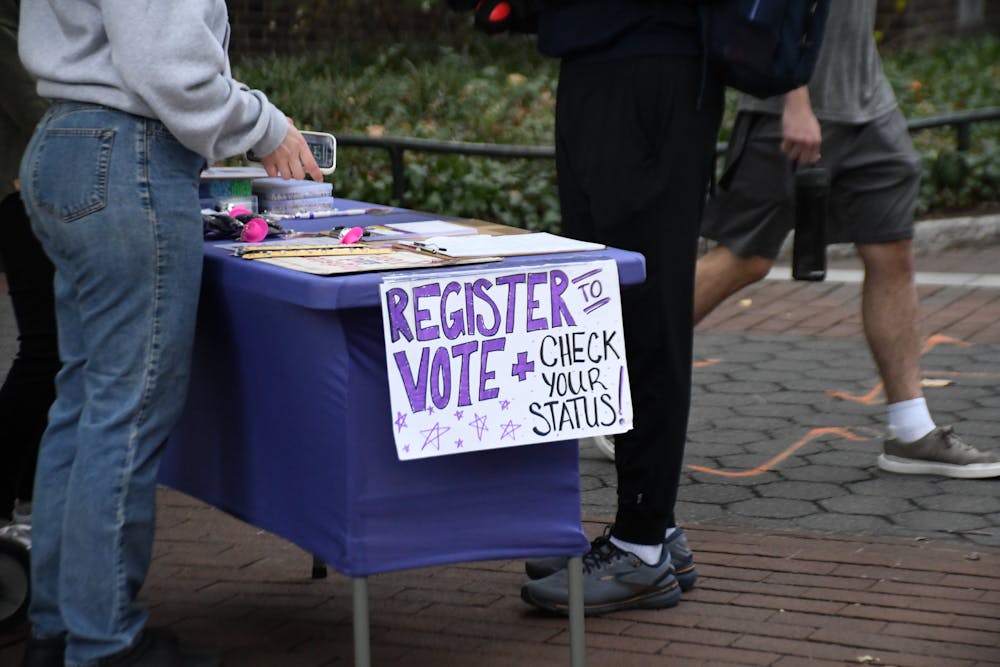
In Philadelphia, elections aren’t decided by the many — they’re decided by the few. A few thousand votes can seal the fate of representation for hundreds of thousands for decades. In such a system, voting isn’t just a right; it’s playing God with people’s lives. And when that power is in part being exercised by Penn’s student body — a group with little intention of staying in Philadelphia after graduating and whose familial, temporal, social, financial, and political interests aren’t even in the same state — it forces an uncomfortable question: Should we be using our right at all?
According to the 2026 Cook Political Report’s Partisan Voter Index, Pennsylvania’s Third Congressional District, which includes Penn, was the nation’s most blue district. In practice, this makes the Democratic primary the only election that matters. With incumbent Rep. Dwight Evans (D-Pa.) retiring, that decision now rests with a remarkably small electorate: In 2025, just 19.7% of registered Democrats turned out to vote in a citywide primary.
The same dynamic holds at the state level. In the last primary for the 188th Legislative District — Penn’s local district, only around 12% of the district voted. With Penn undergraduates making up roughly 16% of the district, we as a community have disproportionate power to determine representation for tens of thousands of residents.
In light of how much is at stake, students who aren’t from Philadelphia have an ethical obligation to abstain from voting in local races. Most Penn students either do not live in Philadelphia or do not intend to call it home once they graduate, with only around 14% of Penn students choosing to stay in the area. We as a community rarely venture out into the city, and when we do, we spend almost all our time between 2nd Street and the Schuylkill River. We are here temporarily and have little vested interest in the future of this area. So it makes little sense that anyone who doesn’t have skin in the game should have a say in decisions that will impact residents in the area long after we have all moved to New York or the San Francisco Bay Area.
This is not an argument against student political participation. It is an argument about where that participation belongs.
Students, if they are registered in Pennsylvania, absolutely should vote in national elections. But local elections are different. They determine who controls school funding, zoning decisions, policing priorities, and public services that shape the daily lives of residents who will still be here in 10, 20, 30 years. When turnout is high and elections are competitive, this tension is diluted. But in a system like Philadelphia’s, where primaries decide everything and only a fraction of voters show up, the question of who votes becomes inseparable from who gets represented.
We as a student body largely do not pay Pennsylvania’s major taxes, including property tax, inheritance tax, corporate tax, and realty transfer tax, nor do we meaningfully contribute to long-term fiscal burdens borne by residents. While some students do pay income or wage taxes through part-time jobs, these contributions are minimal compared to the sustained tax obligations of full-time residents. We also largely avoid the additional school income tax and business taxes that the city of Philadelphia levies. Most of us don’t have kids enrolled in the Pennsylvania school system, and we immediately pack our bags and return home during breaks, leaving campus to be a ghost town. Why should we deserve a vote?
Many Penn students registered to vote here in Pennsylvania because they were told it was a swing state and their vote would make more of an impact here — but that is a political consideration designed to take advantage of the electoral college to affect national politics. National politics are not a factor in municipal and state races here in Philadelphia hence, why shouldn’t we pull back and let the locals decide on their own fates?
SEE MORE FROM EDEN LIU:
Penn prides itself on being integrated into the West Philadelphia community, but our actions and attitudes speak otherwise. And that’s okay. Maybe what should come from that inevitable concession is an equal one acknowledging that we don’t have a moral right to determine the fate of those we don’t integrate with. Decisions are made by those who show up, and just because not as many show up does not mean our paternalistic instincts should override theirs with our out-of-state votes.
To be clear, students have every legal right to vote in Philadelphia. But democracy is not just about rights — it is also about judgment. The fact that you can vote somewhere does not always mean that you should. When your connection to a place is temporary, when your investment in its long-term trajectory is limited, and when your vote could outweigh that of residents whose lives are permanently tied to that community, there is an onus on you to respect the rights of locals to engage in their own self determination and restrain oneself from indulging in paternalistic practices.
Philadelphia deserves representatives chosen by those who will live with the consequences of their decisions. For students passing through, the most responsible choice is to step back.
EDEN LIU is a College sophomore studying philosophy, politics, and economics from Taipei, Taiwan. His email is edenliu@sas.upenn.edu.
SEE MORE FROM EDEN LIU: