Rumor has it that Penn has sports teams. Like, real teams that you can go watch.
While you may have seen our student-athletes strutting down Locust Walk in their Nike-branded apparel or ripping bicep curls on the second floor of Pottruck, have you ever actually gone and seen them play their sport?
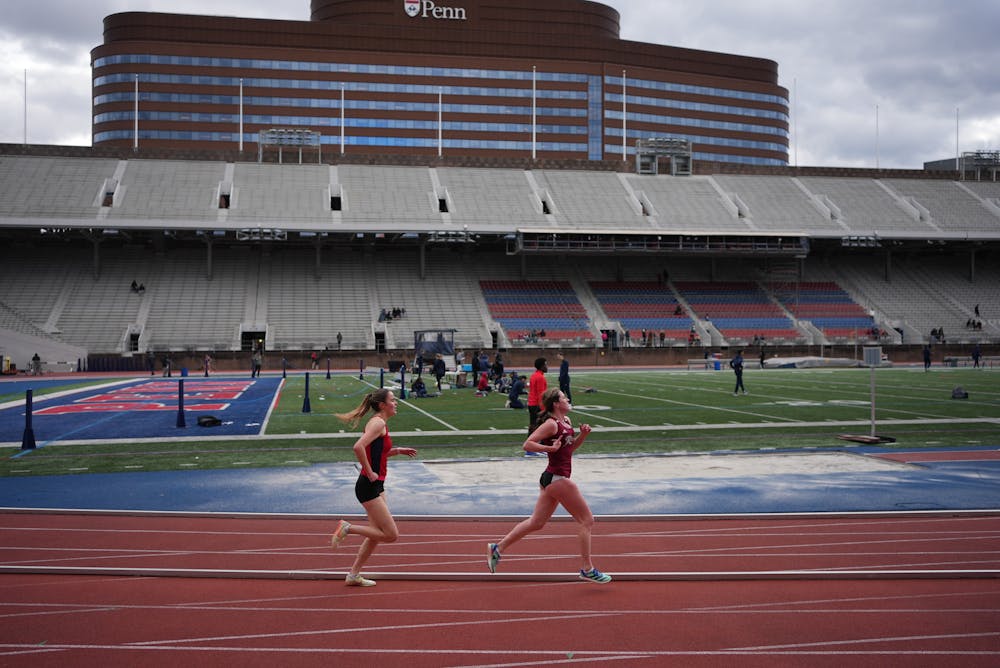
The answer that rings unanimous across all Penn undergraduates is a big, fat, loud “No.” Even though Franklin Field can hold about 50,000 people, if you stroll in on any given Saturday, you’ll notice it looks more like an ancient relic than a college football stadium. Whether students are knee-deep in their BEPP 1000 homework or just lounging on their beds in the cramped confines of the Quad, it doesn’t seem like anyone wants to take part in the world of Quaker athletics.
As a high school senior applying to colleges, I found myself searching for universities that balanced sports, social life, and academics. When it finally came time to investigate Penn, I was surprised by their statement that “athletics are a large part of our campus culture, bringing members of the community together as they cheer on our Quakers.”
I don’t know about you, but after just one semester on campus, it’s easy to tell that this is a load of nonsense. Although our University may support its athletic department financially, it isn’t making any effort to make it an essential part of the Penn experience. If you survey the scene at Penn, it’s obvious that non-varsity sports are all synonymous with campus life. Whether it’s hometown, intramural, or club teams, Penn students bring passion and dedication to those spaces. So why don’t students rally for their Quakers with the same enthusiasm, avidly repping the Red and Blue?
Across the country, there are a myriad of schools similar to Penn in size and academic standard, where sports — and fans — serve as the heartbeat of the university. I recently had the chance to speak with students from a few of those schools, and from Duke to Cornell to Vanderbilt to Yale, it became clear that school pride and spirit do, in fact, exist in parallel institutions.
Tabitha Sterman, a sophomore at Vanderbilt, was eager to express how student life is defined by athletics. She told me that “Saturdays have tailgates, frat parties, and pregames that all have to do with football.” If the commodore crowd isn’t actively carrying goalposts out of the stadium, you can find them screaming in SEC spirit, rocking striped overalls, and somehow getting back to their dorms in just enough time to finish the problem sets they began the night before. As Vanderbilt is tied for the 17th-best university in the United States, it’s clear that it’s not an issue of academic quality, but rather culture.
If you trek several hours east, you may run into Jack Halperin, a junior at Duke University. “I chose Duke over Penn because when I toured, and everyone was wearing ‘Duke-branded’ things, it made me feel like I wanted to be a part of it,” he said. While Halperin wasn’t originally looking for a “sports school,” he said he “became a part of one at Duke.” It doesn’t matter if it’s tenting outside Cameron Indoor or celebrating the win at Shooters II — having fun at Duke revolves around anything and everything athletic.
Even within the Ivy League, other schools’ students are able to acknowledge the undeniable presence of sports on their campuses. A student from Cornell told me that hockey consistently gathers a crowd, and sports are defined by community and traditions, such as tossing fish on the ice when the Big Red take on the Crimson. A Yale student added that Harvard vs. Yale games are “fun, electric events that bring the school together,” as “rivalry fuels everything.”
While we have our own “rival” repping black and orange in New Jersey, competitions with the Tigers rarely draw substantial attendance. Earlier in February, Penn defeated Princeton in a one-point, 61-60 thriller in their first win against the Tigers since 2018. They may have gathered their largest crowd of the season, but they still couldn’t even fill up half of the Palestra.
After speaking to students from across the country, nothing made sense: Penn has traditions, a formidable opponent, and people who love sports, so why wouldn’t the same formula work here?
I asked a multitude of Penn students this question, but not one was able to formulate a reasonable explanation. College first year Josh Miller said that professional players and teams are often a topic of conversation in parties, classes, and clubs. When it comes to Penn sports, however, he admitted he couldn’t even name a single Penn athlete. Other students mentioned how they want to go to games, but it isn’t normalized to attend Penn sporting events. Many pointed out how even athletic traditions, such as the Homecoming game in the fall, can’t sell out a single section of the bleachers.
College sophomore and Penn cheerleader Piper Slinka-Petka, who is also a columnist at The Daily Pennsylvanian, wasn’t afraid to share her thoughts about the Penn athletic experience. “Sports are only a part of student life if you’re an athlete for Penn,” she said when asked about the role of athletics in Penn’s culture. While she generates more spirit than the rest of the student body combined, Slinka-Petka also noted that “other schools have significantly better sports cultures,” a conclusion she’s drawn from watching hundreds of events firsthand. She also expressed concern that being an athlete at Penn must be difficult due to the constant lack of recognition.
Even alumni, such as 1969 College graduate Howard Dansky and 2004 College graduate Matthew London, recognized the faults in Penn’s stars. Dansky discussed how the Palestra was packed when he was a student, as dominance in the Ivy League — and an eventual 1979 March Madness run — fueled students with pride and energy that we haven’t seen since those glory days. In the decades that followed, athletics became a token of the past. London, a former sprint football player himself, told me that sporting events were never major social occasions for him or the vast majority of his peers. While both alumni are proud to be products of Penn, neither keeps up with the current athletics scene.
After speaking with a member of the women’s basketball team who wished to remain anonymous, I learned that our athletes are also aware of this emptiness epidemic. “It’s quiet at home,” she said, “and when we’re at other places, and the crowd is on their feet, it can be defeating.” She pointed out that “having fans is so important at games, it adds a good pressure and good excitement.” Similarly, Wharton first year and men’s fencing epeeist Simon Lioznyansky, who recently placed third in the Ivy League Championship, attested to how he performs better when fans are watching. He talked about how sad it is that few Penn students attend sporting events, adding, “It doesn’t make any sense why people aren’t getting involved.”
Across all of my interviews with athletes, alumni, supporters, and students, nobody could deny one thing: there is a direct correlation between a team’s success and the number of fans they generate. As teams like the Jets and Browns are defined by perennial subpar seasons, it’s easy to recognize that repetitive losses lead to fans leaving. And while a 5-star signing or a brand new championship banner for the Quakers may help to reverse that pattern temporarily, our attendance should not be reliant upon athletic success.
Penn students have access to free tickets, high-quality Division I athletes, and legendary, historical arenas — everything a “sports school” could offer. As Lioznyansky said, “the louder we are, the better they’ll play.” From top to bottom, we, as students, need to start showing up and live up to the 250 years of athletic excellence that precedes us. Whether that means throwing a watch party for an away game, rocking a T.J. Power jersey to recitation, or even raising a toast to Dear Old Penn, let’s revive the electric, athletic environment we all want — not only for the athletes and sports we know and love, but also for the Penn that we’re proud to represent.
JUDAH BLITSTEIN is a College first year studying international relations from Elkins Park, Pa. His email is blits@sas.upenn.edu.