It was never going to go quietly.
For much of Penn men’s basketball’s streak-snapping win over Princeton on Saturday, it seemed the Quakers might banish their eight-year drought against the Tigers without any fireworks. Penn took a double-digit lead into halftime and kept its rival at arm’s length for much of the low-scoring affair, riding a stingy defense and key performances from junior forward TJ Power and sophomore guard AJ Levine.
But the game, like so many others over the course of the historic series, ended in dramatic fashion. As Penn clung to a one-point lead on the final possession, Levine played stout defense on Princeton guard Dalen Davis, forcing him into a contested mid-range jumper that clanged off the front of the rim.
The moment was a euphoric one for a team that’s made a habit of settling old scores — earlier this season, the Quakers bested rival Saint Joseph’s for the first time since 2019. Now, in coach Fran McCaffery’s first year at the helm, Penn claims a long-awaited victory over its oldest foe.
“You definitely feel it on the court,” Power said of the Penn-Princeton rivalry. “It’s like a different type of gravity on the floor.”
RELATED:
Carnathan | Halfway through Ivy season, Penn men’s basketball is trending in the right direction
The win also continues the Quakers’ climb up the conference standings — Penn is now tied for third in the league table, putting them firmly in the mix for Ivy Madness. And in many ways, the effort proved Penn’s ability to win under difficult circumstances.
The Quakers’ offense this season has relied heavily on two things: three-point shooting and the three-man play between Power, senior guard/forward Ethan Roberts, and senior guard/forward Michael Zanoni.
On Saturday, neither were operating at peak capacity. The Quakers shot 1-for-10 from three in the first half and 27.8% overall, while Zanoni and Roberts were limited to just five combined points. After the game, McCaffery lamented the defensive looks the pair have received in recent Ivy games.
“What’s happening to [Zanoni and Roberts] is disappointing,” McCaffery said. “A lot of physicality there. They should be shooting free throws.”
Zanoni thrives when catching off pin-down actions, but Princeton made a concerted effort to crowd those sets at the point of contact and limit the attention they paid to the screener. Roberts, who missed much of the second half after recording his fourth foul with 15:18 remaining, has also been the target of heavy help, particularly around the perimeter.
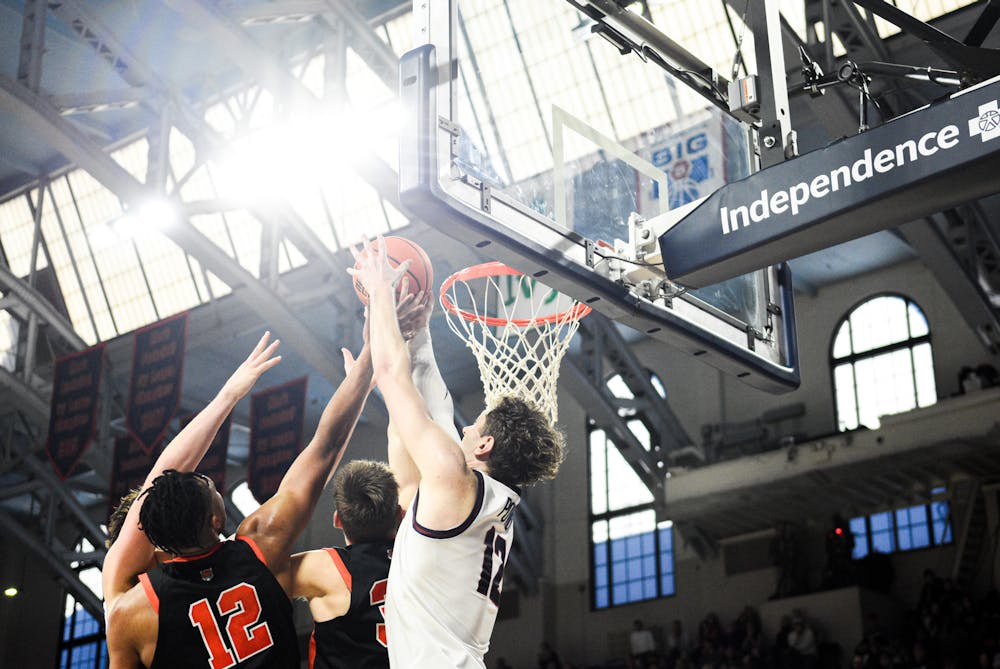
On Saturday, that made space for Power, who led all scorers with 18 points. In the early going, the former five-star recruit was the star of the show. Power has had several notable heaters this season, including an 18-point first half against St. Joe’s. Saturday had a similar look — Power hit his first four shots and made 12 of Penn’s 35 first-half points, injecting life into an offense that was ice cold from outside.
At his best, Power’s 6-foot-9 frame and elite body control make him a unique weapon in the Ivy League. He is a plus-shooter from beyond the arc — look no further than his clutch three to put Penn ahead 61-57 that proved to be the difference in the game — but he’s also capable of putting the ball on the floor and going to work against favorable defenders.
Here, Power uses his handle to dice Tigers guard Landon Clark, bumps him to get position on the low block, then gets back to his right hand and bumps again to create space for a smooth hook finish.
“I saw some matchups that I could take advantage of, so I just tried to get some paint touches, get some close shots early,” Power said. “It’s fun once you’re getting those little flows, and you just try to stay aggressive.”
Levine, who is scoring 12.1 points per game in Ivy play after averaging 5.5 during the non-conference season, continued his offensive renaissance with a standout second half. He began the period with a knifing drive to put Penn ahead 37-25 and kept it going the rest of the way — all four of his baskets after halftime came at the rim, many of them complete with nifty finishes.
Here, Levine gets downhill decisively off the pick-and-roll and banks a tough hooking layup right over 6-foot-6 Princeton guard/forward Sebastian Whitfield.
“Just understanding the flow of the game … seeing the floor and the game a little bit slower to make the right decisions,” Levine said of his scoring uptick. “At times I was passing up those scoring opportunities earlier in the season, and those weren’t the right decisions. So it’s just really about making the right decision, and recently that’s been scoring for me.”
But Penn’s most impactful effort came on the defensive end, where the Quakers limited the Tigers to their lowest point total of conference play. In the teams’ first matchup on Jan. 5, Princeton won the day thanks, in large part, to a stretch of 16 consecutive made field goals. The Tigers also got to the basket at will in that game, racking up 42 points in the paint.
This time, Penn battened down the hatches, blocking six shots and limiting Princeton to just 28 paint points. Both figures were the result of a frenetic scheme that saw the Quakers throw multiple defenders whenever the ball entered the post, limiting clean looks and often forcing Princeton’s bigs to kick out. When they did, Penn rotated well to limit the ensuing jumpers, holding the Tigers to 31.6% from three.
Princeton’s ability to puncture that front played a large role in their late comeback bid. Tigers forward Malik Abdullahi converted three paint buckets in the second half, including a layup to cut Penn’s lead to three with 2:28 remaining. But in the end, the Quakers did enough to hold off the Tigers’ late surge.
“It was spectacular,” McCaffery said of Penn’s defensive execution. “We played great defense for 30 minutes [in the team’s first matchup with Princeton.] Today, we did it for 40. And if you’re gonna beat Princeton, you gotta do it for 40.”
In their first six Ancient Eight games, the Quakers let up an average opponent field goal percentage of 47.7%. In their current two-game win streak over Cornell and Princeton, that figure is down to 43.1%.
Beating the Tigers is a significant emotional win for a program that appears renewed under McCaffery. But it is also promising sign for a Penn team that has proven it can win in multiple ways.
WALKER CARNATHAN is a College senior and former DP Sports editor from Harrisburg studying English and Cinema and Media studies. All comments should be directed to dpsports@thedp.com.