

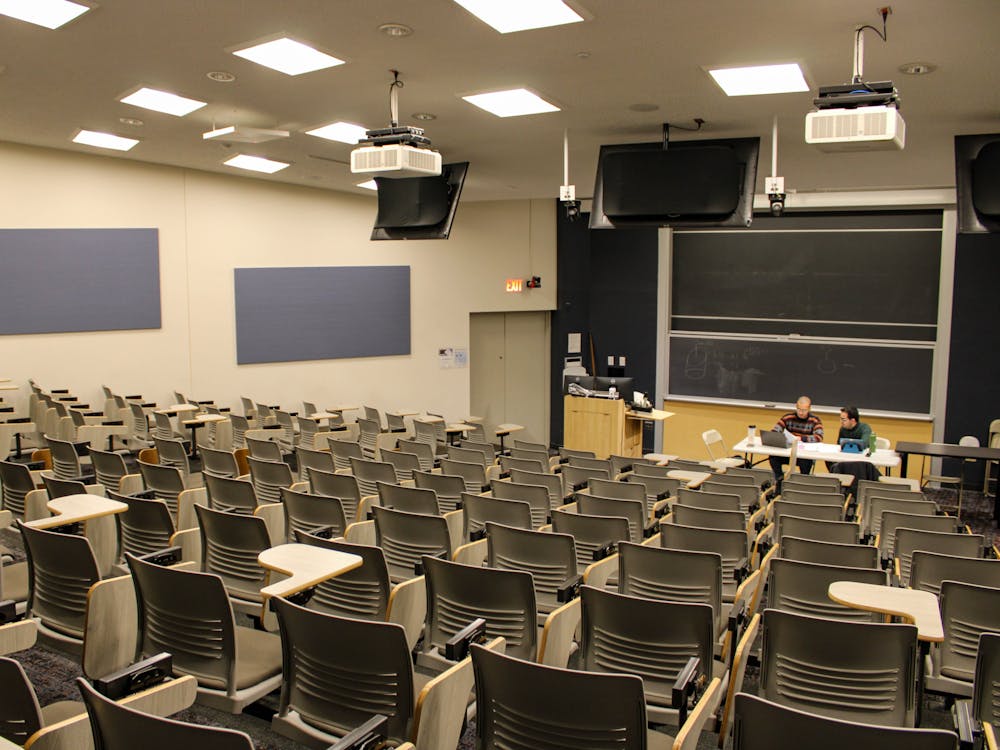
There comes an inevitable point in every student’s career when you find yourself enrolled in the most mind-numbing lecture of your life. It is almost always at 8 a.m., in the dingy basement that is Meyerson Hall, with a professor methodically clicking through slides that seem to have been untouched for at least a decade. At some point, more out of boredom than rebellion, you decide to upload the slides into ChatGPT.
“Here are comprehensive notes, organized as an interesting story!” the bot writes back enthusiastically. In front of you lie the key concepts, practice questions, and even analogies tailored specifically to you.
The discovery feels almost illicit. Here is a way to learn in 20 minutes what the registrar has scheduled 90 to deliver. You have optimized for efficiency and succeeded. Next Monday morning, you could sleep in. Maybe even grab the new banana shortbread latte at Stommons instead. When the “efficient” strategy delivers the same 4.0, the guilt dissolves quickly under the sweetness of caffeine and an extra hour in bed.
At several points during my time at Penn, I have hit this crossroad. For a long time, I felt guilty. Here I am at a university that prides itself on world-class academic excellence, yet I find myself calculating whether the classroom is the highest return on my time. On this campus, time is treated like capital, best deployed towards research, recruiting, or the next internship. When a lecture begins to feel like a low-yield investment for the same outcome, this calculation feels harder to ignore.
Penn professors, like many across higher education, have attempted to respond. In the College of Arts and Sciences and the Wharton School, timed attendance codes are now common which is the first time any of us learn collaborative teamwork. One of my classes recently even implemented location tracking precise enough to confirm my physical presence in the room. These systems enforce bodies in seats. They do not answer the more uncomfortable question: Why are students evading lecture in the first place?
It’s tempting to blame it on generational laziness or shrinking attention spans. The harder truth is far more utilitarian. For centuries, lectures have relied on an antiquated method in which information was scarce and professors were its primary gatekeepers. But today, large language models have not just made information abundant but also increasingly personalized. If a lecture simply regurgitates what can be read off slides or in the textbook, rational students will do what markets train them to do: optimize.
The question then becomes: Is it feasible to create lectures chatbots cannot replace?
Last spring, I took professor Philip Gehrman’s three-hour-long Introduction to Experimental Psychology course. By any measure, a large evening class should have tested my TikTok-conditioned endurance. But on the first day, Gehrman asked more than 200 students to write personal introduction notes and later responded to each one individually. Instead of projecting slides, he filled chalkboards, interfacing research on memory and learning directly into the way he taught. He would pause mid-lecture and force us to wrestle with a question before clarifying the answer. I left those evening lectures arguing about the implications of memory reconstructing or recording experience, thinking longer than any artificial intelligence summary would have required. ChatGPT never crossed my mind as a substitute because the lecture was doing something fundamentally irreplaceable. More than just teaching me psychology, it was teaching me how to think about psychology.
SEE MORE FROM DIYA CHOKSEY:
Deflating grades will not inflate curiosity
This spring, I have felt this intellectual friction yet again in AI In Our Lives: The Behavioral Science of Autonomous Technology with professor Stefano Puntoni. He intersects his research directly into his teaching, bridging historic underpinnings with contemporary findings. Our assignments require us to reflect on how we prompt artificial intelligence rather than simply use it. Guest speakers contextualize the theory within real industries. I always leave the lecture with a notepad scribbled not with copied bullets, but with questions I’d previously not known how to formulate.
Both these lectures have affirmed to me that the problem is not the lecture as a concept. Rather, it is in its execution. To truly serve as purposeful now, lectures should be metacognitive frameworks on how to think and ask questions in the first place, while capitalizing on the increased modern-day value of in-person collaboration.
What Penn and its fellow Ivy league universities must do now is serve as the frontier of this academic remodeling. We need to invest in our professors, not confining them to research excellence but empowering them to develop modern, experimental forms of lecture pedagogy. Models like the United Kingdom’s Teaching Excellence Framework or the University of British Columbia’s Teaching track can serve as useful formal blueprints. This would enable us to build curricula developing the interdisciplinary thinking and human judgment needed from the next generation.
If we make students genuinely excited to enter the lecture hall, if we engage them with research and the experience of thinking in real time with others, we will not need location tracking to keep them in their seats. They will choose to be there because the classroom is offering an experience that cannot be optimized away. This is the only way we can keep universities alive in the age of artificial intelligence.
DIYA CHOKSEY is a College sophomore from Mumbai, India studying cognitive science. Her email is dchoksey@sas.upenn.edu.
SEE MORE FROM DIYA CHOKSEY:
Deflating grades will not inflate curiosity

Diya Choksey is a College junior studying cognitive science from Mumbai, India. Her column focuses on student culture and identity. She can be reached at dchoksey@sas.upenn.edu.


