This story is part one in a two-part series chronicling the history of Penn’s men’s basketball program. Read part two here.
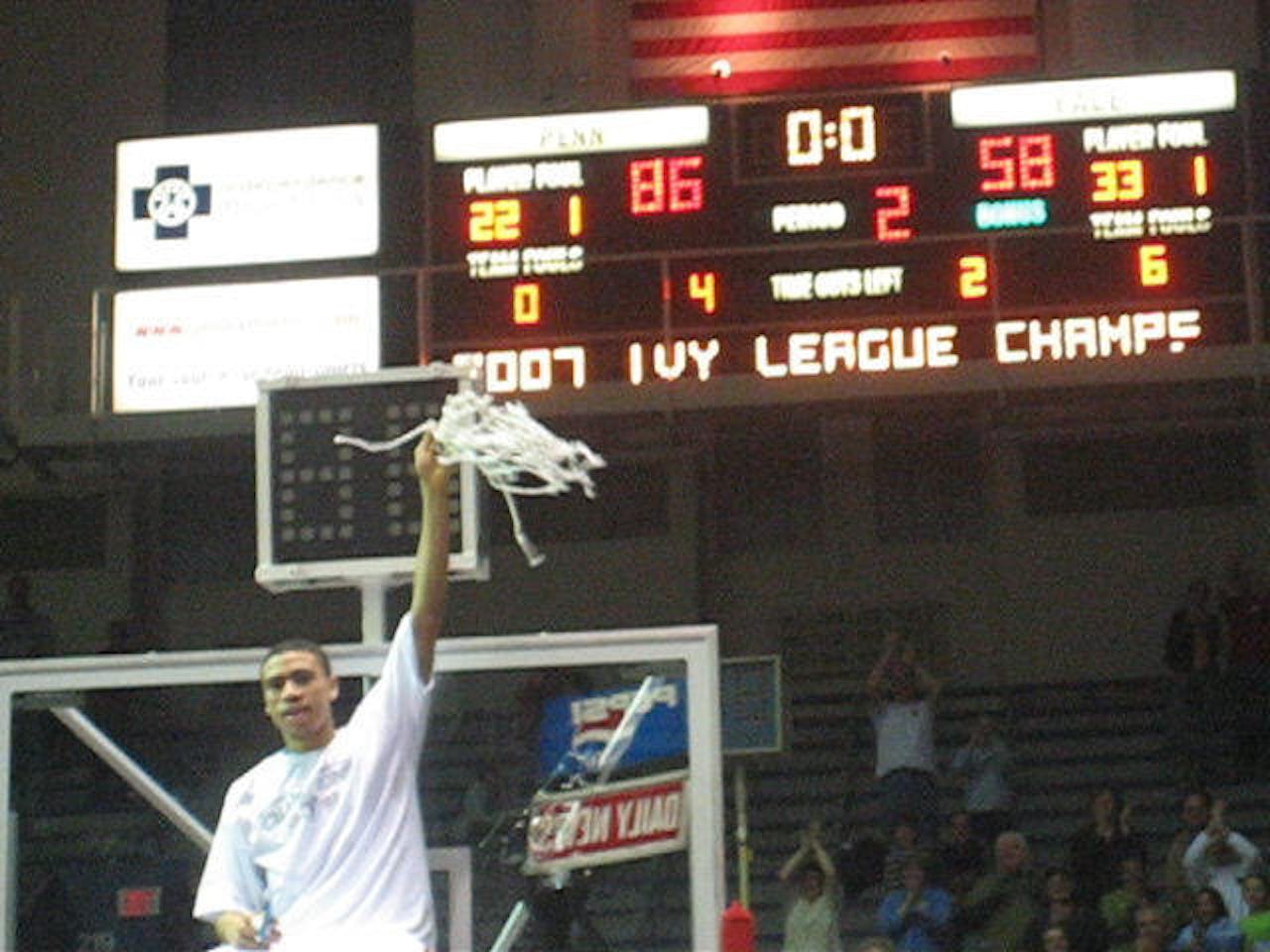
On March 2, 2007, the scoreboard at the Cathedral of College Basketball flashed a familiar refrain: “Ivy League Champs.”
There, as two-time Ivy League Player of the Year and 2007 College graduate Ibrahim Jaaber sat on the rim and waved the severed net above his head, Penn men’s basketball occupied a similar position atop the Ivy League. A 28-point win over Yale had secured the Quakers their 25th conference crown, their second in a row and seventh in nine years.
That campaign, the first under coach Glen Miller, seemed to portend another decade of dominance for Penn. But as the title came and went, so too did stars like Jaaber, leading scorer and 2007 College graduate Mark Zoller, and leading shot-blocker and 2007 College graduate Steve Danley, all of whom were recruited by former coach Fran Dunphy.
Miller never coached another winning season and was fired less than three years later. In retrospect, the close of that 2007 season was not a continued coronation, but the start of a new age for the program. One of fewer banners, fewer fans, and one characterized by a broader theme: failure to sustain the program’s previous standard of success.
Over the course of 38 seasons from 1970 to 2007, the Red and Blue won 22 Ivy League titles, including streaks of six in a row in the early ’70s and four in a row in the mid-’90s. In the 18 seasons since, they have won one.
RELATED:
Fran McCaffery is back to change Penn men’s basketball for the better
In Photos: An exclusive look at Penn’s historic Final Four run, 45 years later
During that 38-year span, Penn finished with a losing record in the Ivy League once. Since, it has happened nine times.
In those 38 years, Penn went 47-31 against Princeton, its top conference rival. Since, the Quakers are 7-29 against the Tigers, including a streak of 13-straight losses that stretches to this day.
In evaluating Penn’s decline, former coaches and players have laid blame on a number of factors: recruitment shortcomings, the advancement of Ivy League competition, and the league’s larger slide from the national stage. But now, with an alumnus from those glory days returning to helm the program, Penn hopes its winning ways are soon to follow.
“It’s important to all of us that we get back to where we were,” new coach Fran McCaffery, who played for the Quakers from 1979-1982, said. “And it's not easy.”
The first title in Penn’s decades-long dynastic run came in 1970 under coach Dick Harter. That season, the Quakers went 25-2, including a 14-0 clip in the Ivy League, and defeated their opponents by an average of nearly 13 points. Penn went on to win the conference title in each of the next five seasons, the latter four of which came under legendary coach and future NBA champion Chuck Daly.
At the time, Penn’s unique combination of historic facilities, premium location, and world-class academics made it a hotbed for top basketball talent.
“Basketball means so much to the city of Philadelphia,” Matt Langel, who played for the Quakers from 1996 to 1999 and currently serves as the head coach at Colgate, said. “When you’re finding success, you’re not just representing your teammates and your program … but [all of] Philadelphia.”
“Kids want the Ivy League apart from the rest of Division I,” Alan Cotler, who played for the Quakers from 1969-1972, said. “They want the Palestra, they want the Big 5, they want the Wharton School.”
From 1970-2007, eight Quakers went on to play in the National Basketball Association, with many others carving out professional careers overseas.
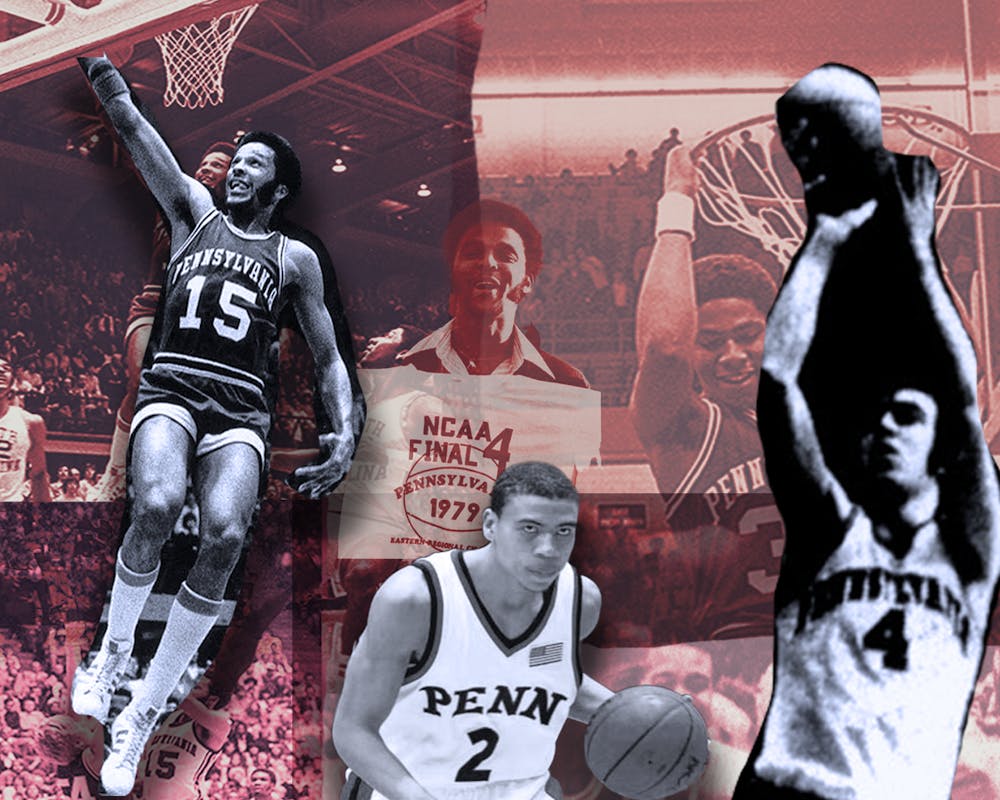
One such professional player was standout shooting guard Tony Price, who was selected by the Detroit Pistons in the second round of the 1979 NBA Draft after helping Penn to its most successful campaign in program history. That season, the Red and Blue danced all the way to the Final Four of the NCAA Tournament — a feat not replicated by any other Ivy League team in the last 45 years.
Bob Weinhauer, the coach of that Final Four group, employed a high-tempo brand of offense designed to generate additional possessions against slower-paced opponents.
“In those days, there was no clock. A lot of teams didn’t play fast,” McCaffery said. “We played fast. Pushed the break, makes and misses, we attacked. We had a mindset that was aggressive.”
Weinhauer made the leap from Penn to Arizona State in 1982, a step that had become commonplace for Quaker coaches. Daly, Weinhauer, and Weinhauer’s successor Craig Littlepage each coached the Red and Blue for six seasons or less before jumping to larger programs or, in Daly’s case, an NBA assistant job.
Despite its lack of coaching continuity, the program found success with each new iteration. Of Penn’s six head coaches between 1970 and 2007, each won at least one Ivy title.
In 1989, coach Tom Schneider departed for Loyola Maryland, leaving the head coach position vacant once again. Penn hired from the inside, promoting an assistant coach from Schneider’s staff who was no stranger to the school’s basketball tradition: Fran Dunphy.
“My impressions were how phenomenal [Penn] was,” Dunphy said. “I went to the Palestra seemingly every Wednesday, Friday, and Saturday night — I grew up there as an elementary school person. I was honored to go to Penn, and I knew what the history and legacy was.”
Dunphy’s tenure not only continued the program’s previous tradition, but advanced it. After failing to win the conference in his first three seasons at the helm, Dunphy led the Quakers to three straight undefeated Ivy League seasons from 1993-1995.
One of the key ingredients to Dunphy’s success was top talent — in his 17 seasons at the helm, Dunphy coached the Ivy League Player of the Year nine times. But just as important to the program’s all-time winningest coach was the approach those stars employed.
“When we got to a pretty good level, the guys that were our best players were also our best defenders and our best teammates,” Dunphy said. “The culture got started because of their unselfishness and desire to succeed.”
“If you’re not tough, and you’re not built to get through some really tough stuff, [Penn] is not the place for you,” Jed Ryan, who played for the Quakers from 1995-1999, said.
In addition to their mentality, the early-2000s Quakers’ tandem of skill and athleticism made the team must-watch campus entertainment and the Palestra a can’t-miss destination.
“We had guys who played above the rim. … We didn’t play like a quote-unquote ‘Ivy League team,’” Ugonna Onyekwe, who was named Ivy Player of the Year in 2002 and 2003, said. “I can’t think of a more exciting time in Penn basketball.”
Penn’s non-conference schedules, which featured opponents like Duke, North Carolina, and Michigan State, also helped elevate the team’s national footprint, according to Dunphy and Onyekwe. But in West Philadelphia, there was no greater fervor than when the Tigers came to town.
“It seemed like the entire student body was standing [in] lines out the door at Smokey Joe's for that Tuesday night [after the Princeton game]." Ryan also recalled an incident during his career in which a Roman candle exploded on the court during a Penn-Princeton matchup.
“It was definitely an all-campus event, definitely something that everyone looked forward to,” Ryan added. “It would be … probably 8,500 people in the Palestra, standing room only.”
The feud between the Quakers and the Tigers was fueled by proximity — the schools are separated by less than 50 miles — but also by scarcity: there was only one conference title to go around. From 1970-2007, a team other than Penn or Princeton won the Ivy crown just three times.
“In the Ivy League at the time, the regular season champion was gaining the automatic berth [in the NCAA tournament],” Langel said. "And in the city of Philadelphia, the most formidable opponent in the conference was Princeton … it becomes a natural rivalry because you're competing for what everybody else is striving for.”
“The Ivy League of [the] early 1990s was different than the Ivy League today,” Dunphy said. “Penn and Princeton were the two programs that were winning the title every year. Now, I think all eight teams are capable of making a difference in the league every single year.”
In 2006, Dunphy led the Quakers to a 12-2 conference finish and another tournament appearance. It would be his final season with the Red and Blue.
That April, Dunphy crossed town for Temple, leaving his program and players to Miller. Dunphy continued his success with the Owls, guiding the program to five conference tournaments and seven NCAA Tournament appearances.
But just a few miles away, Dunphy’s former program began a slow descent from the limelight. In 2007, Jaaber, Zoller, and Danley graduated. In 2009, Miller lost his job after his Quakers began the season 0-7.
And in many ways, through different teams, coaches, and administrators, Penn’s once-dominant program has never been the same.