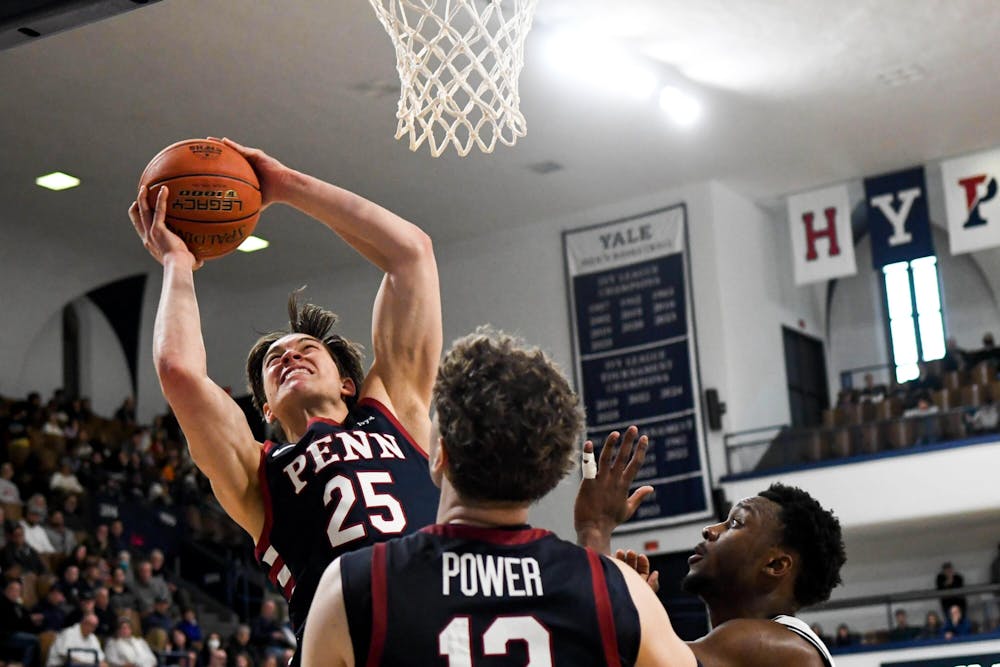
NEW HAVEN, Conn. — After going the distance with the Ivy League’s top team, Penn men’s basketball came up just short.
On Saturday, the Quakers fell to first-place Yale 74-70, snapping the team’s four-game win streak. After leading the Bulldogs by double digits in the first half, Penn (13-11, 6-5 Ivy) ultimately lost control in the second half as its hot shooting cooled off. All told, the Red and Blue looked more than capable of competing with the two-time reigning champs but couldn’t string together enough stops to close out the effort.
While Yale was without Ivy League Player of the Year candidate Nick Townsend, it received big-time contributions from the other two members of its supersized frontcourt: forward Isaac Celiscar and center Samson Aletan. Celiscar, a well-built 6-foot-6, and Aletan, 6-foot-10, 223 pounds, are major handfuls down low, forcing opposing defenses to bend around them.
Celiscar in particular made life extremely difficult for Penn, physically imposing on the Quakers’ defenders and frequently drawing help. He finished the day with 16 points and 14 rebounds, but the more telling figure may have been his five assists. When Penn sent two defenders, Celiscar made right decision after right decision, dishing off to Aletan and the Bulldogs’ perimeter shooters for open looks.
Here are two examples of Celiscar’s bully-ball-generated open looks from three-point range. In the first, he clears out junior forward TJ Power at the elbow, freezing sophomore point guard AJ Levine just long enough for his man, guard Trevor Mullin, to get off a clean jumper.
The second is even simpler. After Celiscar plows his way onto the block and pulls both junior forward/center Augustus Gerhart and freshman guard Jay Jones into his orbit, he deftly finds forward Jack Sullivan in the corner for a wide-open triple.
“[Celiscar and Aletan] are handfuls, but the reason they’re handfuls is because of what else [Yale has]. They got weapons everywhere,” coach Fran McCaffery said. Yale’s do-it-all forward Casey Simmons also finished with 13 points. “So you gotta pick when you’re doubling, who you’re doubling off.”
Celiscar also called his own number in several key moments. In the final two minutes, he connected on a fadeaway free throw line jumper to put Yale ahead 67-60. Then, after a pair of three-pointers brought Penn back within two, Celiscar dialed up an isolation against Power and converted a tough baseline mid-range jumper to give the Bulldogs a 70-66 lead they would not relinquish.
“[Celiscar] hit a big shot,” McCaffery said. “You gotta give it to him. It’s a one-legged, fadeaway contested. Up two, that shot was a game-winning shot.”
Penn’s early lead was fueled by a white-hot shooting stretch that saw the Quakers hit six of their first eight three-pointers. Power and senior guard/forward Michael Zanoni accounted for three apiece, and each finished the first half with 15 points.
Zanoni was unconscious for much of the early going, serving as a Cristiano Ronaldo-like play finisher for possessions successful and not. The 6-foot-5 forward has spent much of Penn’s recent win streak getting crowded as he moves off the ball, but in New Haven, Conn., he was able to catch cleanly and execute with minimal space.
Some of Zanoni’s makes were well-schemed gems. Here, near the end of the first half, he darts to the corner after being sprung open by a solid screen from freshman center Dalton Scantlebury, connecting on a baseline jumper to put Penn ahead 36-33.
Others were heat checks — here, after the Quakers’ offense goes stagnant, Zanoni bails them out with a deep catch-and-shoot triple despite a hand in his face.
Here, trailing by five in the final minute, Zanoni waits to time his movement with Power’s inbound catch, then launches off a Gerhart pick and hits a wing fadeaway with barely any air.
Penn’s primary issue was that looks like those — for Zanoni and Power — were few and far between after halftime. Zanoni was one-fourth from three-pointer in the second half, while Power was one-half. As a team, the Quakers converted just 33.3% of their second-half field goals, struggling to penetrate Yale’s front without fiery shooting to light the way.
“We should’ve done a better job getting TJ the ball in the second half,” McCaffery said. “We called some things for him, but he’s so unselfish he just gives it up. We tried to iso him, we tried to get him in situations where he was gonna be open. But we will do a better job with that.”
McCaffery also lamented Penn’s struggles on the glass. Yale notched 14 second-chance points to Penn’s 11, and some were especially back-breaking: on the third possession of the second half, the Bulldogs nabbed two offensive rebounds en route to an Aletan and-one. With 7:19 to go, Simmons corralled a miss and hit a three-pointer shortly after to punctuate an 8-1 Yale run.
The Bulldogs lead the conference in rebounding margin since the start of conference play, while the Quakers rank fourth. It likely won’t be an issue for Penn against teams that don’t have Yale’s size and length, but if the Red and Blue want to compete for a conference title, it’s a matchup they will likely need to overcome. In their loss to Yale on Jan. 24, the Quakers lost the rebounding battle 42-28.
“We didn’t rebound the ball. That was the issue in the beginning of the second half,” McCaffery said. “Get the first miss and go.”
Penn will play two of its final three regular-season games at home and is still a near-lock for Ivy Madness. In a tight loss to the league’s top dogs, there were positives but also plenty of lessons for a team with championship aspirations.
WALKER CARNATHAN is a College senior and former DP Sports editor from Harrisburg, Pa. studying English and Cinema and Media studies. All comments should be directed to dpsports@thedp.com.