

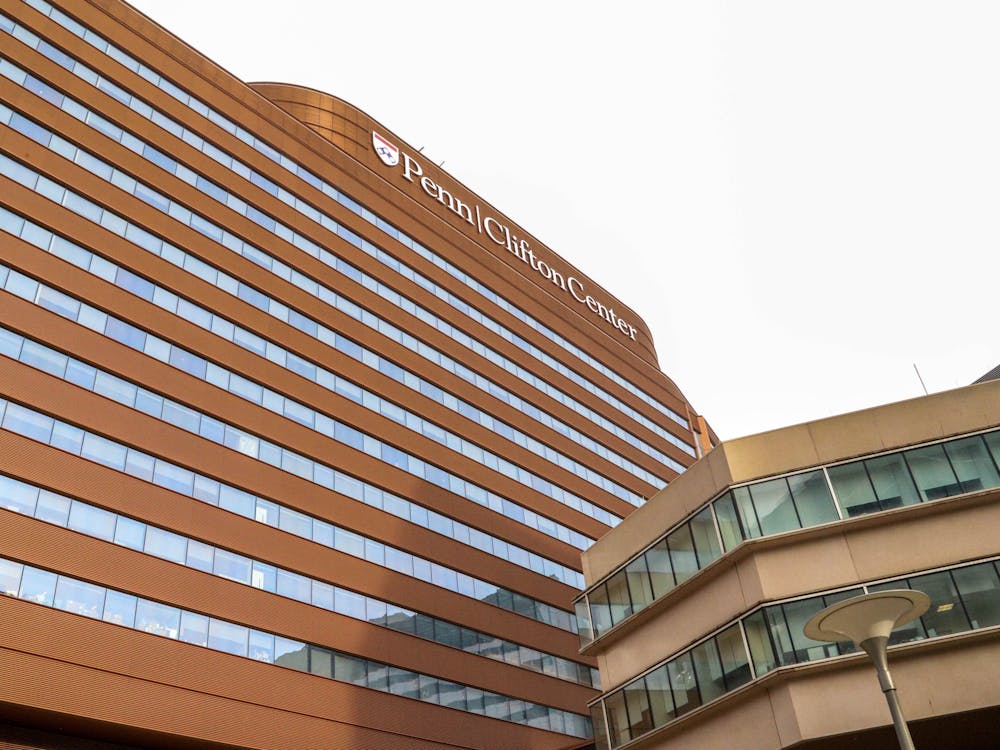
As Penn continues to grapple with federal funding cuts to research programs and grants, The Daily Pennsylvanian examined how the University’s published research output compares to that of its peer institutions.
Penn — a designated R1 institution — describes itself as “one of the nation’s top research universities.” The University employs over 5,000 faculty researchers and invests $2 billion across 230 research centers and institutes.
Senior Vice Dean and Chief Scientific Officer at the Perelman School of Medicine Michael Ostap wrote that the University’s R1 designation allows it to pursue a “wide range of opportunities,” including securing large federal grants and philanthropic and industry partnerships.
The DP’s analysis reviewed articles published in 12 top scientific research journals — Nature, Nature Medicine, Nature Communications, Proceedings of the National Academy of Sciences, Science, Cell, The New England Journal of Medicine, Angewandte Chemie International Edition, IEEE Access, JAMA, The Lancet, and Advanced Materials — over the past year.
Journals were chosen based on their h-index, which measures the productivity and citation impact of a research publication.
In the past 12 months, Penn-affiliated researchers published nearly 400 original research articles across the selected scientific journals, including over 200 articles published by the Perelman School of Medicine.
RELATED:
Penn professor publishes new book discussing use of proxies to model past climates
Two Penn professors admitted to American Academy of Sciences and Letters
“We have also invested in state-of-the-art research infrastructure, which makes it possible for our teams to do truly cutting edge work,” Ostap wrote. “That kind of environment attracts both top talent and major sponsors who want to support high impact science.”
According to Penn Medicine Neurosurgery Department Vice Chair for Research and professor Michael Beauchamp, a university’s publication success often varies based on the size of its research teams.
“If you have a giant team, you’re going to have to publish very frequently,” Beauchamp said. “Alternatively, you might just be a single, solitary researcher working on your own, and then you’re unlikely to publish hundreds of papers, because you’re doing everything yourself — so it’s completely dependent on the size of your research team.”
Penn had the greatest number of articles — nearly half — published in Nature Communications, followed by Nature and PNAS and Nature.
Beauchamp explained that high-impact journals like Nature or Nature Medicine only publish articles “of enormous significance,” whereas more “mundane” research is typically reserved for lower-tier or specialty journals.
“Everything in the scientific ecosystem is dependent on where your work gets published,” Beauchamp said, adding that high-impact journal visibility can help researchers secure funding and get promoted.
Journals such as Nature, Science, and NEJM publish only a limited number of research articles each week, reducing the overall volume of accepted submissions.
Nature reports that only about 8% of submitted manuscripts are accepted for publication.
“Articles published in Nature have an exceptionally wide impact, both among scientists and, frequently, among the general public,” a Nature webpage reads.
In contrast, Nature Communications operates as an open-access “megajournal” and is designed for articles that may not have the same “scientific reach” as those published in Nature.
Ostap noted that Penn’s publication trends are a byproduct of the University’s research goals.
“A lot of PSOM research ends up in top journals because the work itself is genuinely impactful,” Ostap wrote. “Our investigators are creative, dedicated thinkers focused on big, meaningful questions, and high‑impact publications tend to follow.”
“We are chasing important science, not journal titles,” he added.
In the past 12 months, Penn-affiliated researchers published 394 research articles — fewer than the number published at Harvard University, Stanford University, Columbia University, and Yale University, whose researchers produced 712, 513, 463, and 405 articles, respectively. Penn only ranked above Johns Hopkins University, whose affiliated researchers published 347 articles in the select journals over the same time period.
Like Penn, Harvard, Stanford, Columbia, Yale, and Johns Hopkins have an affiliated medical school.
Penn, however, spends as much or more on research than several of its peer institutions. Penn reports $2 billion in annual research expenditures, compared to $2.2 billion at Stanford, and roughly $1 billion at both Harvard and Yale. In 2024, the National Science Foundation ranked Penn ninth among universities nationwide in reported research and development spending for that year.
“Scientific publishing is undergoing a lot of transitions right now, because there’s growing appreciation that it’s not very sustainable in that scientists review other scientists’ articles for free, and then must pay to have their articles published,” Beauchamp described.
He noted that services such as Penn Libraries often pay millions of dollars to subscribe to journals and provide the campus community “open-access,” which helps allow many publishers to become “enormously profitable” billion-dollar companies.
Researchers who want to increase the visibility of their work have to pay a fee for their article to become “open-access.”
According to a recent analysis in Quantitative Science Studies, scientists paid an estimated more than $1 billion in open-access article fees to five of the largest publishers — Elsevier, Sage, Springer-Nature, Taylor & Francis, and Wiley — between 2015 and 2018.
Beauchamp said that recent federal funding research cuts may inspire some changes.
“The hope is that it may spur changes to the publishing model, because it’s so clearly … not providing benefits to the community, as most of the benefits are occurring to these multinational billion-dollar publishing companies,” he said.
Staff reporter Rachel Kang contributed reporting.
RELATED:
Penn professor publishes new book discussing use of proxies to model past climates
Two Penn professors admitted to American Academy of Sciences and Letters
Staff reporter Sameeksha Panda covers science and health and can be reached at panda@thedp.com. At Penn, she studies chemistry.


