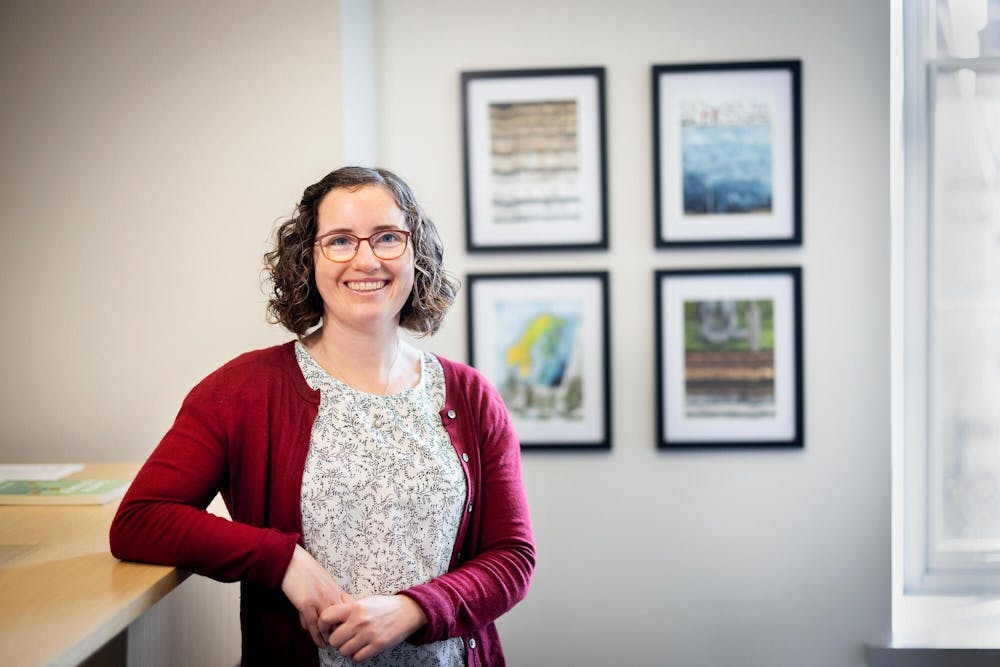
Penn History and Sociology of Science assistant professor Melissa Charenko recently published a new book discussing how 20th-century climate researchers used proxies to model ancient climates.
The book, titled “Climate by Proxy: A History of Scientific Reconstructions of the Past and Future” and published this month, focuses on the 20th century and explores how scientists understand past climates. In the work, Charenko emphasizes how valuable proxies are in addressing today‘s climate challenges.
In ”Climate by Proxy,” Charenko follows scientists who “reconstructed climate using natural archives” to show how “material objects worked with scientists’ perceptions of human groups to compel, constrain, and reinforce their understandings of climate, history, and the future.”
In an interview with Penn Today, Charenko described how, while on a trip with a paleoecology lab at the University of Wisconsin — Madison during her Ph.D. in the history of science, she found herself riding behind a snowmobile across a frozen lake as experts drilled for sediment cores with fossil pollen grains.
“I was literally along for the ride as a historian,” Charenko said of the experience.
According to Charenko, direct measures of past climates, usually including instrumental measurements like thermometers and rain gauges, only go back about 150 years, making proxies essential for getting insight about the history of the Earth’s climate.
“Different trees produce different types of pollen, and the quantities of these types of pollen will tell us something about former climates because trees have certain climatic preferences,” Charenko said to Penn Today.
Charenko also acknowledged that there are limitations to proxy evidence. For example, tropical trees are under-sampled due to colonial and historical patterns. Additionally, many do not produce rings like their temperate counterparts. However, according to Charenko, scientists are still developing new methods for extracting climate data from them.
RELATED:
Penn Sustainability continues to pilot ‘Leave the Leaves’ initiative to protect campus biodiversity
2025 Weitzman Awards honors students, researchers for innovations in climate science, public health
Charenko believes her work demonstrates the need for a plurality of different responses to climate change.
“[My book shows] potential alternatives that may be more helpful for solving the climate crisis,” Charenko added to Penn Today. “We need to understand the objects by which we know climate so that we understand what climate is and what we should do about it.”
RELATED:
Penn Sustainability continues to pilot ‘Leave the Leaves’ initiative to protect campus biodiversity
2025 Weitzman Awards honors students, researchers for innovations in climate science, public health
Staff reporter Ryan Rucker covers the University’s graduate schools and can be reached at rucker@thedp.com. At Penn, he studies political science.