Would you pay a stranger on the subway to give you a flu shot? Would you go to your taxi driver to oversee your recovery after a stroke? If you had a speech impediment, would you consult your six-year-old nephew on it first? Most likely not, because when it comes to your health and education, you want a professional.
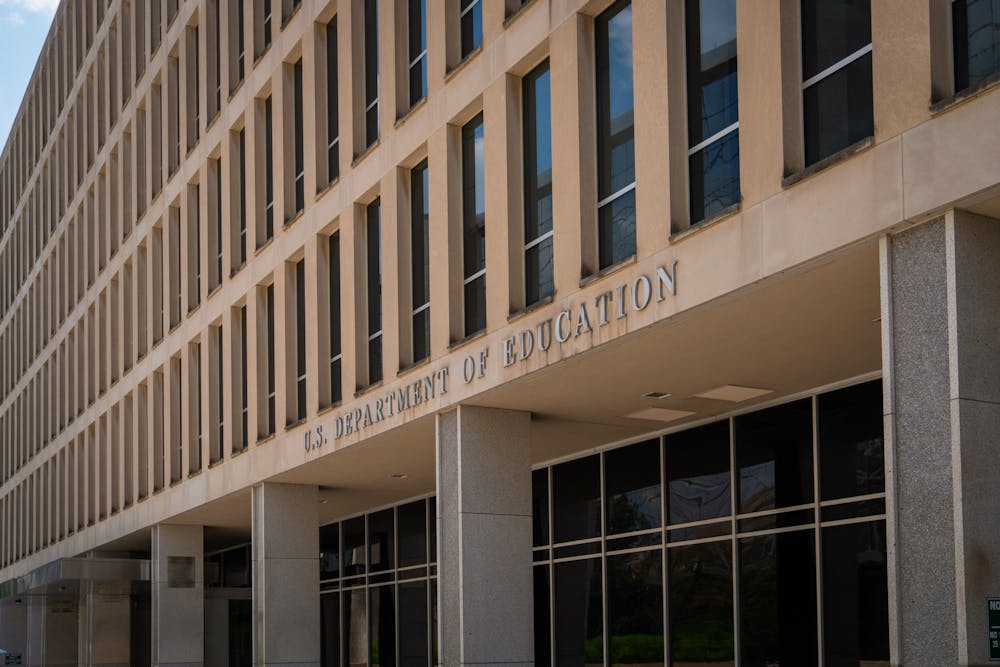
Unfortunately, in the Department of Education’s eyes, my nephew and a trained nurse have the same degree of professionalism: that is, none. Despite years of proven training and education, in early November, the Education Department reclassified what qualifies as “non-professional” higher degrees. But what exactly does this mean, and who does it affect most?
While there hasn’t been a comprehensive list of degrees released from one source, a minimum set of degrees has been confirmed to be labeled as “non-professional,” including nursing, education, physician assistants, physical therapists, audiologists, architects, social workers, and accountants. What this means is that people seeking those degrees can only take out a federal loan of $20,500 annually and $100,000 total, meaning they otherwise have to pay out of pocket, or risk a private loan.
According to the One Big Beautiful Bill, President Donald Trump is eliminating the Grad PLUS program, which allows graduate students to borrow up to the cost of attendance. This, combined with the new extensive list of degrees no longer qualified for proportionate federal loans, makes higher education in specific fields nearly unattainable. And who is hit hardest by this new level of anti-education? The degrees omitted from professionalism are not random; the majority have one thing in common: They are in female-dominated fields.
Women account for 88% of nurses, 77% of teachers, 75% of physician assistants, 92% of audiologists, 70% of physical therapists, 60% of accountants, and 90% of social workers. Seven out of the eight “non-professional” degrees are female-dominated, and those are just the verified ones. It seems that with the rise in college-educated women comes the attempt to curb those achievements, and now it has come to simply slashing access to higher education altogether. As more women become college educated and enter the workforce, the people they’re trying to help put up more obstacles.
However, with the Education Department’s latest attack on education comes another toll: the impact on children. If access to education, nursing, audiology, and social work degrees becomes limited, it won’t just be the employees suffering; it will also be the children who receive those benefits and services. Nursing and education fields have already been experiencing record labor shortages; this new classification and loan restriction will only further decrease interest in those careers.
With a lack of employees comes a lack of resources. These resources are primarily available to children with special needs, learning and behavioral disorders, chronic illnesses, children in foster care, school counseling, and afterschool programs. Children who require intervention in various ways depend on these programs, which are run via education and health services, and they suffer when there is a shortage in these areas. At a time when both child literacy rates and children’s health are declining, should we really be penalizing degrees that help children the most?
The reasoning behind the new federal loan restriction is to hopefully force colleges to lower tuition by making it virtually impossible for students to pay the current price. However, as every ECON 0100 student will tell you, any sort of price ceiling imposed by the government results in a toll: loss of consumers. Not to mention that while this plan might pressure some schools, it won’t have the same effect on private or top 20 universities, because they’re already founded upon exclusivity. Regardless of the reasoning, the reclassification will result in a loss of students pursuing these degrees.
You may not want to get a flu shot from a stranger on the subway right now, but soon, you might have to. In times where higher education is so critical, why are we doing everything we can to make it inaccessible? At the end of the day, it won’t be the colleges suffering; it’ll be the dedicated, passionate people pursuing honorable degrees and the people who desperately need their services.
CHARLOTTE PULICA is a College first year from Enoch, Utah studying criminology and economics. Her email is cpulica1@sas.upenn.edu.

Charlotte Pulica is a College sophomore studying cognitive science from Enoch, Utah. Her column focuses on academic policy and student life. She currently serves as a Deputy Opinion Editor and can be reached at cpulica1@sas.upenn.edu.