

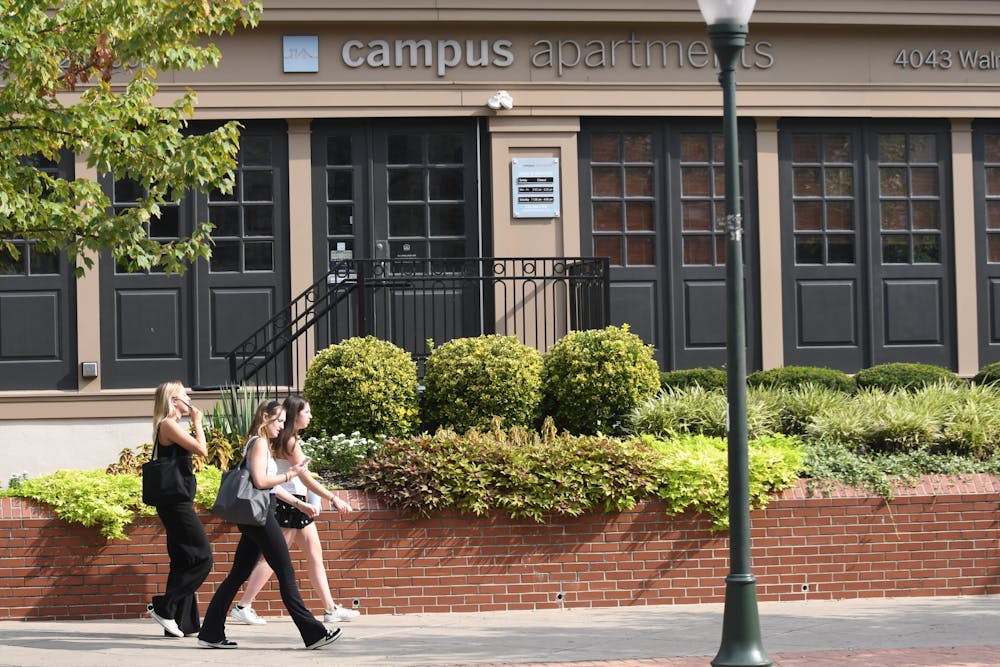
As Penn students finalize housing decisions for the 2026-27 academic year, The Daily Pennsylvanian spoke to three rising juniors currently weighing the cost of transitioning to off-campus units.
While undergraduate students are required to live on Penn’s campus for a minimum of two years, many choose to move off campus as upperclassmen. While these students are still eligible for on-campus housing, annual rates have risen steadily with each academic year since students returned to campus in 2021 — following a period of virtual learning due to the COVID-19 pandemic.
For the 2024-25 academic year, college house room rates were $12,640 or $16,580 depending on the type of room selected. For 2025-26, these figures increased to $13,132 or $17,226 respectively.
In an interview with the DP, College sophomore Jenny Nguyen said that she weighed off-campus options before deciding to continue living on campus for next year.
“Even though off-campus can be cheaper, it feels like you’re paying for convenience on campus,” Nguyen said. “Not having to worry about leases or utilities is a big factor.”
Nguyen emphasized that remaining on campus also allowed her to avoid the hunt for other living options.
“When I’m comparing myself to other friends stressing about searching for apartments or signing leases so early, staying on campus feels a lot simpler to me,” Nguyen added.
Wharton sophomore Lina Yang, on the other hand, described her interest in moving beyond Penn’s campus.
RELATED:
Riepe College House flooding incident damages seven rooms, displaces three students
How the College House system shapes residential living at Penn
“I think it’s really rare to actually be able to live with your closest friends, be able to hang out with them in your living room and just have that be your home,” Yang told the DP. “That’s definitely something I wanted to partake in when I came to college.”
Yang said that she found the house she plans to live in next year by coordinating with friends in her sorority who were “looking to pass it down to someone that they knew.”
She added that she and her roommate “both have older siblings who went to Penn,” so they were able to “use their experience” to better understand the transition to off-campus housing.
“I think all of our friends are doing the same thing,” Yang said while describing the importance of “relying on word of mouth and upperclassmen.”
Many students also decide to apply for Resident Advisor positions, which are employment opportunities that guarantee on-campus housing.
College sophomore Anthony Imm told the DP that he plans to apply to serve as an RA as a “way to stay on campus.”
He specifically highlighted his hope to get “involved with the community and still have my own personal space.”
Imm also explained that his decision to remain on campus stemmed from a desire to avoid the “uncertainty” of the off-campus selection process.
“Living off campus feels like a fundamental upperclassman experience, but there are so many variables involved,” Imm explained.
For students navigating the off-campus housing process independently, Penn Off-Campus Services offers support through individual appointments to review leases other details before signing.
“These conversations are designed to help students better understand their options and make informed decisions before signing a lease,” Penn Business Services Director of Communications Courtney Dombroski wrote in a statement to the DP.
According to Dombroski, the office also offers “educational programming throughout the year,” including workshops on tenant rights and roommate communication. Penn Off-Campus Services’ annual Virtual Housing Fair will launch March 25 and remain open through July 24.
RELATED:
Riepe College House flooding incident damages seven rooms, displaces three students
How the College House system shapes residential living at Penn
Staff reporter Hailey Hilsabeck covers facilities and infrastructure and can be reached at hilsabeck@thedp.com. At Penn, she studies cinema and media studies and English. Follow her on X @hhilsabeckk.


