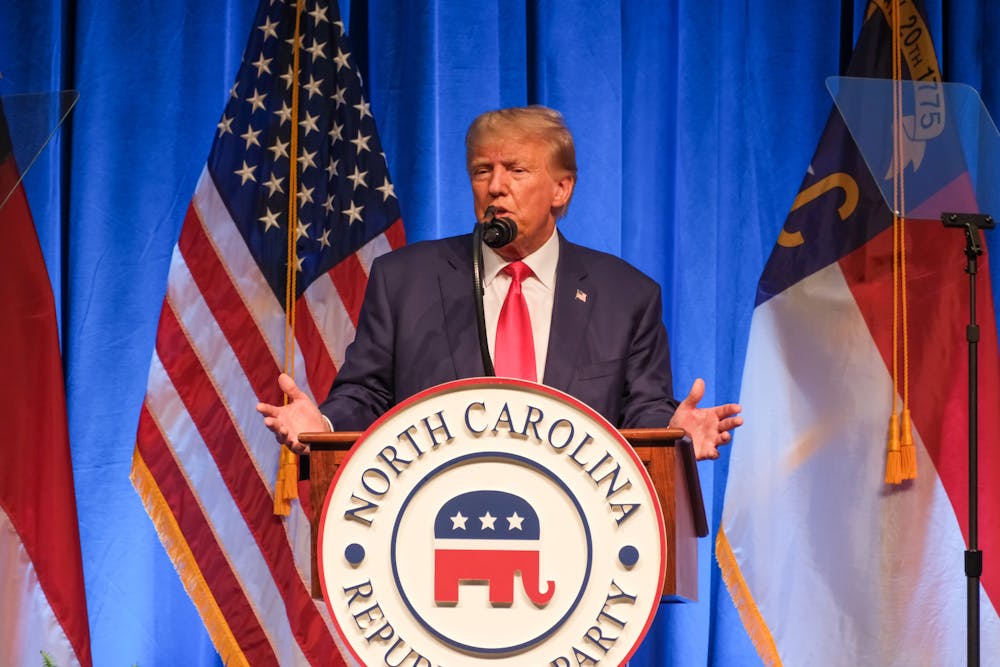
Penn faculty members and free speech experts criticized a recent national security memorandum signed by 1968 Wharton graduate and President Donald Trump.
The Sept. 25 memo — titled “Countering Domestic Terrorism and Organized Political Violence” — followed a Sept. 22 executive order designating Antifa as a domestic terrorist organization. In interviews with The Daily Pennsylvanian, Penn professors argued that the memo compounds other actions taken by the Trump administration to create a “chilling effect on free speech” at Penn and other universities.
Nicknamed “NSPM-7,” the memo outlined a new national security strategy aimed at combatting “domestic terrorism.”
“Through this comprehensive strategy, law enforcement will disband and uproot networks, entities, and organizations that promote organized violence, violent intimidation, conspiracies against rights, and other efforts to disrupt the functioning of a democratic society,” the memo read.
In a statement to the DP, University of Pennsylvania Carey Law School professor Kermit Roosevelt expressed concerns that the measure’s language casts an unusually wide net.
“It seems to have a pretty broad theory of what foments political violence — educational institutions that radicalize students through extremism on race and gender are mentioned explicitly,” Roosevelt wrote, pointing to language in NSPM-7 that describes education as a potential medium for “organized campaigns of targeted intimidation, radicalization, threats, and violence.”
The memo also included a list of “common threads animating this violent conduct” — including “anti-Americanism,” “anti-capitalism,” and “extremism on migration, race, and gender.”
Roosevelt added that he expects the memo to be “pretty easily read” as a “pretext to harass left-wing organizations and universities.”
RELATED:
‘Kissing the Trump ring’: Penn faculty condemn University's Title IX settlement
Penn expert criticizes announcement from Trump, RFK Jr. linking autism to acetaminophen use
A Penn spokesperson declined to comment on whether the memo will impact the University’s policies on open expression and protest.
History professor Jonathan Zimmerman described NSPM-7 as the latest move in a “recurring theme” from the Trump administration.
“The recurring theme is that we need to control people’s speech and ideas, and we need to do it from the executive chamber,” he told the DP.
Zimmerman cited the Trump administration’s possible plan to alter exhibits depicting slavery at the President’s House Site in Independence National Historical Park as an example of other actions taken by the administration that target speech.
Another controversial move came in January, when the administration signed a separate executive order directing federal agencies to identify and deport noncitizen participants — including college students — of pro-Palestinian protests. On Tuesday, a district judge in Boston ruled that actions taken by the Department of Homeland Security and the Department of State following the January order had “deliberately “ and “intentionally” suppressed “the rights to freedom of speech and peacefully to assemble” of the affected students.
In NSPM-7, protests against Trump’s immigration policy and police violence — referred to respectively as “Riots in Los Angeles and Portland” and “anti-police and ‘criminal justice’ riots” — are cited as examples of “domestic terrorism and organized political violence” the administration seeks to crack down on.
According to Zimmerman, protest — which has been a notable feature on Penn’s campus over the past few years — is a key component of the college experience.
“College was made for protest,” Zimmerman told the DP. “It’s been a hotbed of protest since it began. The reason [for this] is that college is supposed to expose us to new ideas and inspire us to act on them.”
In an interview with the DP, Penn Carey Law professor Claire Finkelstein highlighted the use of the language “domestic terrorism” as opposed to “crime.”
Finkelstein said that the “terrorism” designation is not unique to the Trump administration but rather a product of “the war on terror.” She claimed this language provides the federal government with “powers” and “legitimacy” that it would not have if it characterized these actions as “crime.”
Finkelstein also hypothesized that the designation “may give a basis for invoking federal agents … for the purpose of doing counterterrorism work,” potentially signaling a shift from the Trump administration’s formal use of the National Guard — which has recently faced legal challenges.
In an amicus brief filed in August, Finkelstein — alongside the Penn Center for Ethics and the Rule of Law — argued that Trump’s attempt to federalize the California National Guard against the wishes of California Gov. Gavin Newsom posed serious constitutional risks.
Multiple professors also criticized the Trump administration’s emphasis on “left-wing” violence, which they argued is not responsible for the majority of political violence in the United States.
“In fact, there is much more right-wing violence than left-wing violence over time, over the history of this country,” Finkelstein told the DP.
In a statement provided to the DP, Roosevelt stated that the “problems” with the memo are that it “focuses on left-wing ideology, when most political violence is perpetrated by right-wing actors.”
A recent study conducted by the Center for Strategic and International Studies found that in the past decade, “despite the increase in the number of left-wing incidents, left-wing attacks have killed 13 victims, compared with 112 and 82 victims for right-wing and jihadist attacks, respectively.”
Vic Walczak — who serves as the legal director for the American Civil Liberties Union of Pennsylvania — told the DP that there is “no basis in law for what [the Trump administration] is trying to force institutions to do” and that a possible crackdown on speech and protests at college campuses could be challenged in court.
However, Walczak added that institutions may “capitulate” despite the lack of legal basis, hoping to “avoid” the “fight, expense, publicity, [and] hassle” of a long legal battle.
In July, Penn decided to enter into a settlement with the White House to recoup $175 million in frozen funding. The University’s agreement — which several Trump administration officials suggested could serve as a “model” for other institutions — was quickly followed by the announcements of settlements by both Brown University and Columbia University, along with the start of similar negotiations with other peer institutions.
“Ultimately, we would certainly encourage the University of Pennsylvania to stand up to such bullying and intimidation tactics from the White House,” Walczak concluded. “The First Amendment is a bedrock of our democracy, social justice, and ability to make progress in this country.”
RELATED:
‘Kissing the Trump ring’: Penn faculty condemn University's Title IX settlement
Penn expert criticizes announcement from Trump, RFK Jr. linking autism to acetaminophen use
Isha Chitirala is a News Editor at The Daily Pennsylvanian and can be reached at chitirala@thedp.com. At Penn, she studies economics and political science. Follow her on X @IshaChitirala.