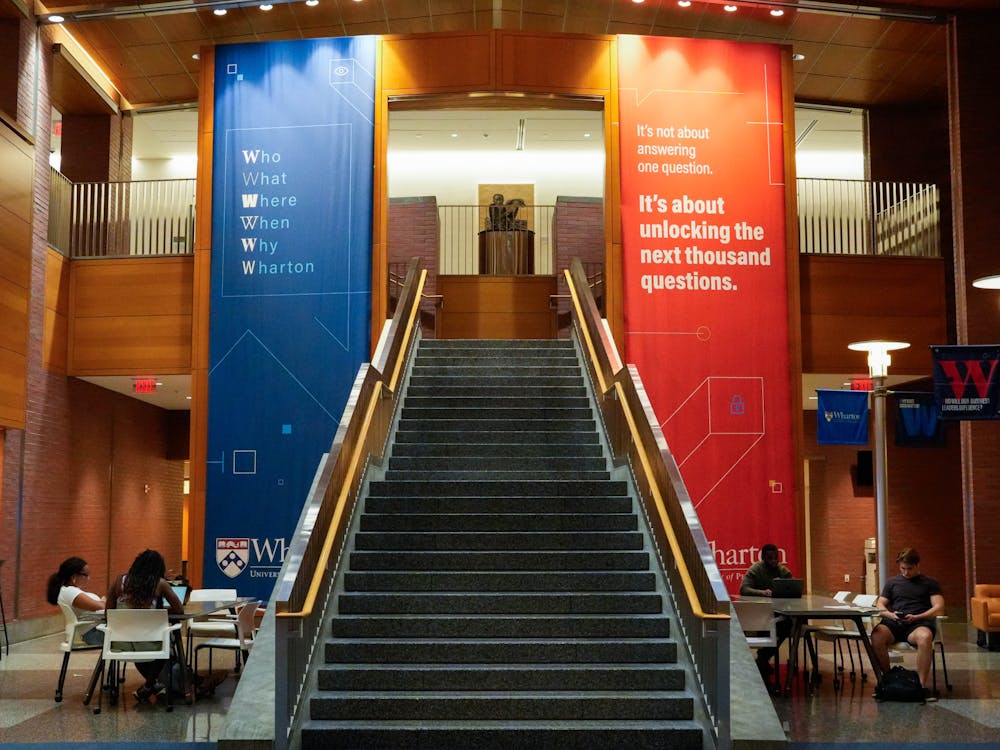
The number of corporations partnering with the Wharton School has decreased for three straight years.
Wharton’s collaboration initiative — officially titled “The Wharton Partnership” — is a collection of corporations and foundations that “contribute human capital and financial resources” to the school. According to an analysis by The Daily Pennsylvanian, fiscal year 2025 marked the lowest number of organizations partnered with the school over the last five years.
These partnerships, according to a Wharton webpage, help “fuel Wharton’s contributions to the world” and drive recruitment at the school.
“Wharton has long prioritized industry engagement, including the important role of corporate partnerships, and corporate philanthropy in support of our mission remains as strong as ever,” a Wharton spokesperson wrote to the DP.
Though the number of partnerships increased slightly from 146 in the fiscal year of 2022 to 156 in the fiscal year 2023, collaborations have steadily decreased since then. The fiscal year of 2025 marked a five-year low, with just over a hundred active partners.
Wharton organizes partnering organizations into four different categories: principals, who have contributed $100,000 or more, executive directors, who have contributed $50,000 to $99,999, directors, who have contributed $25,000 to $49,999, and associates, who have contributed between $10,000 and $24,999.
Principal donors in the fiscal year 2025 included Accenture, AKO Foundation, Alfred P. Sloan Foundation Inc., Arnold Ventures, Bank of America, Bill & Melinda Gates Foundation, Coinbase, Goldman Sachs, Golub Capital, Google, Kimley-Horn, Kirkland & Ellis LLP, Mars Inc., Monogram Health, Ripple, Rxsense LLC, Slalom, Sonata Software North America Inc., The Benjamin and Mary Siddons Measey Foundation, TIAA, Walmart Inc., and Warburg Pincus LLC.
RELATED:
Wharton reports higher median base salary, fewer employment offers for 2025 MBA graduates
College and Wharton senior Florence Onyiuke named 2026 Rhodes Scholar
The number of principal partnerships peaked in the fiscal year of 2020 with 40 principal partnerships, and decreased to roughly 30 between 2021 and 2024. In fiscal year 2025, there were only 22 principal partnerships.
Similarly, the number of executive director partnerships decreased from a high of 22 to a low of 10 in fiscal year 2025. The number of director partnerships increased slightly in fiscal year 2025, going from 18 in the previous fiscal year.
RELATED:
Wharton reports higher median base salary, fewer employment offers for 2025 MBA graduates
College and Wharton senior Florence Onyiuke named 2026 Rhodes Scholar
Senior reporter Arti Jain leads politics reporting and can be reached at jain@thedp.com. At Penn, she studies economics and political science. Follow her on X @arti_jain_.