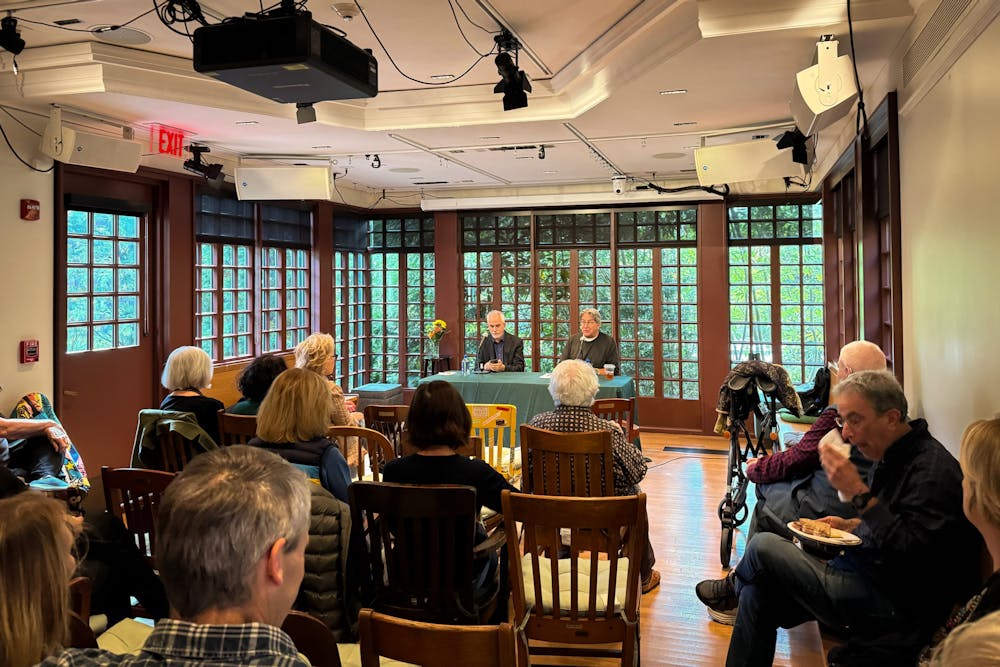
The Kelly Writers House hosted a conversation on the crisis of accountability journalism and challenges under highly polarized media space.
The Oct. 22 event was co-sponsored by Truth and Disinformation in the Writing Arts and the Povich Journalism Program and featured David Corn, an American political journalist and author. At the event, Corn conversed with English professor Dick Polman, who hosted.
Corn stated that journalism should be a means of holding people accountable and shared how these ideals were reflected in the investigation for Watergate, which was the event that ignited his interest in reporting.
“[Watergate] seemed to be a minor affair for most of the media, but these young reporters saw this as being key to holding the most powerful man accountable and responsible for his actions,” Corn said. “As a young kid, growing up outside of New York City, I thought that was the bee's knees.”
According to Corn, journalists now face many challenges in holding power figures accountable in the media landscape. He added that President and 1968 Wharton graduate's Trump’s $230 million to cover legal debts and crypto deals with foreign powers would have been more extensively covered in the past.
Corn also shared that fragmented news consumption in the status quo makes it harder for important information to reach people.
“I manage a newsroom of about 12 to 15 people from Mother Jones,” Corn said. "It does daily reporting, weekly reporting and long investigative features. We try to find stories that no one else is doing and try to report on that, and the bar to get people's attention for that is a lot higher.”
Corn added his opinions on disinformation in the media given the current political atmosphere. With easier access to media and content consumption, he explained, ideology polarization also increases.
RELATED:
Penn hosts alum, senior VP at iHeartMedia to kick off RealArts@Penn presentation series
Kelly Writers House hosts Nora Magid Mentorship Prize panel on careers in journalism and media
“If you don't want to engage, if you don't care about news, or what's going on with the presidential debate or something, it's very easy to not see it or hear it,” Corn said. “And people who are engaged have been more or less siloed into areas where they get the news that they want to get.”
Polman spoke to The Daily Pennsylvanian about his thoughts on political polarization in media space. He expressed concerns with the weaponization of disinformation and use of fear-mongering, citing media reports during the No Kings Rally.
“The administration was saying it's going to be all Marxists and domestic terrorists and they want violence,” Polman said. “And there was no violence: they were just average people, who were peaceful, and wouldn't even know what Marxism is.”
The event ended with a 15 minute Q&A session with the audience.
After the event, Corn spoke with Polman’s 'Political Journalism' writing seminar. He shared his past work with students and discussed how fragmented information on social media makes people less perceptive to journalism content.
“Stuff spreads like wildfire,” College sophomore Tareque Chowdhury said. “But sometimes that is bad, because you end up reading the headlines and not get the details.”
College sophomore Gabriel McGuire added that the visit was a “very eloquent overview of the state of journalism and state of news.”
“I came out of that feeling a bit more secure in my understanding of the situation in the field right now,” McGuire said to the DP.
RELATED:
Penn hosts alum, senior VP at iHeartMedia to kick off RealArts@Penn presentation series
Kelly Writers House hosts Nora Magid Mentorship Prize panel on careers in journalism and media
Staff reporter Cathy Sui covers federal policy and can be reached at sui@thedp.com. At Penn, she studies finance and statistics.