

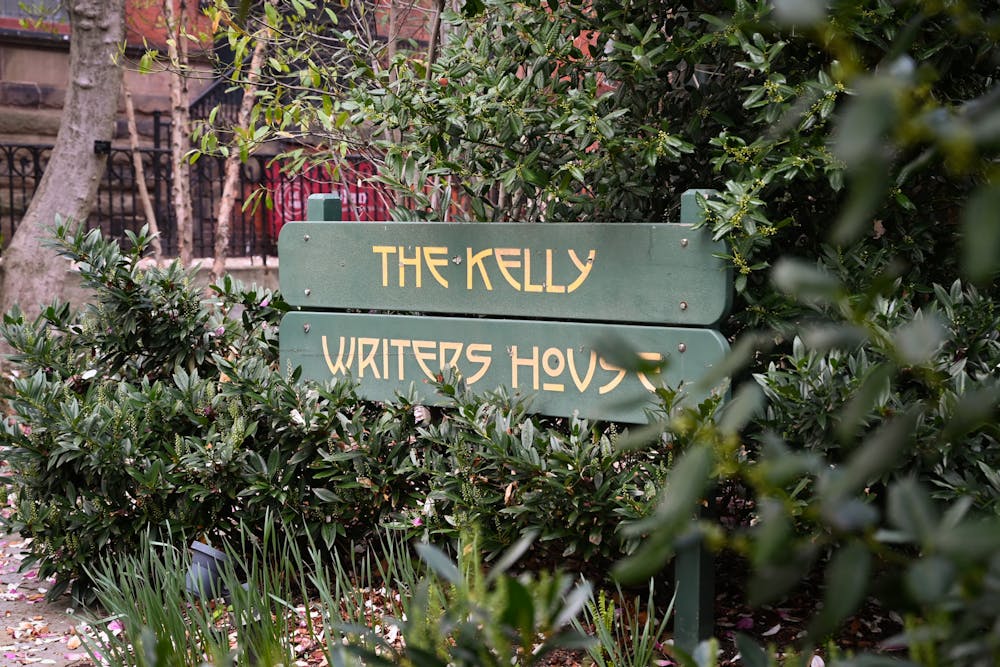
The Kelly Writers House hosted the Nora Magid Mentorship Prize’s annual panel featuring four College graduates who discussed their careers in journalism and media.
The Sept. 30 event was organized by 1979 College graduate Stephen Fried, a lecturer in the English Department and member of the award’s advisory committee. The panelists — all of whom were previous recipients of the award — spoke about their careers and offered advice to students who are interested in applying to positions in journalism.
Fried hosts the panel to mark the beginning of the application process each year, when Penn seniors interested in non-fiction writing can apply to win $5,000 to put towards “professional development.” Fried spoke to The Daily Pennsylvanian about how he raised funds for the prize alongside his peers when Nora Magid, his English professor at Penn, died in 1991.
“It’s an excuse to get Penn to pay attention to non-fiction writing,” Fried told the DP. “Kelly Writers House was originally created as a fiction, poetry place, and we tried to make sure that non-fiction was included — which it is now.”
He also emphasized the importance of prioritizing careers in journalism at Penn.
“The people who wanted to go into journalism had a different need for career advice than a lot of the other more academic people at Penn,” he said. “The easiest way to do that was to bring alumni back to give advice on what their career path had been in the magazine business. As we gave more people the prize, it started being a combination of the mentors and mentees.”
The panel began with 2012 College graduate Jessica Goodman — who was moderating the event — asking each panelist to share their first job experience. The panelists emphasized the importance of being “consistent” and utilizing the resources available to Penn students.
2005 College graduate Ashley Parker — a three-time Pulitzer Prize winner and staff writer at The Atlantic — explained that she sent emails for a whole summer to show her persistence and interests before getting her first internship. 2017 College graduate Luis Ferré-Sadurní — an immigration reporter at the New York Times — similarly expressed that it is useful to take advantage of a situation when the opportunity presents itself.
2022 College graduate Beatrice Forman explained that your first job does not always have to be “the right fit.”
“I felt like I was stuck in a spot where, on paper, everything sounded so good and so perfect, but in reality, I was so unhappy because I was doing too much,” Forman said in an interview with the DP.
Panelists also discussed what qualities are important to have in journalism.
“That kind of experience does not just thicken your skin early on, but improves the skills that you need to find information that's hard to find and to write stories that are hard to write,” 2011 College graduate Matt Flegenheimer said.
They noted that academic backgrounds in journalism can be very different.
“I think it's actually really important to major in something other than journalism,” Fried said during the event. "I was going to be a lawyer, but I took economics, and actually, economics taught me how to think about all the different things you need to pull together and tell a story."
The event also included a question-and-answer portion. During this time, Associate Dean for Undergraduate Studies at the Annenberg School for Communication Litty Paxton asked how the speakers think about the use of artificial intelligence in work.
Ferré-Sadurní shared his recent experiment using AI to synthesize and summarize long documents before dissecting the articles himself. However, he added that journalists “are not allowed to use AI for writing.”
“The moment you cross that line, it’s a slippery slope from there,” Ferré-Sadurní said.
Forman similarly cautioned people against using AI to generate work.
While reflecting on their time at Penn, the panelists emphasized their appreciation for the time they spent at various magazines and newspapers on campus, including the DP.
“I wrote about sports for the DP," Flegenheimer said. “It’s where a lot of the skills you need professionally can develop. Interviewing people and pulling stories together – all sorts of building blocks for a professional career.”
The panelists discussed how the organizations sparked their interest in journalism, helped them form long-term friendships, and pointed them to a clearer career path.
“34th Street and the DP gave me an opportunity,” Parker said. “18 years old — no one would let me write a 5000-word feature but 34th Street.” “When I went out into the real world, I felt prepared for my internshipsI still had a lot to learn, but I never felt so overwhelmingly intimidated because I’ve done this before.”


