

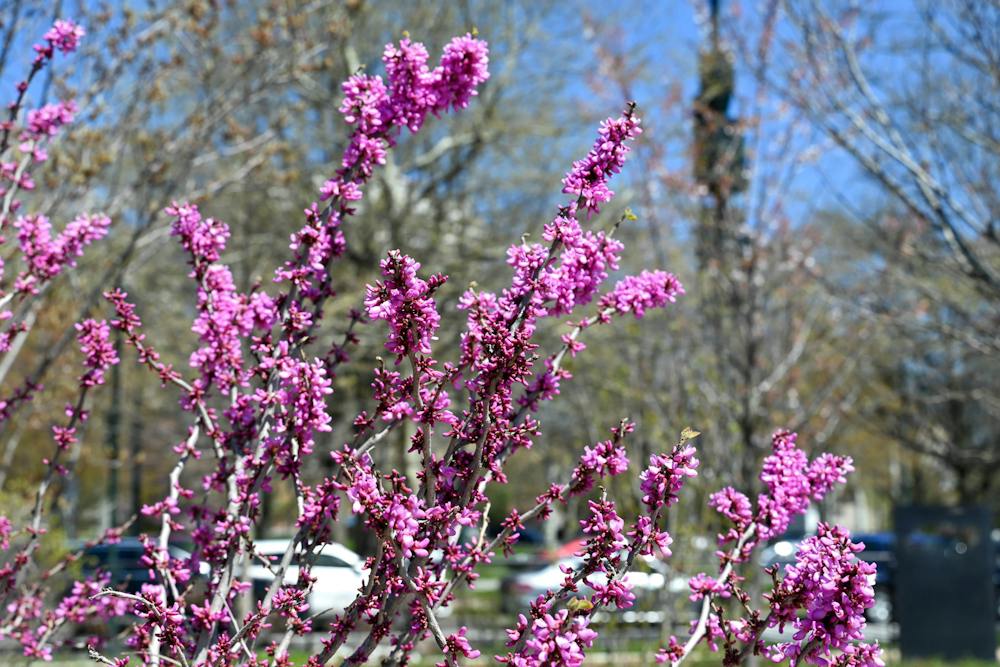
Penn professors, landscape designers, and photographers came together to tell the story of the University’s foliage — tracing how its trees and gardens have evolved over time.
The book, titled “Penn’s Sylvania” after the Latin word for woodland, centers around nearly fifty images of campus trees. The photos were collected and edited by Stuart Weitzman School of Design Dean Frederick Steiner and landscape architect Ignacio Bunster-Ossa, who graduated from the school with a master’s in 1979.
Bunster-Ossa wrote in a statement that the project started in the wake of the COVID-19 pandemic when he began documenting vegetation while strolling campus. He described a particular fondness for black and white photographs of Penn’s trees.
Feeling inspired, Bunster-Ossa showed his work to Steiner, who had shared his passion for Penn’s landscape since arriving as a graduate student in 1975.
Steiner said his interest only increased after his appointment as co-chair of Penn’s Design Review Committee, which advises on new architectural developments. Both Steiner and Bunster-Ossa studied under Ian McHarg, a landscape architect and city planner. Steiner wrote that connection served as a “natural foundation for the project.”
Several other professors and designers contributed to sections of the book. School of Design professor emeritus Witold Rybczynski, for example, introduced the story by detailing the concept of an “ivory tower.”
Rybczynski said in an interview that many early European schools, including Oxford University, were developed as separate towns away from cities. As Americans founded colleges in the New World, that sense of separation gave way to the idea of a campus — one designed to blend more naturally with its surroundings.
Penn’s location within a rapidly changing urban environment, Rybczynski added, made the evolution of its campus unique. Part of that story is the “astounding” variety of foliage, which evokes a “true forest” according to Bunster-Ossa.
RELATED:
Perry World House, Penn Climate host conference on global climate issues
Penn design students win national competition for ‘climate-resilient’ tennis court proposal
One prominent tree type is the tuliptree, which surrounds the Woodland Walk diagonal through Hill Square. The trees were first introduced as part of a project celebrating 125 years of women at Penn.
The book also explores Penn’s role as an officially accredited arboretum, a designation the University received in 2017. The status reflects Penn’s commitment to maintaining botanical collections for education and research, a role that Chloe Cerwinka examines alongside fellow chapter contributors Lara Roman, Theodore Eisenman, and Bob Lundgren.
Cerwinka, who has been a landscape planner at Penn since 2012, wrote in a statement that the book shows “what it takes to manage a campus arboretum in the middle of a larger city.”
“Penn’s campus landscape is the result of many people caring deeply about this place over generations and leaving a legacy that we can continue to build upon,” Cerwinka wrote. “When people think back on their time at Penn, I think they often remember the spaces between the buildings.”
She highlighted the importance of creating incremental changes with huge ecological impacts. For instance, Penn’s layered vegetation prioritizes visual beauty while allowing for the absorption of rainwater.
Bunster-Ossa wrote that he hopes the project inspires faculty, students, and visitors to “take note of the environment” more.
“A great campus is never finished,” Steiner wrote. “It is our responsibility to leave an even richer and more resilient landscape for those who come after us.”
RELATED:
Perry World House, Penn Climate host conference on global climate issues
Penn design students win national competition for ‘climate-resilient’ tennis court proposal
Staff reporter Sameeksha Panda covers science and health and can be reached at panda@thedp.com. At Penn, she studies chemistry.





