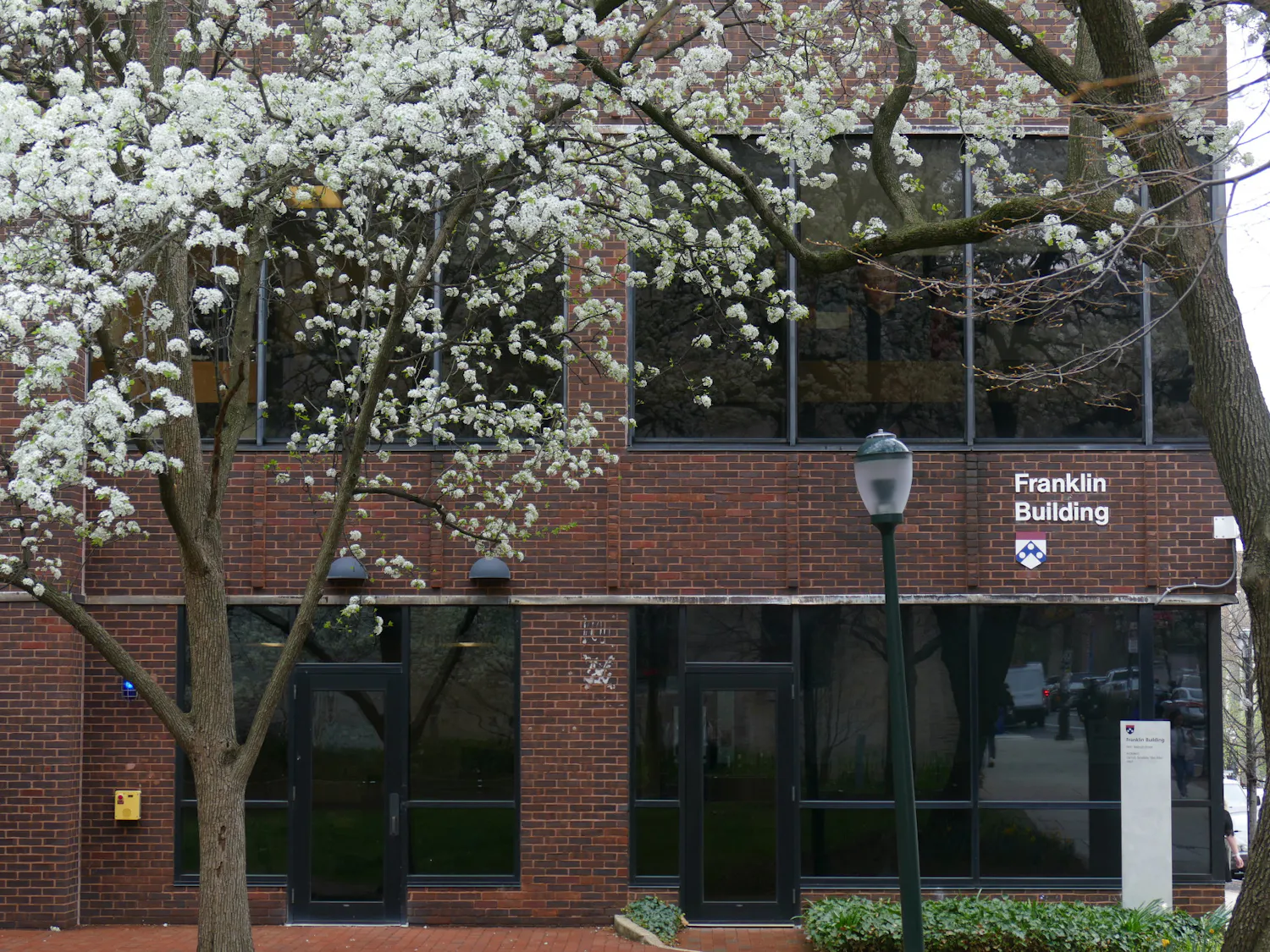
Attending a STEM lecture at Penn is a bleak experience. Entering the Chemistry Building, you’ll scour the hall for an acquaintance and shuffle to their row. As you unfold your seat and maneuver the tiny wooden desk onto your lap, you two will exchange (un)pleasantries, commiserating about the problem set questions you don’t understand and disparaging the professor for their boring teaching. Breathing in the cold, dry air, you’ll put up a good fight, trying to pay attention to an hour-long lecture on atomic orbitals. And once the clock strikes 1 p.m., you’ll let out a restrained sigh and vie for the nearest exit. That is, of course, after making sure to groan to your friend one last time about how little you’ve retained from the past hour.
College students are not known for their optimism. In fact, the Penn academic experience is often imbued with a constant sense of doom. Though we may be a busy student body, we will always make time to complain. This attitude is not unique to pre-meds or other STEM students, but it is special in that many of us treat complaining like a god-given right, as opposed to an indulgence.
Let me be clear: a STEM degree is not an easy undertaking. Classes move quickly, with dense material that students are expected to know in depth. The format of lectures is forced to emphasize content over conversation, making the learning experience isolating, with few opportunities to connect with others. Still, it’s the attitude toward these STEM classes that can truly make them unbearable. The academic experience of subjects like chemistry, biology, and neuroscience feels so far removed from the intellectual questions that guide them as disciplines, treating them instead like training modules.
As a pre-med, I can attest that we often see academics simultaneously as an end-all and a means to an end. The way we speak about a prerequisite class is limited strictly to its content’s acute benefit to us in the short-term future. The immediate reward for learning the material is a GPA boost, with poor performance being treated as a moral failure. Later on, it might be fruitful to know the information once it appears on the MCAT or if it shows up again in medical school. But the knowledge itself never seems to be intrinsically valuable outside of its connection to school, research, or volunteering. It’s as if we approach each tenet of medicine and science as a stepping stone, stripped of its intrigue and inherent worth, rid of the passion that any foundational scientist would have brought to their research. Instead, science education for pre-med students is framed like an intense-but-unavoidable suffering.
This environment feels opposite to much of the humanities, including the English class I’m taking this semester: “Witchcraft and the Occult.” In this class, full of both pre-meds and English majors, the exchange of ideas is lively. Discussion centers tangible questions and genuine curiosity, while maintaining a commitment to its original purpose of inspiring intellectual thought. Leaving class, I don’t feel the desire to jeer at the professor or feign boredom. Instead, I actively want to turn to a peer and revel in the day’s learning, excited to return for the next session. Ironically, an intimate space like this is what a STEM major might deem their semester’s “fun class,” in the context of their more rigorous science classes. But as budding scientists and medical professionals, why can’t our science coursework be just as fun too?
The world of medicine and science is ever in need of new minds and more attention, especially in the face of a physician shortage. It is a good thing that so many of us want to enter it. It is also an opportunity for upward mobility and a space of great prestige, hence its popularity among Penn students. But I’d also like to think that many of us are here because of a longstanding, childlike curiosity, developed while gazing out at space and inspecting the design of nature. Along with our time and effort, we must invest and reignite our passion into the sciences. What good are we really doing for the field by choosing it begrudgingly? STEM education needs to re-emphasize the human curiosity that has driven it thus far. In classes dealing with such paramount questions as the fundamental dynamics of the world, there must be more space to entertain curiosity for curiosity’s sake. And as a bonus, a chemistry lecture might not be so unbearable either.
DEW UDAGEDARA is a College sophomore studying neuroscience and English from Long Beach, Calif. His email is dewdunu@sas.upenn.edu.