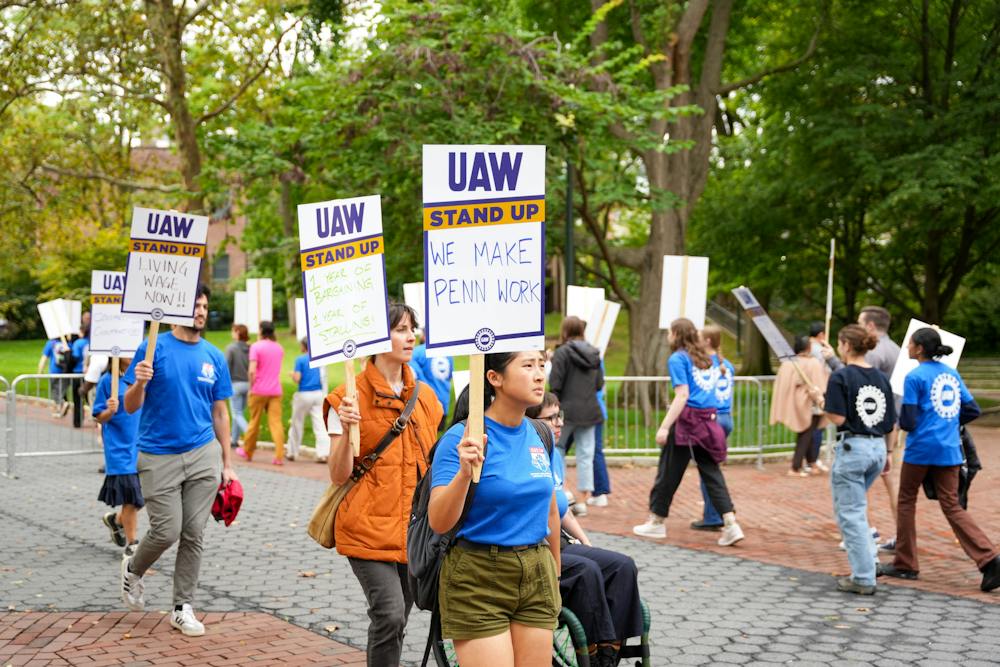
Penn’s graduate worker union formed a political committee to advocate for issues beyond the workplace earlier this month.
Graduate Employees Together — University of Pennsylvania announced its Community Action Program committee on Sept. 15, several months after ratifying its first contract with the University. The new committee will mobilize graduate workers around affordability, transportation, and labor policy while seeking to involve members in the 2026 midterm elections.
Kate Jones, a first-year M.D.-Ph.D. student in the Immunology Graduate Group, emphasized that the committee’s focus areas reflect the role of graduate workers outside Penn.
“As graduate workers, the issues we face extend beyond the workplace to the communities we live in,” Jones wrote in a statement. “We founded the CAP committee to amplify grad workers’ voices in Philadelphia City Hall, Harrisburg, and beyond.”
Among the committee’s priorities is a pledge to improve the commutes for those who use SEPTA or travel by bicycle.
These concerns come after a period of uncertainty over SEPTA’s finances. Facing a budget shortfall in 2025, the transit agency reduced its services before restoring them with money transferred from its capital budget.
Street safety has also remained a point of debate in Philadelphia. The city is continuing work under its Vision Zero program, which seeks to prevent traffic deaths through changes to street design and enforcement. Its current plans include upgrades to bicycle infrastructure and safety work on roads where serious crashes are concentrated.
The committee will also support efforts to strengthen protections for workers outside Penn, Jones wrote. One priority will be raising Pennsylvania’s minimum wage, which remains at the federal rate of $7.25 an hour. The state House of Representatives passed a bill in March that would gradually increase that rate to $15, but the proposal has not become law.
RELATED:
How GET-UP became Penn’s blueprint for labor organizing
Over 700 Penn research associates, postdocs sign petition supporting international workers
“We all saw the power of our collective action when Grad Workers won a strong contract in February,” a GET-UP social media post announcing the formation of the committee read.
Penn and GET-UP reached a tentative agreement on Feb. 16, shortly before the union — which represents more than 3,700 graduate workers — was scheduled to strike. Union members ratified the contract later that month, with 99% of participating voters indicating their support.
The agreement set the minimum annual stipend at $49,000 for its first year and established a $25 minimum hourly wage. It also expanded benefits and added new protections for graduate workers. GET-UP became United Auto Workers Local 5124 in March.
Jones added that the union’s new committee plans to engage its members in the 2026 midterms, with a “special focus on swinging key districts in a state Senate race that will impact policy across the state for the next two years.”
RELATED:
How GET-UP became Penn’s blueprint for labor organizing
Over 700 Penn research associates, postdocs sign petition supporting international workers
Senior reporter Ananya Karthik covers central administration and can be reached at karthik@thedp.com. At Penn, she studies communication and economics. Follow her on X @ananyaakarthik.