
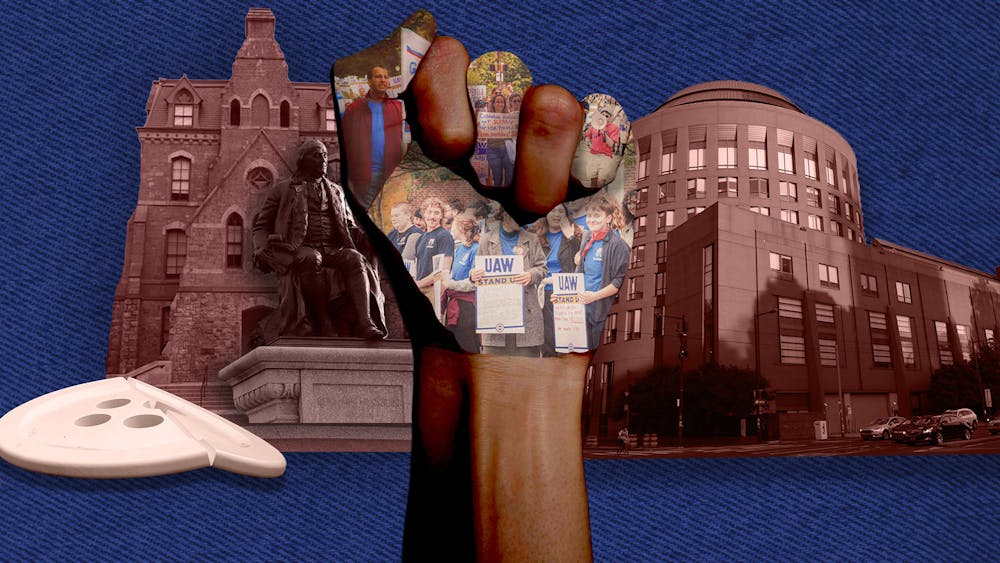
By the time Penn’s graduate worker union ratified its first contract, it had already helped redefine what labor organizing at the University could look like.
Over the course of nearly three years, the contract campaign led by Graduate Employees Together — University of Pennsylvania became a source of inspiration and support for labor organizing efforts across campus. The Daily Pennsylvanian spoke with unions and other groups at Penn to learn how GET-UP has shaped their work.
Penn and GET-UP reached a tentative agreement on Feb. 16, averting an indefinite strike by more than 3,700 graduate workers. The agreement was ratified as the union’s first contract, including a 21% increase in minimum stipends, healthcare provisions, childcare support, protections for international workers, and anti-discrimination measures.
Research Associates and Postdocs United at Penn — which reached some tentative agreements with the University this May — told the DP that GET-UP’s victory directly informed its own bargaining efforts.
“GET-UP’s massive and very impressive win has really set a great model for us, and has assisted our bargaining efforts in certain ways thus far,” postdoctoral researcher in physiology and RAPUP bargaining committee member Geordan Stukey said in a March interview with the DP. “RAPUP has a lot of lessons to learn in looking at GET-UP’s campaign.”
A request for comment was left with a University spokesperson.
The protections RAPUP secured included ones against workplace harassment and discrimination during bargaining sessions in May, an outcome members called “a huge win.”
Stukey said RAPUP has been able to reference language Penn had already agreed to during negotiations with GET-UP, adding that the organization “has really influenced our ability to bargain.”
RELATED:
Nearly 25 years after graduate workers began organizing at Penn, GET-UP is making history
Over 700 Penn research associates, postdocs sign petition supporting international workers
Postdoctoral bioengineering fellow Dimpi Mukhopadhyay — who is also a RAPUP bargaining committee member — told the DP that the union “often” has GET-UP representatives with them during bargaining sessions.
“We learn from their process and what they have been through,” Mukhopadhyay said.
In October 2023, roughly 300 graduate workers attempted to enter College Hall to deliver a letter to then-Penn President Liz Magill and Provost John Jackson Jr. advocating for improved working conditions and stronger protections for workers.
Nearly three years later, RAPUP members gathered outside the same building to deliver a petition urging Jackson to negotiate over protections for international researchers and appointment lengths.
2026 School of Arts and Sciences Ph.D. graduate and GET-UP bargaining committee member Sam Schirvar wrote in a statement to the DP that the lessons from the union’s campaign are generally applicable to worker activism.
“There are no shortcuts to good labor organizing,” Schirvar wrote. “No mass email or social media post can replace the importance of one-to-one conversations among coworkers about the workplace issues that matter to them. And to move a large workplace, you must have engaged leaders present in every part of it. This approach to organizing takes a lot of time, but it is very worthwhile.”
Penn’s chapter of the American Association of University Professors wrote to the DP that collaboration between graduate workers and faculty members also played a role in GET-UP’s campaign.
“AAUP-Penn fully supports the principle of workplace democracy and the protected right of workers to organize on our campus and across higher education, and we are proud to have been a part of GET-UP’s efforts,” the organization wrote.
According to AAUP-Penn, when “the university administration launched anti-union campaigns, attempting to turn faculty against graduate workers,” faculty members organized a pledge not to break the strike and guided colleagues during the campaign, which “helped to strengthen solidarity between faculty and graduate students.”
“We are still in close collaboration with GET-UP as they continue to work to protect graduate workers, which makes Penn a better place for all of us to teach, research, and learn,” the organization added. “Unions are essential institutions that provide a democratic voice at work and the capacity to win real change for the better, and AAUP-Penn stands with GET-UP and all unions and unionization efforts at Penn.”
Schirvar added that GET-UP plans to remain involved in labor organizing efforts beyond its own contract campaign.
“Organizing doesn’t stop with the contract: Grad Workers will continue to demonstrate our power in order to enforce this contract and negotiate another one in two years,” Schirvar wrote to the DP. “Graduate Workers are proud of what we have accomplished together and we are ready to stand by other workers at Penn as they form unions and negotiate new contracts.”
Senior reporter Ananya Karthik covers central administration and can be reached at karthik@thedp.com. At Penn, she studies communication and economics. Follow her on X @ananyaakarthik.


