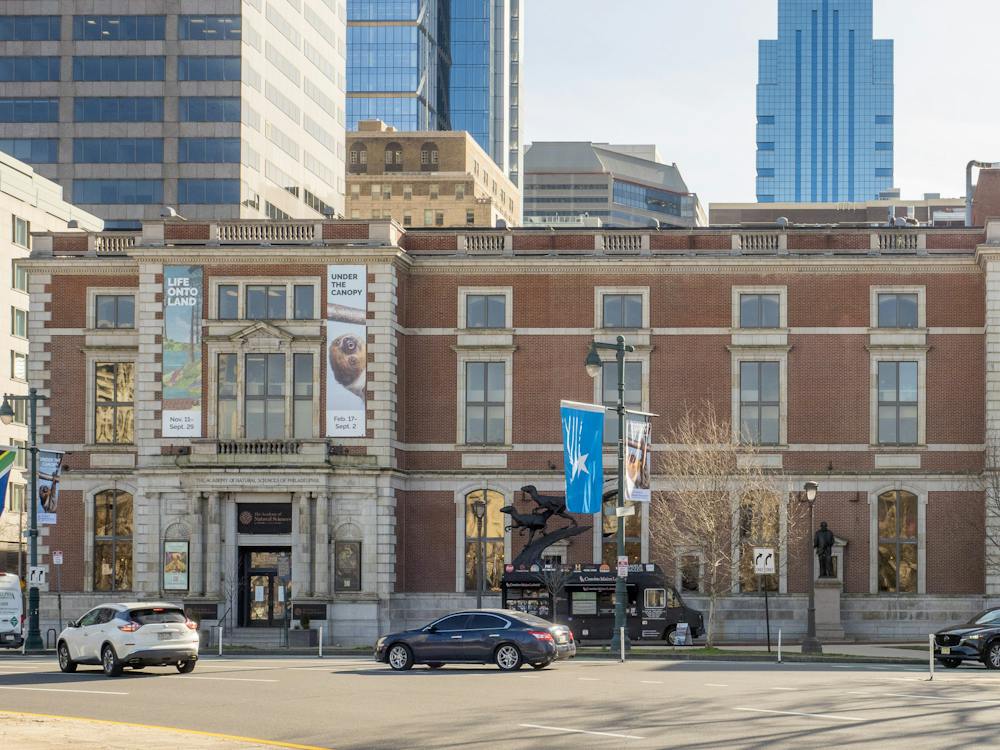
College sophomore Tais Millan fondly recalls digging for fossils, watching hawks perform tricks, and wandering among butterflies at the Academy of Natural Sciences of Drexel University.
The Academy, she explained, was an opportunity to explore science hands-on with her family — on one occasion, she even went home with a mammoth tooth. Citing financial pressures, the nearly 200-year-old Philadelphia institution closed its doors for good on Sunday.
“It was important as a community museum where kids could learn about science and experience it for the first time and get involved and interact with it,” Millan said in an interview. “I don’t think we can replace what the Academy was for kids in Philly.”
For Millan, a unique feature of the museum was the chance to stand just feet from specimens impossible to encounter at a zoo or in the wild — like the “towering” Tyrannosaurus in the dinosaur exhibit.
Veterinary School professor emeritus Peter Dodson helped establish and design the dinosaur hall at the Academy, which opened 40 years ago in the fall of 1986.
Peter Dodson, a professor emeritus at the School of Veterinary Medicine, helped establish and design the Academy’s dinosaur hall in the fall of 1986.
At the time, Dodson had collected fossils from expeditions in Montana and was looking for a place to maintain the specimens. Today, the Academy — which became affiliated with Drexel University in 2011 — is home to “something on the order of 2500” specimens excavated by Dodson.
In an interview, he said he had hoped “children for generations would be able to visit the Academy” and see the Avaceratops, the specimen that brought on the creation of the museum’s dinosaur hall.
RELATED:
Penn hosts lecture on heritage preservation, economic challenges
Penn, local community college launch free entrepreneurial academy for West Phila. business owners
Executive Director of the New Mexico Museum of Natural History & Science Anthony Fiorillo, who studied under Dodson as a doctoral student, said the exhibit was “incredibly important” for children, who often encounter dinosaurs first as toys.
“At some point, that child starts to ask, ‘Where are these animals now? And that is their introduction to extinction,” he said, adding that “dinosaurs are the gateway by which many children get introduced to the scientific process.”
When he was a graduate student, the Academy served as a foundation for Fiorillo’s research.
“When I was considering Penn for a Ph.D. program to work with Peter Dodson, Peter took me to the Academy,” he recalled. “They were renovating their dinosaur hall, and so there was a certain excitement going on.”
That excitement, Fiorillo said, “helped seal the deal” in his decision to attend Penn.
The museum’s “irreplaceable” collections present an “incalculable” value to science, according to Drexel professor emeritus of biodiversity, earth and environmental science Edward Daeschler. Daeschler — who also previously worked with Dodson — began his time at the Academy in 1988 as a vertebrate curator.
While the Academy plans to remain open for research, its museum building has been proposed for redevelopment into commercial real estate. Daeschler worries about where the collections will be moved.
“The alternative to keeping things in Philadelphia accessible, properly housed, is to disperse the collections,” he said. “The academy is an entity. It has a history, and all of these things are intertwined. So that whole is much more important than the sum of the parts.”
Fiorillo added that there is “so much serendipity involved with vast collections” that can lead to incredible discoveries.
In his case, he stumbled upon the last specimens ever collected by a well-known paleontologist when he opened a cabinet door and found the fossils wrapped in 1980s newspaper. His discovery went on to lead to several scholarly publications.
Dodson said he had hoped Penn would step in to assist the museum.
“Natural history and systematic biology is a very important academic discipline, and having a museum that supports those disciplines in all its aspects would make Penn a more complete university,” he said. “This is far too important an institution to let disappear, and it would speak poorly if Penn sits on the sidelines.”
This past week, Drexel declined support from the William Penn Foundation, which offered to fund the museum's operating costs for at least a year. Next month, Philadelphia City Council members plan to convene to protect the Academy’s property.
Millan was at the Academy when it closed last Sunday.
“It was devastating, hearing them come on the intercom and saying ‘we’re closing in 10 minutes, find the nearest staff member and thank them,’” she said. “Everyone started clapping. People were crying, and the kids were just still so amazed and happy.”
“Closing the current Parkway museum is, therefore, a difficult decision taken to concentrate resources on the Academy’s enduring scientific assets and research,” the Academy’s Sept. 1 statement read.
The building “will continue to house the Academy’s collections, research activities and exhibit materials” while leadership “considers potential pathways forward,” a Drexel spokesperson wrote in a statement. “Access to and use of the Academy’s collections will not be affected by the museum’s closure.”
RELATED:
Penn hosts lecture on heritage preservation, economic challenges
Penn, local community college launch free entrepreneurial academy for West Phila. business owners
Staff reporter Mariacristina Calcagno covers science and health and can be reached at calcagno@thedp.com. At Penn, she studies biochemistry and economics.