

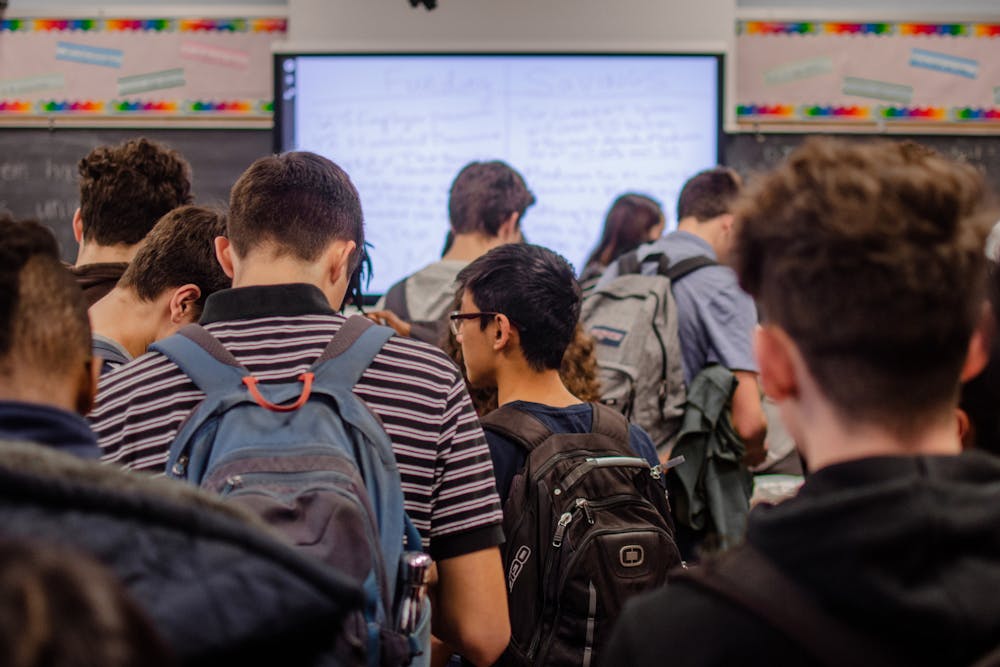
Penn’s College of Arts and Sciences introduced a new pilot curriculum for first-year students this fall, aiming to provide a broad liberal arts education through an integrated set of courses.
The new program, titled College Foundations, consists of four classes that fulfill up to six general education requirements — a writing seminar, a first-year seminar, and two courses known as “Kite” and “Key” that focus on the humanities and sciences, respectively. The Daily Pennsylvanian spoke to College first years enrolled in the program about their experiences with its organization and content.
In an interview with the DP when the program was announced, College Dean Peter Struck said that the program is meant to provide a “broad introduction to what the arts and sciences curriculum is all about.”
According to Struck, the pilot program marks the beginning of a three-year process, with this year serving as “a year of vetting.” In the spring of 2026, SAS faculty will vote before a period of “implementation to roll out a broader curriculum” next fall.
Multiple students said that the pilot has encouraged them to explore new disciplines, even if the coursework is demanding.
College first year Shannon Katzenberger described the program as a “cool way" to complete general education requirements, adding that her “Key” course has felt widely applicable.
“I think we’re learning stuff that’s actually applicable in everyday life,” Katzenberger said in an interview with the DP. “We’ve been learning basic Python, which is never something that I thought I would learn.”
College first year Mark Doraszelski — who is also taking the “Key” class this semester — said that his choice to enroll in the program “came down to the number of foundations and sectors completed from the get-go.”
“I’d rather finish the general education requirements and be able to afford to take whatever classes I want without having to worry about them fulfilling a specific foundation or sector,” he said.
However, College first year Gabri Kurtzer-Ellenbogen said that the program’s restrictions have made her question her continued involvement in the program.
“I spoke to my advisor and to a professor about potentially dropping the Foundations program next semester — not even because of ‘Kite,’ but more because of the restrictions it places on writing seminars,” Kurtzer-Ellenbogen said.
Students in the program who enroll in a writing seminar during the spring semester can choose from four options — two of which are sections of Craft of Prose, offering “significant amount of individualized attention and guidance” and smaller class sizes.
Doraszelski added that the program may not be beneficial to students who already know what they want to study.
“Some people are choosing not to take the ‘Key’ seminar if they already know they’re going to be a STEM-based major, because they think those classes are going to get fulfilled with their major requirements,” he said.
Other students said that the curriculum has pushed them to explore unfamiliar subjects.
“I’ve never heard of coding before,” College first year Max Torres told the DP. “It’s difficult, but really fun because [our professor] makes a problem fun. I definitely see the usefulness of coding now.”
Khalifa Alkhoori, who is also a first year in the College, said that “Kite” courses “broadened [his] knowledge base.”
“I actually wanted to learn different things,” Alkhoori said. “I didn’t want to just learn about a war that happened, or just about psychology, or just about philosophy, or just about ideology.”
Some students said that College Foundations has helped them connect with their classmates outside of their usual academic circles.
“It definitely helped me socially,” Torres said. “I’ve made many friends that I probably wouldn’t have made outside of it.”
College first year Candie Dong also characterized the community as “amazing.”
“In my ‘Kite’ class, even just saying something simple about my culture and how it relates to me really broadens other people’s perspectives,” Dong said. “When it comes to discussions, everyone will try to build upon each other’s ideas.”
Alkhoori said that while he does not yet know what he will study, he feels confident that what he is learning is helping him "understand different perspectives," people, and "ideologies."
“It’s making me into a more complete person,” Alkhoori said.
According to College first year Gweneth Wiest, College Foundations is “a space where failure is encouraged, which is rare in many classes.”
“That atmosphere makes it easier to take risks, ask questions, and actually understand the material instead of just memorizing it for a test,” Wiest wrote in a statement to the DP.
Students also praised the program’s flexibility and the general feeling of support from instructors.
“At least once a week, [our] professor Masao Sako has conversations with us — ‘What are you thinking of the class; what can I do to make it better?’” College first year Will Migas said of his “Key” course. “He’ll shorten the lab if we say it’s too long.”
He added that the program “offers a lot of support — career fairs [and] one-on-one counseling — to help us get through.”
Still, students noted areas for improvement.
College first year Jace Lee said that the “Key” course “teaches too much math” and “should teach more concepts.” He described the class as a “little too technical” for beginners.
Dong said that “the number of readings could definitely improve” while discussing the course book that each “Kite” student receives.
“I come into class and I know what I’ve read, but I don’t really have my own interpretation or understanding of what the reading actually means,” Alkhoori said.
Doraszelski said that lecture attendance “has been slipping” and that “lectures just haven’t really tied in so much with the labs.”
Other students viewed the challenges as part of the natural growth of the pilot program.
“It started out a little difficult, but it’s gotten better with the suggestions that we’ve offered,” Migas said. “Despite it being difficult at points, it’s very much graded on how willing you are to want to learn.”
Some students also criticized the lack of information provided to students prior to committing to the program.
“I had no idea what it was going to be going into it,” Doraszelski said. “They’re trying to sell it, but they should just say what it was. I wish the communication was more clear, because no one knew what it was.”
Alkhoori also said that the program “wasn’t really anything like [it was] described,” emphasizing the difference between the email that announced the pilot program and the eventual class.
“You're given the choice whether you want to or don’t want to,” Alkhoori said. “They didn’t really present what we’re actually doing, so that’s why I picked it.”
Most students were divided on whether College Foundations should expand to all first years. Katzenberger said she would “absolutely” recommend it, calling it “a great way to gain a general foundation in liberal arts.”
Lee, though, said that the expansion “would do more harm than good,” noting that the program only worked well for students who “don’t actually know what they want to do.”
“I think the whole point is that it’s general education — it could apply to someone who wants to be a Spanish major, and equally to someone who wants to do astrophysics,” Doraszelski said.
College first year Sahithi Konatham also said that the program has been central to her Penn experience.
“I don’t think that it should be mandatory, but I do think that it should be more openly available,” Konatham said. “I can’t imagine my first-year experience any other way.”
Senior reporter Arti Jain leads politics reporting and can be reached at jain@thedp.com. At Penn, she studies economics and political science. Follow her on X @arti_jain_.
Senior reporter Ananya Karthik covers central administration and can be reached at karthik@thedp.com. At Penn, she studies communication and economics. Follow her on X @ananyaakarthik.
Staff reporter Anvi Sehgal can be reached at sehgal@thedp.com. At Penn, she studies philosophy, politics, and economics. Follow her on X @anvi_sehgal.


