

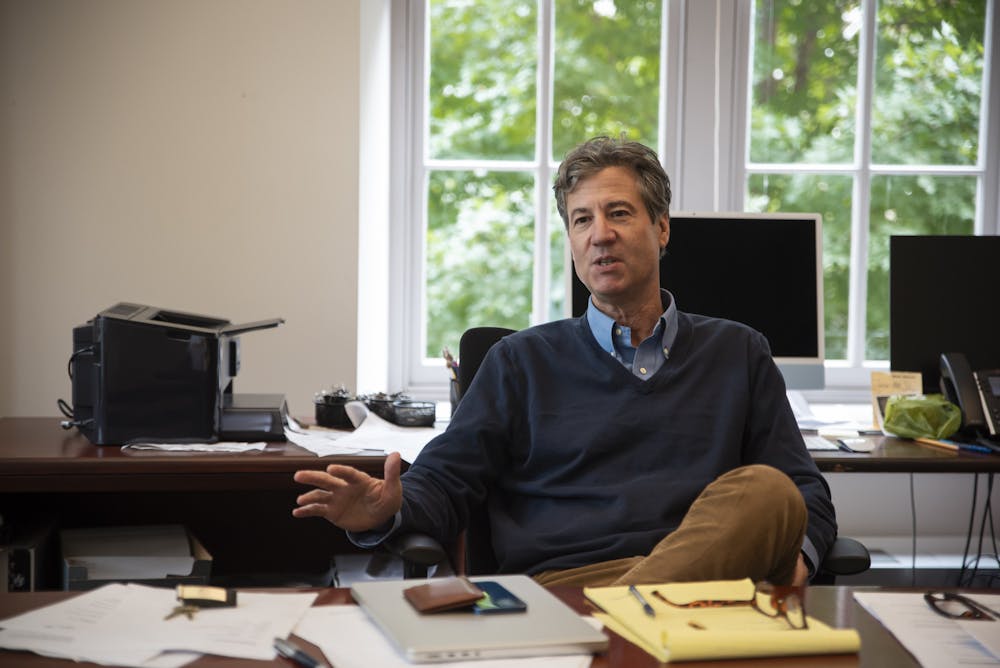
College of Arts and Sciences Dean Peter Struck sat down with The Daily Pennsylvanian on Monday to discuss the school’s new undergraduate curriculum.
College faculty voted to approve the revised framework — which includes the new College Foundations program, simplified general education requirements, and expanded elective options — last month. During the interview, Struck explained the motivations behind the curriculum changes and expanded on the school’s initial announcement.
“We really want to make sure that curiosity is the key driver for people’s educations,” Struck said. “We want to make sure that what we produce is something that is going to build and elevate our community of inquiry.”
The process of revising the College curriculum — which was last revamped in 1987 — started about four years ago. According to Struck, the Committee on Undergraduate Education recommended that the College “overhaul the curriculum as a whole” three years ago.
After deciding to change the curriculum, the school designated the 2024-25 academic year as a “year of design” and 2025-26 as a “year of peer review.”
“We took the draft plan around to all of the constituencies — departments, different instructional teams, people at all levels of faculty, staff, students — asking for input,” Struck said. “This is an iterative process, particularly this year, but that’s been true all the way through, and honestly, it’s going to remain an iterative process.”
The new curriculum will adopt the seminar-style College Foundations program, which the school first piloted this year. The program includes two new courses: Kite, which focuses on the humanities and qualitative social sciences, and Key, which covers natural sciences and quantitative social science disciplines.
Both Kite and Key consist weekly of two 90-minute classes and a three-hour laboratory session led by a teaching assistant. Currently, both Kite sections are capped at 15 students. Key has a larger capacity of 60 students for its 90-minute class, but still maintains a 15-person cap for its lab sections.
RELATED:
College faculty vote to approve new undergraduate curriculum for Class of 2031
Penn faculty discuss College Foundations pilot program, ‘new era’ for general education curriculum
Struck said that Kite and Key were especially inspired by the first-year seminar program, which has existed at the school since the 1970s.
“Our faculty and our students loved that seminar-based learning, broadly pitched across for people without any prerequisites to learn about a new field,” Struck said. “Building from that, we expanded the idea that we’d have a seminar-based first year.”
Struck explained that the College designed Kite and Key to ensure “students understood the breadth of possibilities that were in front of them before it was too late.” The courses, he said, aim to address the recent “funneling” of students toward “a very narrow range of majors.”
According to Struck, course feedback for Kite after the fall semester was “extraordinarily positive.” He highlighted that three of the four Kite sections offered last fall earned “perfect 4.0 ratings,” a feat he described as “unheard of with brand new courses.”
Ratings for Key were also “very high” — averaging above 3.5 — which Struck said is “not characteristic of science and technical fields.”
Last October, several students enrolled in Kite and Key expressed initial mixed reactions to the pilot program in conversations with the DP.
Struck acknowledged that certain majors are “highly structured,” “hierarchical,” and require a significant amount of coursework in a student’s first year that would not be possible alongside the four courses required by the College Foundations program.
“We learned during the year of peer review that this was actually not going to work for a subset of our students who have these very intensive, front-loaded majors that they want to pursue,” Struck said. “So we’re expanding the possibility for doing these requirements over the course of the first couple of years.”
He added, “We learned that some pieces are working better than others, and we’ll make adjustments as we go forward.”
Ahead of the new curriculum’s launch in fall 2027, Struck said the school plans to expand the College Foundations pilot program to over 300 students in the 2026-27 year.
Struck said that Kite and Key will initially be “additive” to the College’s existing course offerings. As the old curriculum is phased out, departments can choose how to allocate their “new capacities” — including by expanding participation in Kite and Key.
The new curriculum also revises the distribution of the College’s general education requirements, which Struck said is designed to encourage “students’ curiosity.”
College students will take courses in three broad categories — arts and humanities, social sciences, and natural sciences — completing at least 12 courses in one division of their choosing, five in a second, and three in the third.
Struck explained that College students have “extremely positive” views of their major but more negative opinions on the current general education requirements. He cited a report from the Student Committee on Undergraduate Education, which raised concerns that students view the requirements “as being more of an impediment to their learning than an enabler.”
“The old system, I think, was too complex,” Struck said. “It allowed people to put off meaningful exploration until too late in their career to make a difference. The new system is meant to be much more streamlined and build in that exploration more intentionally in the beginning.”
Struck acknowledged some faculty concerns on how the broader distribution requirements would affect smaller departments, which currently may incentivize enrollment by offering courses that fulfill specific foundations and sectors.
“We’re going to introduce you to all the possibilities in all these departments,” he said. “We are very confident — and we’ve been able to share that confidence to all of our smaller humanities departments — that this is going to be a better way forward.”
The Annenberg School for Communication and the Stuart Weitzman School of Design, which have longstanding relationships with the College, will offer courses that fit into the new curriculum. Courses offered by Penn’s three other undergraduate schools, however, will not fulfill the general education requirements.
Struck clarified that there will still be “expanded possibilities” for double majors, dual degrees, and submatriculation because students will be able to take between 11 and 13 elective courses.
The revised curriculum also outlines changes to the school’s language requirement. Currently, students must take between zero and four courses in a foreign language based on their proficiency. As a result, Struck said, about half of College students are not required to take any foreign language courses during their time at Penn.
“We really wanted students to have an experience of studying in a language other than English at an advanced level in their college experience,” Struck said.
Under the new framework, the language requirement will range from zero to two courses. The updated threshold to opt out of the requirement will be higher, reserved for students “who are already fluent and operating at a very high level.”
Students will also be required to take a course in a new “perspectives and difference” category, which Struck described as a “reminder from our faculty in particular that this world that we’re moving into is not getting any less complex than it ever was.”
“We should have in our curriculum a purposeful moment to really explore how cultural perspectives shape people’s ways of looking at the world,” Struck said. “This is going to be even more important for our students going forward.”
RELATED:
College faculty vote to approve new undergraduate curriculum for Class of 2031
Penn faculty discuss College Foundations pilot program, ‘new era’ for general education curriculum
Senior reporter James Wan leads administration reporting and can be reached at wan@thedp.com. At Penn, he studies communication and computer science. Follow him on X @JamesWan__.


