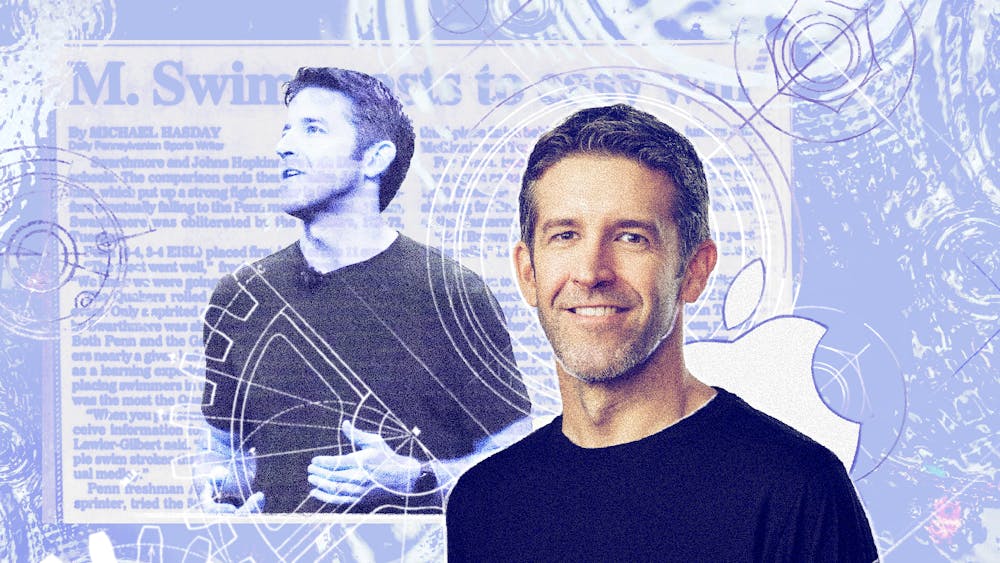
Decades before 1997 Engineering graduate John Ternus was named Apple’s next CEO, he was a student and varsity swimmer at Penn — known to classmates for his discipline, calm temperament, and easy-going humor.
Apple announced earlier this month that Ternus, currently the company’s senior vice president of hardware engineering, will succeed CEO Tim Cook in September. As he prepares to take the helm of one of the world’s largest corporations, Ternus’ former classmates, teammates, and mentors say the traits that defined his career have been visible for decades.
1997 Penn Engineering graduate Paul Feehery — Ternus’ friend, roommate, colleague, and senior project partner — said Ternus stood out for his consistent approach to work.
“He was always just a very low-key guy,” Feehery told The Daily Pennsylvanian. “He’s very driven academically, very deliberate, and never, never made rash decisions.”
Feehery said he and Ternus became friends after working together in mechanical engineering classes and study groups. They went on to live together in an off-campus house near 39th Street and worked together on their senior project.
According to Feehery, the two maintain a close friendship to this day.
Katharine Gilbert — who coached Penn men’s and women’s swimming and diving from 1983 to 1999 at Penn — said she first got to know Ternus while recruiting high school athletes for men’s swimming and diving.
“He was very polite and very interesting to me on the phone,” Gilbert recalled. “He was himself, but he was very likable."
RELATED:
Penn alum John Ternus named next Apple CEO
Goldman Sachs CEO David Solomon to speak at Wharton MBA graduation ceremony
1997 Wharton graduate Robert Brown — who competed alongside Ternus during their first two years at Penn — echoed a similar sentiment.
Brown explained that he and Ternus were part of a first-year class of around a dozen swimmers who trained together daily.
“I remember he was confident, in a good way, and friendly,” Brown told the DP. “He smiled a lot and I never saw him in a bad mood.”
Brown said Ternus competed in backstroke and sprint freestyle events, adding that the team’s practice schedule required constant discipline. During winter break, for example, swimmers traveled to Florida for intensive training twice a day before returning to dual meets and conference season.
“You really had to push yourself about as hard as you could every day and be consistent,” Brown said.
In 1994, the DP reported that Ternus won both the 50-meter freestyle and 200-meter individual medley at a men’s swimming meet.
Still, those who knew Ternus were quick to clarify he was never defined by only one aspect of his life at Penn.
According to Feehery, Ternus would later become involved with a recreational ultimate frisbee team and had multiple groups of friends across campus.
“He was always a good friend,” Feehery said. “John had a lot of fun in college but always knew when to draw the line.”
“We went skiing in the Poconos at one point,” he added. “He grew up on the West Coast. So I think he was probably not so impressed by the icy slopes in the Poconos.”
Gilbert said Ternus had an unexpected interest in music. She recalled being amused when Ternus noticed her Frank Sinatra CD.
“I remember it was John Ternus who said to me, ‘Coach, do you like that CD?’ I said, ‘Oh, I really like it!’ He said, ‘So do I!’ and it made me laugh,” Gilbert said.
As an Engineering student, Ternus’ most prominent undergraduate work took the form of his senior project — the Head Actuated Nutritional Device Feeder, or H.A.N.D. Feeder. He worked alongside Feehery, 1997 Engineering graduate Travis Heinrichs, 1998 Engineering Ph.D. graduate Venkat Krovi, and current Penn Engineering Dean Vijay Kumar.
The device aimed to help users feed themselves by translating head and neck movements into the motion of a spoon. The group’s final paper described the prototype as a “telethesis,” or a passive articulated mechanism coupled to the user’s body part.
Feehery said the project stemmed from earlier work on a foot-controlled feeding device. The team wanted to design something that could be used by people with quadriplegia, who typically retain head movement.
“One of the big things was that they wanted something passive,” Feehery said. “It would give them more autonomy and more freedom.”
The design required the team to translate head movements into precise mechanical control without motors or electronics.
“There’s motions you’re trying to capture, and there’s motions you’re trying to isolate, and to do that is pretty difficult with a fully mechanical, non-electrical device,” Heinrichs said.
“We built lots of prototypes,” he continued. “We actually even used Lego sets to do our initial prototypes and learned quite a bit from those.”
According to Krovi — who worked with the team as a graduate student in Penn’s GRASP Lab — the project would go on to win the Procter & Gamble Best Paper Award at a robotics conference.
“That group was really motivated,” Krovi said. “They were an undergrad group, but the work that they had done was something that could be reported and get the best paper award in an international conference.”
Kumar — who worked with Ternus as a faculty member at the time — reflected on the project in a statement to the DP.
“John’s journey from Penn Engineering to leading one of the world’s most influential technology companies is a powerful reflection of the kind of leadership, curiosity, and technical excellence we strive to cultivate in our students,” he wrote.
Feehery said each teammate contributed different strengths. He remembered focusing on robotics math, Heinrichs working on detailed design, and Ternus focusing on modeling the device to a human through Jack — the human simulation program used in the project.
“I think we all brought our own different things to it, but then we worked together to build it,” Feehery said.
Ternus, who addressed Penn Engineering undergraduates at the school’s 2024 Commencement, described a mistake he made while working on the project.
“I nearly destroyed Penn’s first, and at the time only, CNC milling machine,” Ternus said.
Feehery remembered the incident as part of the team’s experience learning to use new equipment.
“John was the one that hit the button and the machine. It was just all wrong,” he said. “The machine had just crashed into the table and did tons of damage to it.”
“The guy who ran the machine shop there was a great guy,” Heinrichs said. “He nicknamed John ‘Crash.’ That name stuck for a long time, and that’s a fond memory of that time.”
For Feehery, the story captured Ternus’ willingness to learn by doing.
“John just really developed an interest in learning this thing,” Feehery said.
Ternus emphasized the importance of curiosity and persistence during his 2024 Commencement address.
“The best engineers don’t just solve problems — they stay curious about the world around them,” he told the crowd. “The care you put into your work matters.”
Ternus carried a similar mindset into Apple when he joined the company’s product design team in 2001. He became a vice president of hardware engineering in 2013 and joined the executive team in 2021 as senior vice president of hardware engineering.
The company credits him with work across its iPad, AirPods, iPhone, Mac, and Apple Watch products, alongside efforts to reduce the company’s carbon footprint.
A request for comment was left with Apple.
Those who knew him at Penn said the most recognizable throughline in Ternus’ career was his temperament.
Feehery said Ternus has remained calm, careful, and steady over the years — even as his responsibilities at Apple grew.
“He doesn’t brag about it,” Feehery said. “He’s doing it because this is what he’s loved doing his entire life.”
When asked to describe Ternus, Heinrichs said the one word that came to mind was “integrity.”
“You could tell integrity was just part of his personality,” he added. “I can’t recall him ever saying a bad thing about anybody else.”
Gilbert told the DP that Ternus’ success reflected something broader about student-athletes at Penn.
“Being in a sport and having that discipline of action and dedication can spill over into anything else that you are interested in, and it makes a big difference,” Gilbert added. “He brings an excellent temperament and intelligence to the position, and there’s no doubt in my mind about that.”
Kumar also wrote to the DP that Ternus’ career trajectory reflects both his personal success and the broader mission of Penn Engineering.
“Penn Engineering is incredibly proud to count him among our alumni and look forward to following all that lies ahead,” Kumar wrote. “I have no doubt he will continue to shape the future in meaningful and responsible ways.”
For current Penn students, Feehery said Ternus’ journey offers a lesson in focusing on what is in front of them rather than trying to engineer every outcome too early.
“I think it all starts with doing well at what you do in college,” Feehery said. “Focus on doing a great job and getting good grades. Focus on the next chapter once you get there.”
Heinrichs echoed a similar sentiment, “If you put your head down and work hard at something for a few decades, you’re probably gonna make it pretty far in life, especially if you have the University of Pennsylvania in your background."
Gilbert said the praise she heard from former teammates after Ternus’ appointment reflected who he had been long before the announcement.
“It’s not because he got this,” Gilbert said. “It’s because he was well-respected and well-liked as an undergrad.”
As he prepares to step into one of the world’s most visible leadership roles, those who knew him at Penn attested to his commitment to doing work well.
“If you stay curious, stay grounded, and keep showing up, you’ll find yourself building things that matter more than you ever expected,” Ternus told the crowd at his 2024 Commencement speech.
“Ternus has the mind of an engineer, the soul of an innovator, and the heart to lead with integrity and with honor,” Cook wrote in an April 20 press release. “He is a visionary whose contributions to Apple over 25 years are already too numerous to count, and he is without question the right person to lead Apple into the future.”
“He’s done incredible things,” Feehery concluded. “I had a great time with him for the four years at Penn. And I just think everybody chooses different paths. And the one he chose, he knocked it out of the park.”
“I love Apple, and I’m deeply honored to take on this role,” Ternus wrote in the same announcement. “We have the most talented teams in the world, and I’m excited to build on everything we’ve accomplished together.”
Staff reporter Advita Mundhra covers student life and can be reached at mundhra@thedp.com. At Penn, she studies cognitive science and economics.