

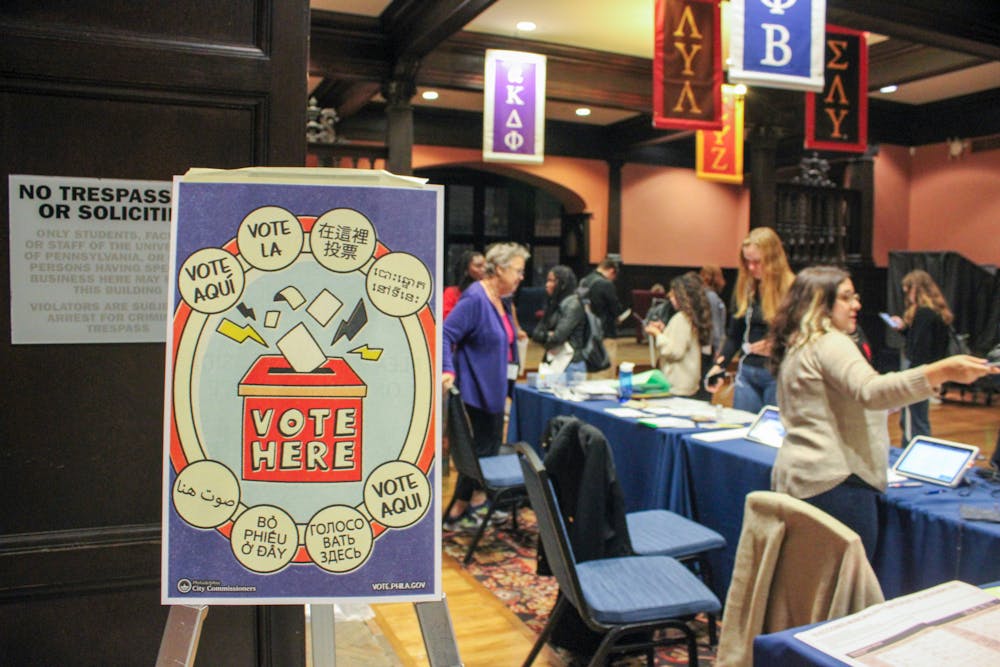
Ahead of the primary elections on May 19, The Daily Pennsylvanian compiled a comprehensive ballot guide detailing where to vote on campus, key state and municipal candidates on the ticket, and an explanation of the two ballot measures students can vote on.
Registration and Mail-In Ballots
The deadline to register to vote is May 4. Voters may register online or in person at the Philadelphia Voter Registration office or the Philadelphia County Board of Elections office in City Hall.
Voters can check their registration status here.
All voters may request to vote by mail-in ballot. To vote by mail-in ballot, the County Board of Elections office must receive a voter’s application by 5 p.m. on May 12. If an individual decides to vote by mail, the ballot must be returned to election officials by 8 p.m. on May 19.
Polling Places
Voters can cast their ballots on Penn’s campus from 7 a.m. to 8 p.m. on May 19. All voters in line by 8 p.m. will be allowed to vote.
Students registered at Kings Court English, Lauder, and Hill College Houses — as well as Domus and Sansom House East and West — can vote in ARCH Room 108.
RELATED:
Penn professor endorsed by former competitor as race to represent University City narrows
Student group hosts Penn-affiliated congressional candidates running to represent University City
Students living in the Quad and Stouffer Hall in Stouffer College House can vote in Houston Hall’s Reading Room.
Residents of Harnwell, Gregory, Harrison, Rodin, Du Bois, and Gutmann College Houses, Mayer Hall in Stouffer College House, the Axis, The Chestnut, the Radian, Chestnut Hall, Hamilton Court, The Hub on Chestnut, and 3737 Chestnut can vote in Bodek Lounge in Houston Hall.
Voters whose voter registration is off campus can check their polling place location here.
First-time voters must show a valid form of photo identification at the polls. Students may use their PennCard as identification, or other approved forms such as a United States driver’s license, passport, or voter registration card.
Races on the Ballot
United States House of Representatives
A crowded primary followed the announcement that Rep. Dwight Evans (D-Pa.) — who had represented Penn’s district since 2016 — would retire. After a series of dropouts over the course of the campaign, there will be four candidates on the Democratic ballot, three of whom are affiliated with Penn.
Political newcomer Shaun Griffith is a tax attorney, local business owner, and public service worker.
His platform includes a focus on regulating artificial intelligence data centers, universal healthcare, fair wages, and environmental protection. Griffith previously testified he was motivated to run after becoming “increasingly concerned by the shift toward authoritarian governance, disparagement of immigrants and minorities, and flagrant environmental degradation.”
State Rep. Chris Rabb (D-200) — a self-proclaimed Democratic Socialist and a state representative — graduated from Penn in 2006 with a master’s degree in Organizational Dynamics.
He has pledged to take no corporate Political Action Committee money and has gathered support from progressives in the Democratic caucus. Between Jan. 1 and March 31, Rabb nearly doubled the fundraising of his closest rivals with a total of $385,000.
Rabb has endorsements from U.S. Representatives Alexandria Ocasio-Cortez (D-N.Y.), Summer Lee (D-Pa.), Jamie Raskin (D-Md.), Ro Khanna (D-Calif.), Pramila Jayapal (D-Wash.), and Ilhan Omar (D-Minn.). This month, the Philadelphia Inquirer Editorial Board also endorsed Rabb.
His platform includes several “Universal Basic Guarantees” in areas such as Medicare, housing, income, childcare, food and water, and transit. Rabb has also expressed support for defunding Israel, and continuously labeled the state’s actions in the Gaza Strip as “genocide.”
Ala Stanford is a Penn professor, public health advocate, and former neurosurgeon. She founded the Dr. Ala Stanford Center for Health Equity and the Black Doctors COVID-19 Consortium to address health care discrepancies in Philadelphia communities.
Stanford — who served as a regional director of the Department of Health and Human Services under the Biden administration — has previous experience in the federal government. She is running for Congress to “fight back” against 1968 Wharton graduate and President Donald Trump’s “disastrous policies.”
Stanford has been endorsed by Evans, former Philadelphia Mayor Michael Nutter, David Oxman — who dropped out of the race in March — and EMILYs List PAC. She also received endorsements from U.S. Reps. Madeleine Dean (D-Pa.) and Chrissy Houlahan (D-Pa.).
1999 University of Pennsylvania Carey Law School graduate State Sen. Sharif Street (D-3) is the son of former Philadelphia Mayor John Street and has served as a state senator since 2017.
As a state senator, Street helped create Pennie, a health insurance exchange for Pennsylvania. He is the former chair of the Pennsylvania Democratic Party and has endorsements from 2016 Fels Institute of Government graduate and Philadelphia Mayor Cherelle, eight Philadelphia City Council members, the Philadelphia Democratic Party, and former Pennsylvanian Governor and Penn lecturer Ed Rendell.
He has campaigned on legalizing marijuana, criminal justice reform, and delivering affordable health care and housing.
No Republican candidates are running for this office.
Pennsylvania Governor
Both gubernatorial candidates are running unopposed in this year’s primary election.
Pennsylvania Gov. Josh Shapiro, who also serves as an ex officio member of the University Board of Trustees, is running to be reelected as the state’s governor.
While announcing his campaign in January, Shapiro outlined policy goals for his second term in office — including raising the minimum wage, protecting reproductive freedom, and producing more clean energy. Shapiro highlighted his bipartisan record and called on Pennsylvanians to reject divisive politics.
During his first term, Shapiro criticized Penn’s response to allegations of campus antisemitism on multiple occasions. In December 2023, the governor expressed concerns over then-Penn President Liz Magill’s congressional testimony.
In January, Shapiro released a book in which he wrote that he “flatly” would not apologize for statements he made about pro-Palestinian protesters at Penn. At an event promoting the memoir earlier this year, Shapiro addressed Pennsylvania’s readiness to handle United States Immigration and Customs Enforcement operations across the state.
Shapiro is also set to deliver Penn Carey Law’s Commencement address on May 18.
Pa. Treasurer Stacy Garrity currently serves as the Commonwealth’s treasurer. She has worked on initiatives to increase transparency for Pennsylvania’s finances and return unclaimed property.
In January, Garrity received an endorsement from Trump. She has also advocated for the passage of Trump’s “One, Big Beautiful Bill” and has continued to be an advocate for conservative fiscal policy.
As a retired U.S. Army Reserve colonel, Garrity has been deployed overseas three times. She has also previously worked as a lobbyist for a defense contractor — influencing public policy, military manufacturing, and global trade.
Lieutenant Governor
Pennsylvanians will vote for the Lieutenant Governor, who serves as the president of the Pa. Senate and chair of the state Board of Pardons.
Incumbent Lt. Gov. Austin Davis (D) has served in the role since 2023. Davis — who is running alongside Shapiro for a second time — is the youngest lieutenant governor in the state’s history and the first Black lieutenant governor in Commonwealth history.
Davis — previously a state representative — has worked to secure grants for violence intervention, 911 services, community and worship centers, and after-school programs since taking office.
Republican candidate for lieutenant governor Jason Richey has received endorsements from Garrity, the Pennsylvania Republican Party, the Pennsylvania Manufacturers’ Association Political Action Committee, and several Republican legislators. He has said he hopes to advocate against raising taxes while improving public safety, energy production, and government transparency.
John Ventre, the other Republican candidate, is a former executive at the United Postal Service. He describes himself as “the closest thing PA has to Trump," and as being “Pro God, Pro-Gun, Pro-Life, Pro-Constitution, Pro-Freedom.”
Pennsylvania Senate
The state Senate — one of two legislative bodies responsible for writing the state’s laws — has half of its 50 seats up for election this year and is currently controlled by Republicans. Incumbent Anthony Williams is running against David Goldsmith Jr. for Pennsylvania’s 8th Senate district.
The 8th district includes the majority of Penn’s campus, including Stouffer, Lauder, Hill, Gregory, Harnwell, Harrison, and the Quad. All other college houses are represented by state Sen. Vincent Hughes (D-7), who is not up for reelection until 2028.
Williams has served as a state senator since 1998. This session, he is the chair of the Senate Community, Economic, and Recreational Development Committee. He has championed Pennsylvania’s charter school legislation, helped establish the Philadelphia Gun Violence Task Force, sponsored the state’s Clean Slate legislation, and created a Diversity Apprenticeship Program during his time in office.
David Goldsmith Jr. is a realtor looking to enter politics this election cycle. According to his campaign website, he is running on a platform of housing, education, and public safety. Goldsmith was a U.S. Air Force veteran and served for three decades.
No Republican candidates are running for this office.
Pennsylvania House of Representatives
Pennsylvania’s House of Representatives, the other legislative body responsible for writing the state’s laws, has all 203 seats up for election. Only one candidate — 2013 Engineering graduate and incumbent state Rep. Rick Krajewski (D-188) — is running to serve Penn’s district in the Pennsylvania House.
Krajewski has represented Penn’s district since 2021. He identifies himself as a Democratic Socialist and has campaigned on ending mass incarceration and funding education. During his time in office, he won a $2.5 million allocation to establish a statewide tenants’ right to counsel, passed medical parole for the sick and elderly incarcerated, and advanced publicly accountable cannabis legislation.
No Republican candidates are running for this office.
Ballot Questions
All Philadelphia voters, no matter their party affiliation, may vote yes or no on two city-wide ballot questions.
The first question asks whether the Philadelphia Home Rule Charter — essentially the city’s constitution — may be amended to create the Philadelphia Retirement Savings Board.
A “yes” vote would approve the formation of a board to oversee the creation of a retirement program for “eligible private-sector workers.” Monetary contributions to the plan would come from those who participate in the program.
The second ballot question asks whether the Office of the Youth Ombudsperson shall be included in the Philadelphia Home Rule Charter. The office was founded by Parker in November 2022, but it is not yet a permanent city office.
The Office of the Youth Ombudsperson aims to improve the “safety and well-being of youth” who are within residential placement facilities. A “yes” vote would also allow the City Council to expand the office’s powers as needed.
RELATED:
Penn professor endorsed by former competitor as race to represent University City narrows
Student group hosts Penn-affiliated congressional candidates running to represent University City
Senior reporter Arti Jain leads politics reporting and can be reached at jain@thedp.com. At Penn, she studies economics and political science. Follow her on X @arti_jain_.
Staff reporter Luke Petersen covers politics and can be reached at petersen@thedp.com. At Penn, he studies philosophy, politics, and economics. Follow him on X @LukePetersen06.
Staff reporter Gabrielle Ostad covers campus politics and can be reached at ostad@dailypennsylvanian.com. At Penn, she studies Middle Eastern studies and international relations.


