The Penn administration has just released an extensive document outlining many new rules and procedures for regulating open expression on campus. The proposed revisions represent a stark departure from the past Guidelines on Open Expression at Penn. This makes it all the more important for students and faculty to pay attention.
In an earlier guest column on this topic, we objected to the top-down, administration-driven process under which these new rules were generated. Leaving aside the issue of improper process, we write to highlight especially problematic aspects of these changes that the community should be aware of.
From a practical standpoint, the complexity of these rules and regulations is clearly meant to chill free speech. Despite multiple readings, we remain unclear on what precisely is required in terms of registration and oversight for a community member to speak their mind on campus. The likelihood of violating some provision within this document seems quite high because of its sheer complexity and ambiguity. Simply put, these guidelines are not designed to encourage open expression.
The revision states: “Whether communications occur on Locust Walk or in cyberspace, open expression remains … subject to the same limitations as non-digital forms of communication. Accordingly, these Principles apply to both in-person and online expression/conduct, particularly where Penn community members act or present themselves as Penn officials, community members, or representatives.”
Note that these limitations apply “particularly when,” but not only when, Penn community members act or present themselves as members of the Penn community. This leaves ambiguity about the expressive activities that students, staff, and faculty engage in on their own time, whether on social media or on the streets of Philadelphia.
We are told that we have a right to express ourselves on social media: “However, this right is also circumscribed by principles of respect.” What is or is not considered “respectful” is highly subjective, so it matters a great deal who the judge is.
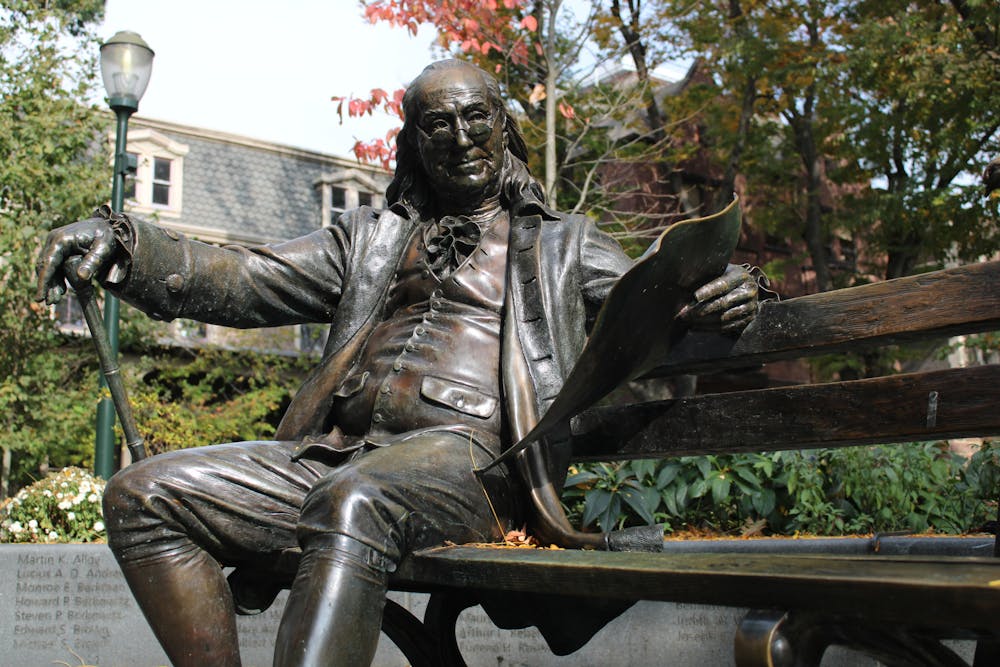
As Benjamin Franklin so aptly put it, “Abuses of the freedom of speech ought to be repressed, but to whom are we to commit the power of doing it?” At Penn, the provost will have authority to oversee the entire Penn community, with the help of (another) new vice provost, a staff member who will serve under the provost and take over the role previously assigned to the Committee on Open Expression, whose composition he would also control. The new executive director of open expression will train and oversee an Open Expression Observer Program. As the proposed revisions state, “The EDOE manages the OEOP and is responsible for recruiting, training, and deploying Open Expression Observers.” It is difficult to ignore the militaristic overtone of “recruiting, training, and deploying” members of the University community to police the open expression of other members of the community.
These revisions make events on campus possible only if one has prior approval, usually seven days in advance. The EDOE is empowered to make disciplinary decisions regarding what kind of speech is punished. In addition, moving forward, all members of the Committee on Open Expression can be replaced by the provost if he chooses. Doesn’t that sound like Robert F. Kennedy’s firing of the vaccine board? The previous guidelines specified that committee members be selected solely by the Faculty Senate.
The new regulations go well beyond prohibitions against threatening or harassing individuals (which is already illegal) to indicate that negative statements about whole groups are also prohibited: “Such speech or conduct will be considered more severe if it targets individuals or groups on the basis of a characteristic or class protected by the University Equal Opportunity Policy and Nondiscrimination Statement.” This includes discrimination “on the basis of race, color, sex, sexual orientation, religion, creed, national origin (including shared ancestry or ethnic characteristics), citizenship status, age, disability, veteran status.”
It is worth considering how these rules might be interpreted. For example, imagine that a student’s sign mimics United States President Donald Trump, who was widely quoted as saying “immigrants are animals.” This is a disrespectful statement directed toward a protected class based on nationality or citizenship status. Should the student be disciplined for speech parroting the president?
Likewise, if an Iranian student carried a sign exclaiming, “Americans are imperialistic pigs,” this is clearly offensive to Americans on the basis of their national origin. Or consider a student at a rally who exclaims, “The American military slaughters private citizens.” This could be viewed as implicating two violation categories because it impugns a group based on shared national origin (Americans), as well as veterans or those on active military duty. It is also true according to our own government. Should a university punish its community members for stating the truth?
These political statements do not threaten a specific individual, but they do express a political point of view about a group in strong terms. Because only true threats and pervasive harassment directly interfere with people’s education and are legally actionable, these vaguely defined new rules increase the chances that rules will be applied unevenly. They are also an invitation to litigation that will need to be paid for by the University.
Extending disciplinary actions to those who say negative things about groups rules out a huge swath of political speech. The Israel-Hamas war brought into focus the fact that different people have different interpretations of the same political slogans. Both Jews and non-Jews alike need to be able to voice disapproval of the Israeli government as well as of Hamas, just as they need to be able to voice disapproval of their own government if they feel so moved.
Consistent with further restrictions, journalists on campus will be required to present “credentials” to justify their presence and may be asked to leave campus during events involving open expression. Did they get this idea from the Pentagon? This is said to be necessary to protect the “safety” of students and other community members. Safety from journalists? Really? Surely the administration knows that the whole point of demonstrations is to attract attention to important issues, so prohibiting the press would be counterproductive.
By becoming members of the Penn community, we forfeit our freedom to express ourselves on the urgent issues of the day, except on the administration’s terms and with its express permission. College campuses are where the free speech movement began, a movement that later evolved into the civil rights movement. Suggesting that students sit this one out until they graduate and have their full rights restored is unacceptable. The University is capitulating to the current political administration’s demands to quell dissent rather than upholding democratic values.
Rules regarding presentation of University identification have also changed. Under the old Guidelines on Open Expression, one could be asked for ID only if one were first accused of having violated a guideline. Under the new rules, anyone can be asked to present ID under any circumstances.
Will there be awkward and uncomfortable moments? Undoubtedly. That is the nature of political conflict. But Penn’s reputation is already suffering from this debacle. It is no accident that the new proposal was buried in a supplement to the Almanac. The lack of transparency throughout this process suggests that our administration does not want to call attention to what it is doing.
By clamping down on free speech in response to Trump’s threats, the Penn administration is sending a dangerous message about its lack of support for democratic norms. Of all times to muzzle the Penn community, this is not it. The country is at war, democracy is at risk, and all people’s voices need to be heard. As Franklin noted, “Whoever would overthrow the liberty of a nation must begin by subduing the freeness of speech.”
We encourage all members of the Penn community to join us on April 23 outside Perry World House at 3:30 p.m. to demonstrate our support for open expression.
CAROLYN MARVIN is a Frances Yates Professor Emeritus of Communication. Her email is carolyn.marvin@asc.upenn.edu.
DIANA MUTZ is a Samuel A. Stouffer Professor of Political Science and Communication. Her email is mutz@upenn.edu.
ROBIN PEMANTLE is a Christopher H. Browne Distinguished Professor of Mathematics. His email is pemantle@math.upenn.edu.