

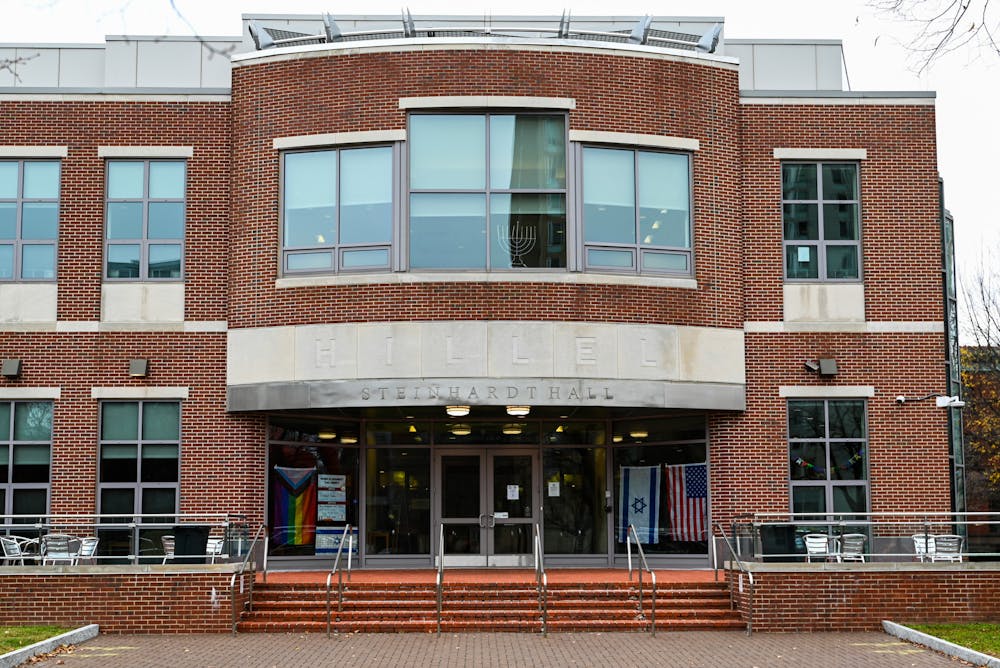
On March 31, United States District Court Judge Gerald Pappert made a ruling that represents a continued and profound threat to the civil liberties of the Jewish community here at Penn: The University must comply with the U.S. Equal Employment Opportunity Commission’s subpoena, which seeks information on Jewish students, faculty, and community members. At the same time, he partially limited the scope of the subpoena, declaring that the University no longer has to disclose an individual’s affiliation with specific organizations, nor must it provide information about three Jewish-affiliated groups on campus. However, this decision ultimately fails to address the key threat to privacy that the EEOC’s demand fundamentally poses and must continue to be challenged.
In his decision, Pappert argued that the EEOC needs to be able to directly contact Jewish employees to learn if they have evidence of discrimination. Defenders of the subpoena have similarly argued that it is not unusual for federal investigators to request employee identities when probing workplace discrimination. In other words, the charge is intended to be a routine investigative procedure. However, it’s important to recognize that the procedural normalcy of the demand does not resolve its constitutional character. Routine or not, compelling a university to compile and surrender a list of individuals sorted by religion — without their consent — is a First Amendment violation hiding in plain administrative sight.
The dangers of such a violation are not merely hypothetical. As five Penn-affiliated Jewish organizations have already argued, the nonconsensual disclosure of private information implicates serious First Amendment violations. Specifically under attack is the freedom of association: the right of individuals to join religious and civic organizations without that membership being involuntarily disclosed to the government. Affirmed most forcefully in National Association for the Advancement of Colored People v. Alabama, the U.S. Supreme Court unanimously held that compelled disclosure of membership lists poses a threat to an organization’s members and their right to civil discussion.
Considering its stakes, this dispute is one that should be handled with the utmost care and legal scrutiny. Unfortunately, that hasn’t been the case, as Pappert himself even acknowledged cracks in the EEOC’s legal foundation — noting that the original charge was “ineptly worded.” That acknowledgment should set off clear alarm bells, for both supporters and opponents of the decision. Nonconsensual identification of Jewish individuals, for any purpose, is the kind of precedent that demands the most rigorous judicial scrutiny, not the most lenient. And while the EEOC’s stated intent of protecting Jewish students and employees may make the subpoena’s supporters feel better, it does not make the mechanism safer.
Perhaps the most dangerous aspect of the situation is the potential for it to become a slippery slope. If the courts establish that the EEOC may compel universities to produce lists of Jewish individuals without their consent, the same investigative reasoning can be applied to a variety of other situations: Muslim individuals in the name of investigating Islamophobia, Black individuals in the name of investigating racial harassment, and so on. Once the precedent exists that a federal agency’s investigative interest should be prioritized over an individual’s right to association, there can be no basis to limit that overreach. The partial restriction that Pappert provided does not resolve this concern either, only delaying the identification and harassment of community members.
Penn’s administration deserves credit for the effort it has already made throughout this long and arduous case. It has simultaneously respected the importance of investigating discrimination while maintaining that the subpoena raises serious privacy and First Amendment concerns. And most recently, the University’s decision to appeal, announced in the immediate aftermath of Pappert’s ruling, reflects a valuable amount of institutional awareness. However, that praise comes with a caveat: Penn must not, at any point, back down and accede to the EEOC’s charge, regardless of how narrow or constrained it becomes.
Antisemitism on Penn’s campus is a real issue which demands serious attention. But fighting that threat does not require a compiled list of Jewish students and employees, nor does it justify sacrificing civil liberties. At a time like this, Penn must choose to affirm its obligation to its community and choose to fight tooth and nail against the EEOC. And especially as the May 1 compliance deadline looms on the horizon, the University must hunker down and prepare itself to conduct a vigorous legal challenge at every available level, including, if necessary, the Supreme Court.
ANDY MEI is a College first year studying economics and history from Palo Alto, Calif. His email is andymei@sas.upenn.edu.
SEE MORE FROM ANDY MEI:
DEI was never worth the cost
In times of tragedy, actions speak louder than words
SEE MORE FROM ANDY MEI:
DEI was never worth the cost
In times of tragedy, actions speak louder than words


