

Penn’s storied history stretches back to 1740 — and so does its tradition of student-led organizations.
From performing arts groups to academic societies, Penn students have gathered around shared interests for centuries. The Daily Pennsylvanian compiled a list of the oldest clubs still operating on campus today.
Penn Glee Club
Founded in 1862 during the Civil War, the Penn Glee Club is the University’s oldest performing arts organization and one of the longest continually running glee clubs in the United States. In addition to its singers, the entirely student-run organization also includes a band and technical section.
In an interview with the DP, College senior and Glee Club President Julia Gauffreau said that some of the group’s long-standing traditions include performing at convocation ceremonies and “[prestigious] gigs,” such as embarking on a tour each year. Glee Club has toured in over 40 countries and territories across five continents, generally alternating between domestic and international trips each year.
“What brings us all together really is this shared value of wanting to have excellent performance, and that carries through a tradition and gives us a brotherhood,” Gauffreau said, adding that Glee Club’s three “pillars” are “performance, brotherhood, and tradition.”
In 2021, the Glee Club voted to merge with its sister group, the Penn Sirens, and remove the group’s gender restriction on singing membership.
“The Glee Club has been a group that’s been willing to adapt and change as times have changed itself,” Gauffreau stated.
RELATED:
How Penn’s UA will allocate its $3 million budget next year
Penn Undergraduate Assembly unanimously passes resolution to increase club sports funding
Gauffreau described Glee Club’s songbook as “really central and important” to the organization because it has preserved traditional repertoire while serving as “the opportunity to make our own new traditions.”
The collection includes longstanding arrangements, as well as the University’s alma mater, “The Red and Blue,” and other fight songs.
She added that the songbook took on new significance after the group became coed in 2021, when portions of the repertoire were rearranged to accommodate soprano and alto voices. The club introduced sections “to be inclusive of upper voices” and continually reviews the songbook with input from students and Director Sam Scheibe.
“We’re this musical ambassador, musical hand to the University, and being able to specifically represent Penn in Philadelphia and around the world is what sets us apart from other performing groups,” Gauffreau said.
The Philomathean Society
Founded in 1813, The Philomathean Society is one of the oldest continuously existing collegiate literary societies in the United States.
College junior and Moderator Ashwin Laksumanage told the DP that the society’s mission is to increase “the learning of our members and the prestige of the University.” He added that members “are supposed to be lovers of learning” and that “Philo is what Philo members want it to be.”
“Our main priority is, firstly, to make sure that our members continue to be the best versions of themselves, to be educated individuals and be intellectuals in the true sense of the word,” he said. “I think University prestige will follow from that almost naturally because when your members have intellectual confidence about them, they’re more willing to put on events for the public and bring that intellectualism to campus.”
Historically centered around debate and discussion, the society also hosts public-facing programming throughout the year, including its Annual Oration, an address to the campus community from a prominent public intellectual. This year’s oration hosted philosopher Angie Hobbs, marking its 200th iteration.
In addition to the oration, the group hosts weekly teas with Penn professors in its College Hall space, where students can speak with faculty about their work and careers. The society maintains a dedicated top-floor suite in College Hall that includes meeting rooms, a library, an art gallery, and a private members’ office.
Laksumanage said that The Philomathean Society “has always been quite a progressive organization,” acknowledging that “we actually admitted women into Philo before even the women’s college was integrated into the University” in 1974.
Laksumanage explained that the society’s other traditions include “march[ing] up and down Locust” while wearing academic robes and reciting Edgar Allan Poe poems on Halloween night.
“We’re always going to want to serve as a place for continuing to make societal progress, but the way we want to do that is through discourse, and we are committed to the idea that through discussing ideas, and even controversial ideas, is how we will move forward,” he said.
The Mask and Wig Club
Founded in 1889, the Mask and Wig Club is a sketch musical comedy group that includes a cast, band, stage crew, and business team. The group performs three shows each academic year and goes on tour across the nation with their annual production in the spring.
College senior and Undergraduate Chair Emilia Bronk said in an interview with the DP that Mask and Wig has had “multiple forms” of shows throughout its history, ranging from “a full satirical review” that embodied more of “a variety show” to “full book musicals” that are a “much more modern take of a comedy show.”
Engineering senior and Secretary-Treasurer Joseph Dattilo also explained that the group has always followed “major theatrical trends throughout all of history,” with their “current age” following an “SNL style.”
Dattilo noted that Mask and Wig traditions include singing songs such as “Only Room for One” and “The Red and Blue” at the end of every show to “signify credit to the University.”
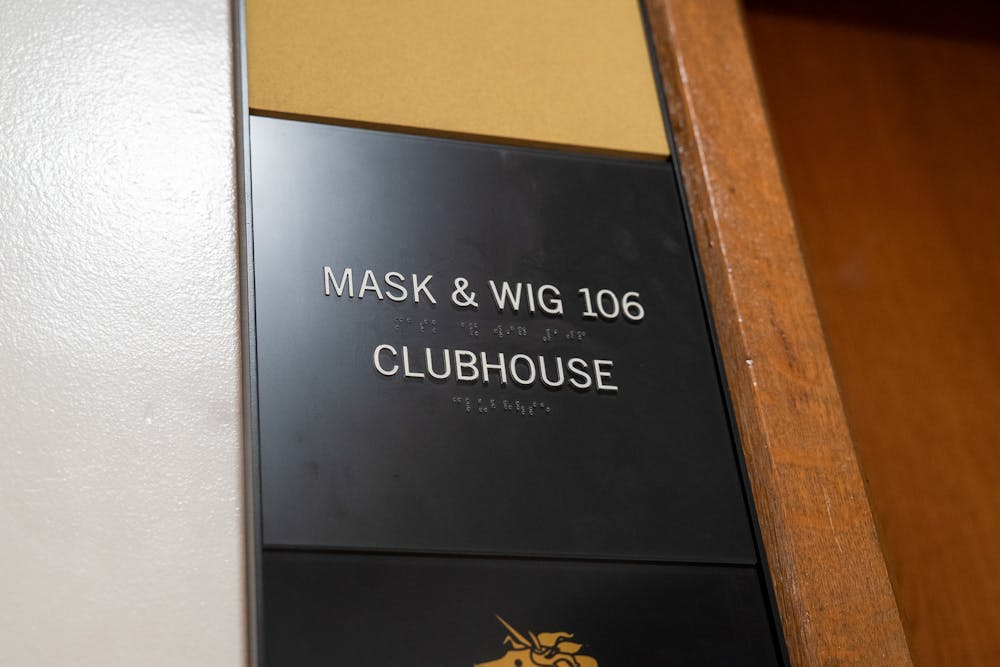
In 1894, Mask and Wig purchased a property at 310 South Quince St. to serve as a gathering place and rehearsal hall, known as the “Mask and Wig Clubhouse.” The clubhouse is funded primarily by alumni donations and revenue from their annual production and bar.
Bronk emphasized the alumni involvement in Mask and Wig as “something that really keeps this whole organization together,” adding that “members have had a very strong history of giving back to the University that they came from.”
In 2021, Mask and Wig announced it would eliminate gender as a membership requirement, opening participation to all genders for the first time in its history as a male-only group. The change was first implemented for the fall 2022 recruitment cycle.
“Before the age of the television and our phones, seeing live theater was something that a lot of people were doing all the time, so it was easy to have a stronghold in performing arts early on,” Bronk said. “We really strive to put on excellent productions and work our hardest.”
RELATED:
How Penn’s UA will allocate its $3 million budget next year
Penn Undergraduate Assembly unanimously passes resolution to increase club sports funding
Senior reporter Amy Liao covers student life and can be reached at liao@thedp.com. At Penn, she studies philosophy, politics, and economics and cinema and media studies. Follow her on X @amyliiao.


