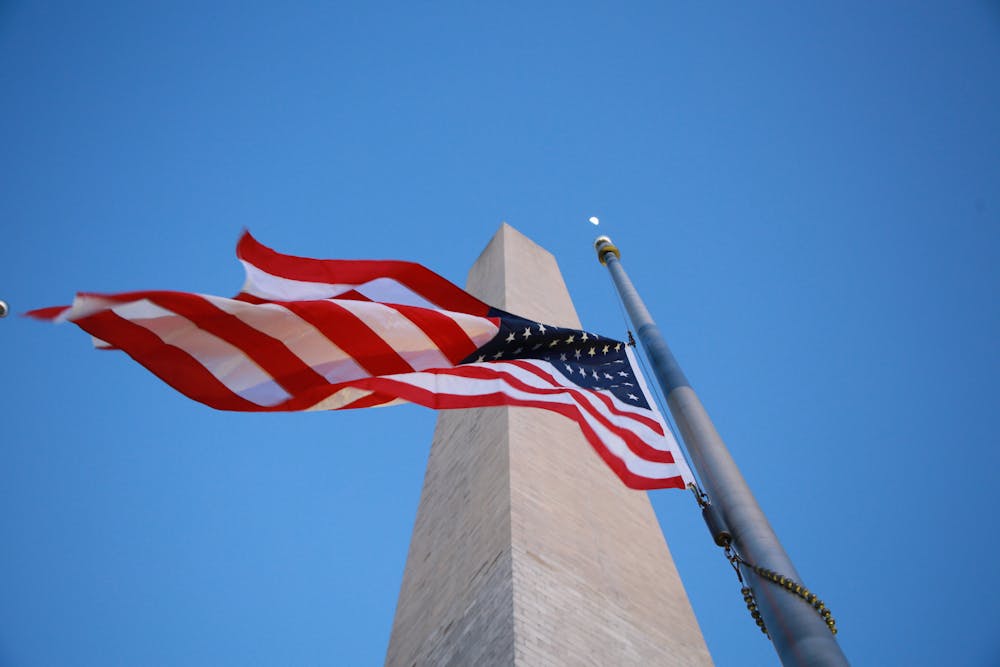
Philadelphia is a beacon to this nation’s past. Echoes of the American Revolution can be seen at every turn, woven deeply into the fabric of the city. As Penn students, we have the unique opportunity to study in the very place where this country was born and better understand the roots of our civic duty. Right at our fingertips are the homes of revolutionary figures like Betsy Ross and our founder Benjamin Franklin. Nearby stands Independence Hall, where the Declaration of Independence was signed, and the print shop where Thomas Paine’s “Common Sense” helped spread revolutionary thought throughout the colonies.
For me, Penn’s rich cultural connection was one of the main reasons I chose to come here. A university situated in the very place where the United States first defined itself as a nation, with a renowned Department of History, felt like the perfect fit for me. I knew from the moment I enrolled that I was lucky to be here as the United States approached its semiquincentennial.
This July, the nation is turning 250. To be Penn students during the semiquincentennial should have been an unforgettable component of our college experience. A moment like this should feel impossible to ignore at Penn — it’s in the birthplace of the nation and it was founded by Benjamin Franklin himself — but it doesn’t. For an anniversary unfolding just beyond campus, our University’s presence feels almost nonexistent. Aside from a few Benjamin Franklin banners hanging from streetlamps on Walnut Street, there is little to suggest that anyone is paying attention or that anything is happening at all.
Personally, I am no American nationalist, nor do I subscribe to American exceptionalism. I am extremely cognizant of and critical toward the ways the United States has reckoned with its history marked by repeated contradictions and broken promises. But as someone with high expectations for Penn’s historical affinity, I am utterly disappointed in the lack of recognition for such a milestone in American history.
To be Penn students during the semiquincentennial should have been an unforgettable component of our college experience. Instead, we are left with most students having “America 250” fly over their heads with no further thought. This is largely due to the lack of visibility surrounding any of Penn’s initiatives related to the semiquincentennial.
While the University does have a website page, a calendar of events, and scattered programming across departments, it all exists in a way that feels distant from student life. And even when you do find it, the offerings are limited and often scheduled for May or the summer, a time where most students have already left campus. What Penn has created is not entirely absent, but it is largely out of sight.
That same pattern carries into the classroom. Penn presented a list of courses tied to “America 250” this spring semester, framing them as part of its engagement with the semiquincentennial. But a closer look makes it clear that many of these courses are not new, and in some cases, not meaningfully connected to the American Revolution at all. Some are standard offerings that appear every year, repackaged under the anniversary to give the impression of something more intentional. Others stretch the connection so far that it becomes difficult to understand how they fit within a list centered around the nation’s founding. What is presented as a curated academic response instead feels like a compilation of existing courses, assembled to fill out a narrative rather than reflect a genuine institutional focus.
Courses like HSOC 4317 — cross listed as STSC 4317 — “Slavery and Disease: Medical Knowledge in the Atlantic World,” and HIST 3210, “Revolutions in Three Kingdoms: England, Ireland, Scotland,” appear on the America 250 list despite having little direct connection to the American Revolution. Others, like HIST 1166 — cross listed as AFRC 1166, ASAM 1166, and LALS 1166 — “A Nation of Immigrants Reconsidered,” focus on 20th century immigration, raising questions about their connection to a curriculum centered on the nation’s founding. While valuable in their own right, their inclusion feels less intentional and more like an effort to fill out a list, resulting in a collection of courses that only loosely gesture toward the semiquincentennial.
SEE MORE FROM SOSE HOVANNISIAN:
Penn’s approach pales in comparison to its peers. At Yale University, the semiquincentennial celebration features a flagship course, “America at 250: A History,” taught by leading historians. Harvard University has organized a university-wide series of conversations with scholars and policymakers reflecting on the American experiment.
To its credit, Penn is not doing nothing. There are events and exhibits happening across campus that engage with different aspects of the Revolutionary era and its legacy. Some focus on print culture, on transatlantic revolutions, and on how American democracy has been remembered over time. These are thoughtful, interesting topics, and they show that there are people at Penn who are taking this moment seriously. There are moments where Penn gets it right. HIST 3120 offers a research-driven approach to the American Revolution, engaging directly with questions of memory, interpretation, and public understanding. But as a research seminar, it reaches only a small number of students and cannot carry the weight of Penn’s engagement with the semiquincentennial on its own.
What makes this especially frustrating is that Penn is not lacking in resources, proximity, or historical significance. The University is choosing not to use them fully. At a time when the country is reflecting on its founding and its contradictions, a university like Penn should be helping to lead that conversation, not sitting on the sidelines.
More than anything, though, this moment reflects a broader issue. Penn does not prioritize American history to the extent that a university in this position should. The limited number of courses and faculty dedicated to it becomes even more visible at a time like this, when the expectation is not just participation, but leadership.
For a university so closely tied to the nation’s founding, that gap is hard to overlook. Is the University truly honoring its legacy with banners on streetlamps and symbolic course offerings? Maybe it is time for Penn to revisit its own founding and consider whether it is living up to the kind of intellectual leadership a moment like this demands.
SOSE HOVANNISIAN is a College senior majoring in communications and minoring in history and consumer psychology from Los Angeles. Her email is sosehova@sas.upenn.edu.