

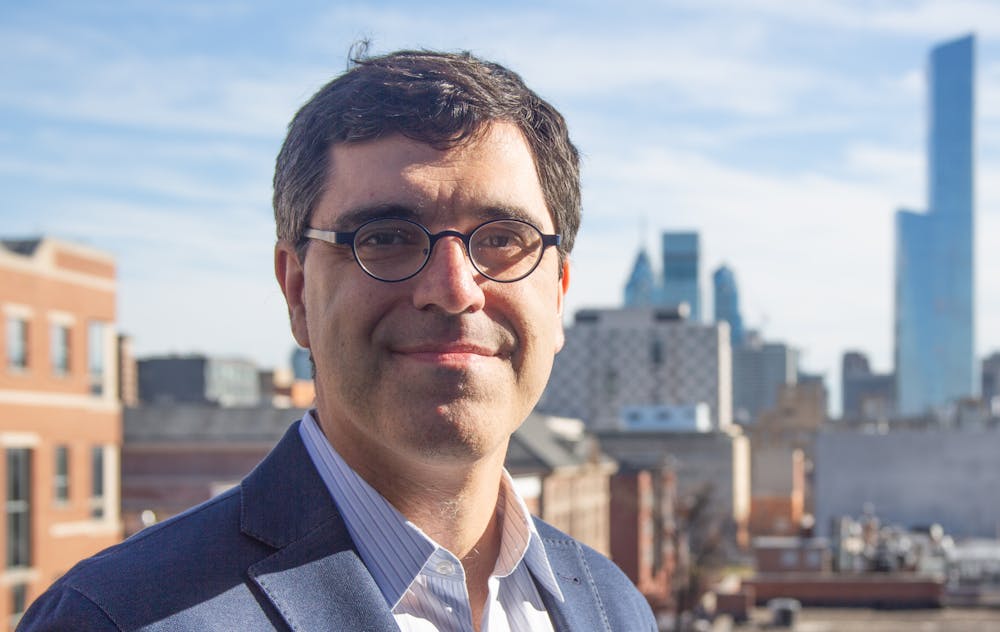
Economics professor Jesús Fernández-Villaverde used an artificial intelligence chatbot to replicate part of a master’s-level course, according to Business Insider.
Fernández-Villaverde used Claude, developed by Anthropic, to create and engage with an individualized curriculum plan that he deemed comparable to one week of a master’s course. He spent about 12 hours studying the work of sociologist Erving Goffman — akin to what a related course would require in the same amount of time — and used the platform as an interactive partner throughout the process.
“It is the difference between reading a book alone and reading it alongside a knowledgeable colleague who has infinite patience and no office hours,” Fernández-Villaverde told Business Insider, referring to Claude’s ability to provide clarifications and connections between the material and his prior economics knowledge.
The learning process consisted of three stages. First, Claude generated a “tailored syllabus” based on Fernández-Villaverde’s existing knowledge, which included “readings, key themes, and connections to other thinkers.”
Using the Claude-selected recommendations, he read several of Goffman’s works. The AI platform structured the readings around the sociologist’s books and excerpts, similar to the reading list on a typical university syllabus.
Fernández-Villaverde added that Claude “excelled” at organizing material and adapting it to a student’s individual background.
This type of curriculum curation is “one of the hardest things a professor does,” according to Fernández-Villaverde. The system performed “at a level that I would say exceeds the 90th percentile of real professors, at least for this kind of task.”
While Fernández-Villaverde highlighted many of Claude’s achievements, he also addressed several of the AI platform’s limitations.
RELATED:
Penn student launches AI platform designed to remember user conversations, identify patterns
Penn Engineering master’s student launches ‘PortaDash’ app to map public restrooms
“It answers the questions you ask rather than the questions you should be asking,” he said, explaining that Claude does not challenge students to the extent professors do. An individual’s back and forth with a chatbot cannot replicate “the peer experience of a classroom” that is found at many universities.
Fernández-Villaverde expressed that the technology may have implications for universities, particularly for programs that rely on lectures.
“If your main value proposition is transmitting existing knowledge in the classroom, and a student can get a comparable or better version of that for $20 a month, the business model is under severe pressure,” he told Business Insider.
He added that AI’s impact may vary across institutions, dependent on their quality of research mentorship, peer communities, laboratory equipment, and credentials.
“The universities that will thrive are those that offer something AI cannot,” Fernández-Villaverde said.
Fernández-Villaverde's experiment comes as AI continues to expand across Penn’s academic and research practices, with many new initiatives introduced to integrate the technology in education and beyond.
Penn is currently hosting its third annual AI Month, where schools and centers across the University will organize symposiums, seminars, and workshops covering a variety of fields.
Last month, researchers at the School of Engineering and Applied Science launched a project designed to safely bring AI agents — systems that act on behalf of users — into the physical world.


