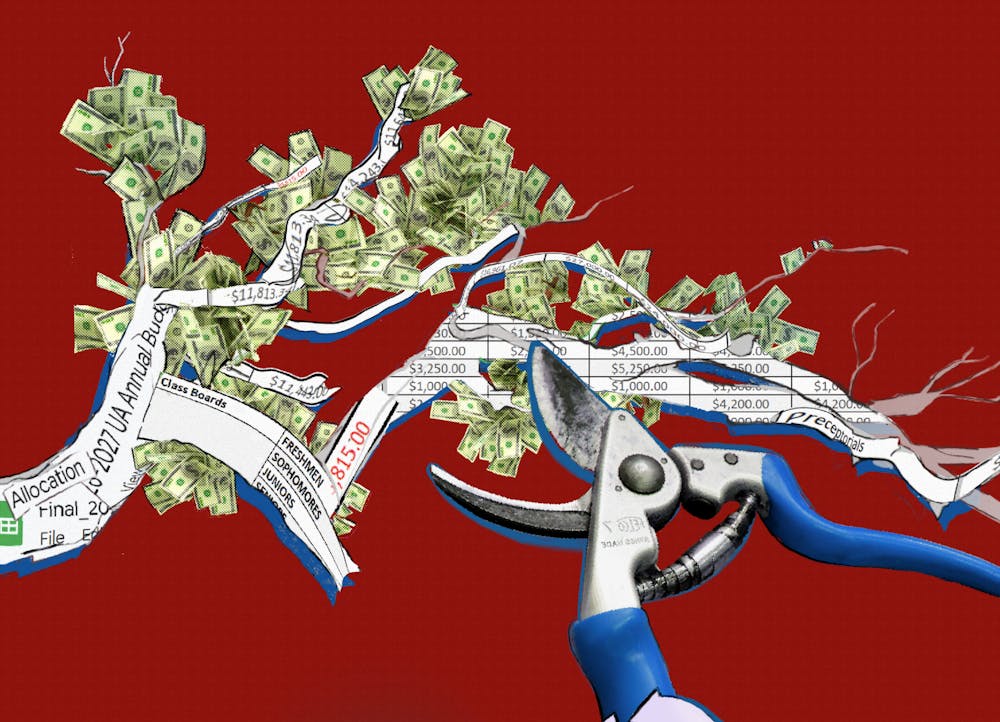
Last week, the Undergraduate Assembly finalized its annual budget, which allocated over $3 million in funding for the 2026-27 academic year. The spreadsheet itself is both unassuming and convoluted, completely incomprehensible to anyone unfamiliar with UA procedure. But the actual numbers — and the lengthy process through which they were decided — should be incredibly concerning to Penn students.
The UA is responsible for directly funding all Penn Student Government branches, along with other essential services, like Penn Labs and Penn’s Medical Emergency Response Team. About half of the budget is usually allotted to the Student Allocations Commission, which funds all other student organizations. This year, the UA made a point to publicize the fact that it increased SAC’s budget. It was less forthcoming about the fact that, simultaneously, it gutted other vital student operations.
Perhaps the most egregious cuts were to the Student Committee on Undergraduate Education, the advocacy arm of PSG, which collects, synthesizes, and reports student data every year. SCUE’s overall budget was reduced by 40% — from $14,200 to $8,600. A large portion of the lost funding was a 33% cut to its survey incentive fund, which is used to offer free food to students in exchange for their responses to surveys about their academic experiences. These findings are then published every five years in a white paper that is presented to administrators in order to advocate for changes to University-wide policy. This data collection is SCUE’s essential function. With such a large cut to its incentive program, it is limited in its capacity to capture the reality of the Penn academic experience.
At the same time, the UA cut social spending across the board for PSG. This means no social events, retreats, or merchandise for any of the branches. According to the UA, these costs “were identified as the least essential to maintaining core organizational operations and mission-driven programming.” But costs for social events are essential for these groups. As highlighted in a joint budget amendment filed by representatives from the non-UA branches of PSG and Penn Labs, the costs deemed “social” are necessary to build community and support members while they work on valuable projects. The students who spend hours planning events, coding apps, and collecting data, all to make the Penn experience better for us all, deserve funding to make that hard work feel fun.
In cutting subsidies for social events, the UA also risks excluding PSG members who cannot afford to pay their own way for retreats, formals, and other events. Just because Penn isn’t paying for these events does not mean they won’t happen. It means students without disposable income will not be able to attend them. By cutting social funding for all PSG branches, the UA solidified one thing: student government is a rich kids club.
So where did all this extra money from the cuts go? A large portion went to airport shuttles, which received a 700% increase this year, as the UA lost external funding for the service. But these shuttles are only used twice a year, and generally only sell between 500 and 600 tickets each semester. Given how few students use the service, there is no reason for the UA to waste $4,000 on the service, let alone spend an additional $1,000 to advertise it. Airport shuttles are not an essential service, especially when students can pay $8.75 for a regional rail ticket straight to the airport. Public transit is also more environmentally friendly, which the UA might have taken into account given that its cuts to printing were justified by a “broader sustainability initiative.”
A good chunk of money from PSG cuts was also redistributed to SAC. In their amendment, other PSG branches — including SAC itself — requested that $4,000 from SAC be reallocated back to social and operational costs that had been cut. While the UA argued that this funding was necessary to support student groups broadly, it actually only translates to an additional $5 for each of the 781 clubs recognized by SAC. Meanwhile, PSG received massive and unprecedented cuts that will severely inhibit its operations in the coming years.
The very nature of the budget process is inherently adversarial. The budget is finalized over the course of three meetings, all of which are entirely led by UA members who make the initial allocations, debate amongst themselves, agree with each other, and then vote to pass their own budget. In this year’s first budget meeting, UA leaders encouraged members to “fire questions” at other PSG branches defending their budgets and to act as if their meeting was a “congressional hearing.” UA members essentially filibustered the second meeting, making three separate motions to recess within the last 30 minutes, until Houston Hall closed and they were forced to vacate the room. In the third meeting, they killed the PSG reallocation amendment within the first 20 minutes, without hearing justification from any of the co-signing branches.
SEE MORE FROM THE EDITORIAL BOARD:
Perhaps this is all unsurprising. Only around 15% of Penn students bother to vote in UA and Class Board elections. Even worse, this year, for the first time in recent memory, a single candidate was running for both UA president and UA vice president. How can we expect them to take accountability if their victories were guaranteed?
Despite being the largest elected branch of student government, the UA may be the least representative. Its members design a budget, control any amendments, and approve that budget, with no obligation to any other body. They don't publish reports on our needs. They don't host the annual events students look forward to. At the end of the day, the biggest impact they have on our campus experience is when they come up to us in Stommons and ask for our signature to get them on the ballot.
Editorials represent the majority view of members of The Daily Pennsylvanian Editorial Board who meet regularly to discuss issues relevant to the Penn community. This body is led by Editorial Board chair Jack Lakis and is entirely separate from the newsroom. Questions or comments should be directed to letters@thedp.com.