

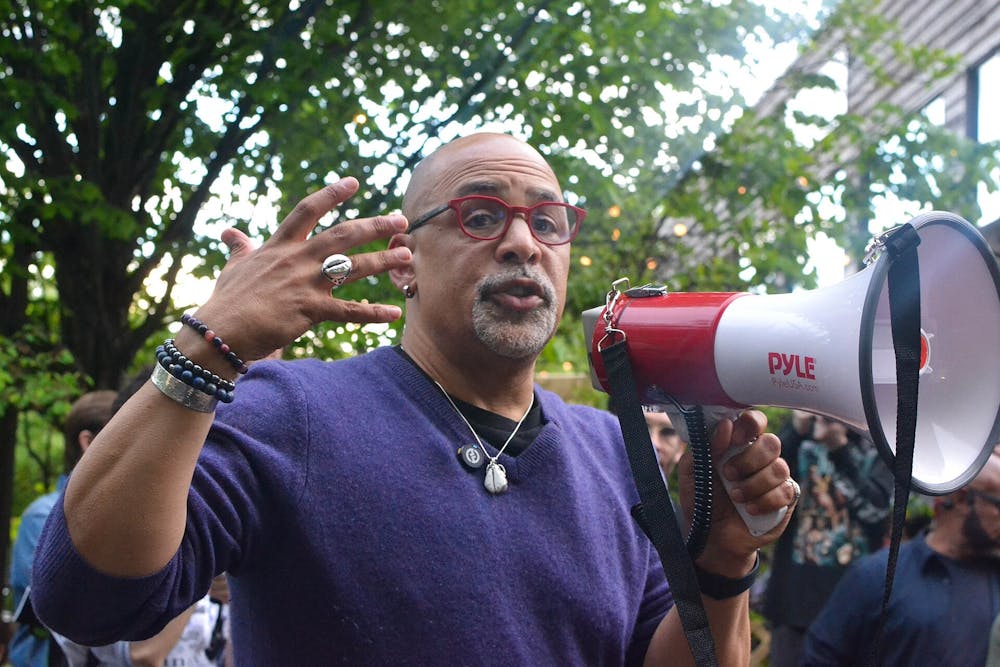
In a major win for Philadelphia’s progressive coalition, State Rep. Chris Rabb (D-200) clinched the Democratic nomination for Pennsylvania’s third congressional district last week.
Rabb — who graduated from Penn in 2006 with a master’s in organizational dynamics — captured roughly 44% of the vote in a three-way race against Penn professor Ala Stanford and 1999 University of Pennsylvania Carey Law School graduate State Sen. Sharif Street (D-3). Following the May 19 primary election, Penn professors and progressive organizers told The Daily Pennsylvanian that Rabb’s win signals a shift in the city’s Democratic Party politics.
Considered an underdog for much of his campaign, Rabb ended election night 15 percentage points ahead of second-place candidate Street. With no Republican challenger in the race, he is all but guaranteed to win the November general election and go on to represent Penn and University City in Congress for the next two years.
“I certainly think that it was surprising both that Rabb won and particularly the magnitude of his victory,” political science professor Daniel Hopkins said.
“I think many of us who watched Philadelphia politics for a long period of time had expected that this race would break down in some ways similar to the mayoral Democratic primary back in 2023, in which the progressive candidate Helen Gym finished third,” Hopkins explained.
Philadelphia Mayor Cherelle Parker — who graduated from the Fels Institute of Government in 2016 and was largely considered the establishment Democrat candidate during her mayoral campaign — won roughly a third of the votes cast in the 2023 Democratic primary.
“The surprise to me was the size of his victory, that he won by a magnitude much greater than Cherelle Parker won the city in the Democratic primary three years ago,” Hopkins continued.
Rabb, however, was not “surprised” by his campaign’s success last week.
“All the indicators for success were very good,” he said in an interview with the DP. “We outraised our opponents. We outworked them on the ground with our field operation, having hundreds of trained volunteers all over the districts.”
Rabb added that it was “helpful” that he was “consistently labeled a progressive” by campaign reporting.
According to political science professor Marie Gottschalk, Rabb’s electoral victory was the culmination of “over a decade” of organizing in the city.
“The progressives are on a roll in Philadelphia,” she wrote in a statement to the DP. “But they did not come out of nowhere.”
Rabb attributed his success to grassroots organizing, comparing his campaign’s approach with those of Street — “an insider who got the support of the Philadelphia political class, the establishment” — and Stanford, who he said had “really no footholds in Philadelphia politics.”
“I had nearly 8,000 donors,” Rabb continued, “10 times as many local donors as all of my opponents combined.”
His campaign raised nearly a quarter million dollars from individuals who contributed $200 or less to his campaign. Street and Stanford raised roughly $56,000 and $31,000 from small-dollar donors, respectively.
Nick Gavio, who serves as Mid-Atlantic Communications Director for the Working Families Party in Pennsylvania — a left-leaning, third-party organization that endorsed Rabb — called this month’s election results the product of years of work.
“We’re always trying to build on what we did in previous cycles and take that into future cycles,” he said. “For us, it’s always the goal to get to this point, and it is the result of years of organizing.”
Several Penn professors argued Rabb’s victory indicates the declining influence of establishment party figures and organizations — not only in Philadelphia politics, but across the United States.
Both of Rabb’s opponents had notable institutional backing going into the race. Longtime incumbent Rep. Dwight Evans (D-Pa.), who announced his retirement ahead of the primary, endorsed Stanford, while Street received the support of Parker and the Philadelphia Democratic Party.
Hopkins said the fact that Rabb significantly outpaced Street, despite both candidates being incumbent state legislators within the district, should signal to Democrats that there is a “palpable and meaningful kind of anti-establishment current in some parts of the Democratic Party.”
What especially may spell trouble for the “longstanding players in Philadelphia city politics,” Hopkins explained, is the fact that Rabb most likely “would have won a head-to-head race” against either Street or Stanford.
“The magnitude of his victory was so sizable that the only way for either one of them to have beaten him is if basically they managed to win all of the other candidates’ voters,” he added. “That just doesn’t happen.”
Rabb may have benefited from voters having “trouble picking a candidate to coalesce around,” Hopkins said, adding that “early on, it seemed like maybe Ala Stanford was the candidate if you were opposed to Chris Rabb, and then later it seemed like actually it was Sharif Street.”
According to Rabb, the political establishment in Philadelphia has had “no recent track record of turning out the vote whatsoever.” Instead, he argued, Democratic Party voters have largely taken to “anti-establishment fervor” and “progressive populism.”
“The two overlap, but are not the same,” Rabb told the DP. “I have a foothold in both of those and a track record for addressing issues and systems that fundamentally are connected to people closest to the pain and working families who are struggling.”
“The real question in Philadelphia and nationally,” Gottschalk wrote, “is whether the longtime leadership of the party will remain obstructionist or whether it will finally read the room and accommodate its progressive wing.”
History of education professor Jonathan Zimmerman attributed the growing anti-establishment current to 1968 Wharton graduate and President Donald Trump’s reelection in 2024.
Zimmerman argued Trump’s return to the presidency has made “Democrats ever more alarmed about the current situation and skeptical about anything that seems mainstream or moderate.”
“The electorate is anti-establishment now,” he told the DP. “It’s an impatience with the status quo, which I completely understand, especially on the part of young voters who tipped decisively for Rabb.”
At Penn’s on-campus polling locations, Rabb earned 63.9% of the vote — nearly 20 percentage points above his district-wide average.
Though Rabb won without the backing of Philadelphia’s political establishment, both Zimmerman and Hopkins were skeptical if his progressive brand of politics could find success nationwide in general elections.
“I think that we should be really cautious and limited about the inferences we draw in what this means in general elections,” Hopkins said. “These were Democrats who voted in primaries in the most Democratic-leaning city in the Commonwealth of Pennsylvania, and I think that this tells us at this point essentially nothing about the general election.”
“I think it’s a little dangerous to extrapolate from this case because it’s not a representative case,” Zimmerman explained. “It seems to me the route to winning is to try to attend, as much as possible, to all the members of the party.”
Rabb is similarly aware that Pennsylvania’s third congressional district is not a reflection of the Democratic Party’s voter base at large.
“Because it’s the bluest district in the country, its representative should have the most confidence and support for promoting the boldest, most visionary, and inclusive legislative agenda items in the nation,” he told the DP.
For Gavio, Rabb’s success is just the latest among a wave of candidates who are emphasizing affordability and progressive policies. Rabb’s “bold economic proposals” made his organization’s endorsement a “no-brainer.”
“Whatever city or district, whether it’s Philadelphia, in the case of Rep. Rabb, or whether it’s New York, in the case of Mayor Mamdani, we see that as a growing kind of priority for our candidates,” Gavio explained. “Every city, every district is different, but I think it really shows that there’s a hunger out there among voters for candidates that prioritize that.”
Since Trump’s reelection in 2024, the progressive left has notched major wins nationwide, most notably with the election of 34-year-old democratic socialist Zohran Mamdani as New York’s mayor.
The Democratic Party’s more left-leaning caucus has maintained its momentum this year. Graham Platner is now Maine’s presumptive Democratic Senate nominee after Maine Gov. Janet Mills withdrew from the race in April. And in Michigan, recent polling shows progressive candidate Abdul El-Sayed leading his more centrist, establishment rivals in the Senate primary — a first for his campaign.
“There’s always going to be adverse situations, always going to be attacks on our civil liberties and our freedoms,” Rabb said. “The response is what matters, and when it is rooted in community, when it is thoughtful, when it leads with integrity and care — this is how we move forward.”
He added that “organized people beat organized money every time, and that is something that is part of the rich Philadelphia tradition that goes beyond the Liberty Bell and Independence Hall.”
Isha Chitirala is a News Editor at The Daily Pennsylvanian and can be reached at chitirala@thedp.com. At Penn, she studies economics and political science. Follow her on X @IshaChitirala.


