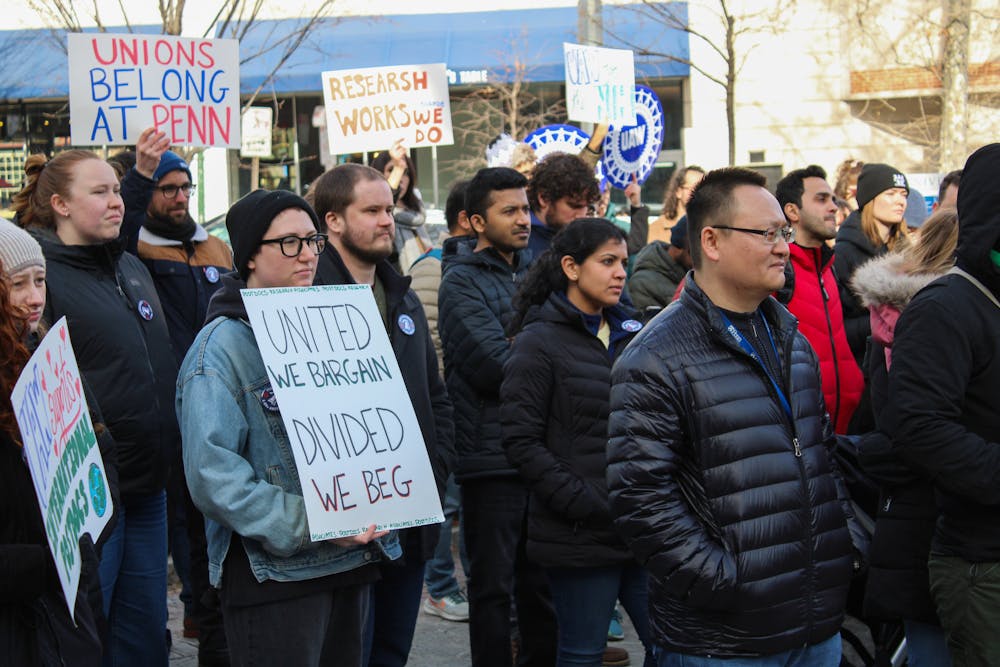
Research Associates and Postdocs United at Penn reached tentative agreements with the University on protections against workplace harassment and discrimination during bargaining sessions this month.
The protections — announced via RAPUP’s Instagram page following bargaining sessions on May 14 and 19 — come after the union introduced 31 proposals earlier this year for its first contract with Penn. The union has continued to negotiate with administrators over proposals regarding workload protections, compensation, retirement benefits, childcare support, and international researchers’ rights.
A request for comment was left with a University spokesperson.
In an interview with The Daily Pennsylvanian, postdoctoral researcher in physiology and RAPUP bargaining committee member Geordan Stukey said that negotiations with the University were “productive, but still a little disappointing.”
“There is enough movement and enough back-and-forth on low and medium difficulty issues, although it’s a little disappointing in how frequently Penn has time to negotiate, as well as the number of articles they’re willing to negotiate over at a single time,” Stukey said. “We’re making progress, but it’s very slow, and it’s an arduous process.”
Stukey described the tentative agreement on workplace harassment and discrimination protections as “a huge win” for the union.
“We’ve won strong language related to what constitutes harassment and discrimination, and it provides us a different avenue to seek recourse for that and to address those issues,” he told the DP.
Stukey added that several major proposals remain on the table.
RELATED:
Research associate and postdoc union pushes Penn on compensation, health protections
Penn postdocs, research associates vote to unionize with overwhelming majority
In recent bargaining sessions, RAPUP has pushed Penn for greater workload protections for postdoctoral researchers and research associates. In a May 19 bargaining update, RAPUP wrote that the University was “not interested in solving” the issue of overwork in the union’s proposed contract language.
Stukey said the union’s proposal is intended to address situations in which workers “may be compelled by their superiors to work excessive number of hours consistently,” adding that the union wants language in its contract that would protect them from “unreasonable workplace expectations.”
“This is really an article which we are tailoring to extreme cases,” he added.
According to Stukey, Penn administrators expressed concerns that the workload-related language could increase the number of complaints filed.
“They are trying to insulate themselves and protect themselves from unnecessary grievance proceedings,” he said. “But we are not proposing language that would allow for somebody who works a little more than 40 hours a week — or even a lot more than 40 hours a week every once in a while — to actually utilize this as a grievable offense.”
Stukey added that RAPUP is continuing to advocate for proposals related to appointment lengths and protections for international researchers, who he said make up approximately 60-70% of the bargaining unit.
In past proposals, the union outlined a minimum salary of $85,000 for postdocs and $103,210 for research associates. RAPUP also included additional provisions on relocation payments, teaching stipends, and expanded access to housing-related programs. These articles have not yet been agreed upon.
Stukey said that the union’s proposals reflect norms established at peer institutions.
“These are industry standards,” he said. “We know what we need, we know what we deserve in this sense, and we can’t really accept less than that.”
RELATED:
Research associate and postdoc union pushes Penn on compensation, health protections
Penn postdocs, research associates vote to unionize with overwhelming majority
Senior reporter Ananya Karthik covers central administration and can be reached at karthik@thedp.com. At Penn, she studies communication and economics. Follow her on X @ananyaakarthik.