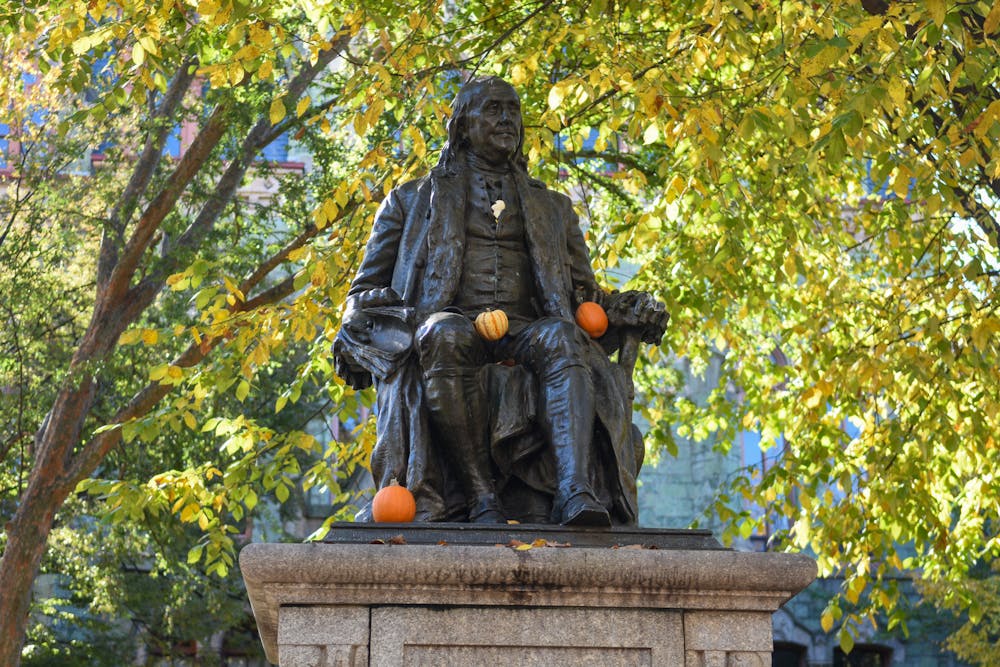
Benjamin Franklin is a secular patron saint here at Penn — our founder as well as a founder of the United States. As the 250th anniversary of the Declaration of Independence comes around, it’s worth considering: What would Benjamin Franklin do? He would not just sit back and enjoy the celebration.
If he came back to life today, Franklin would first be thrilled at the advancement of science, though he would not be too surprised. In a 1780 letter to his friend and fellow scientist Joseph Priestley, Franklin wrote that it is “impossible to imagine” the heights to which science would carry humanity “in 1000 years.” He foresaw “large masses” defying gravity in flight and the doubling of agricultural productivity. He imagined all human diseases would be “prevented or cured.” Known for his kite experiment with lightning, he would be wowed by our mastery of electric power and electronic communications, including the inventions of the internet and artificial intelligence.
In the same letter, however, Franklin worried about the prospects for what he called “moral science.” He hoped “men would cease to be wolves to one another,” but had doubts.
According to Ezekiel Emanuel, a faculty colleague who teaches a course on Franklin, he would be shocked by the epidemic of “shamelessness” today. Immoral and criminal conduct at the highest levels of our society go uninvestigated and unpunished. The Epstein files only scratch the surface. President Donald Trump has pardoned felons guilty of securities frauds of hundreds of millions of dollars. Abuses of due process against immigrants are rampant, and court orders to release many of them are ignored. Even the killings of two U.S. citizens in Minneapolis by ICE agents broadcast in real-time via cell phone videos have been covered up, and the dead protesters slandered.
Franklin would place much responsibility for our current lawlessness on President Trump and those he has appointed to “take care that the laws are faithfully executed,” but he would also call out Congress and “We the People” for condoning this behavior.
He would ask: what are you doing to respond?
Franklin would recommend using words and images — including satire — to criticize our government. He was a journalist who would enjoy the anonymity of the internet to skewer the pompous and the powerful under the protection of pseudonyms. His favorites included Alice Addertongue, Anthony Afterwit, Silence Dogood, and Poor Richard Saunders.
A consummate businessman who retired at the age of 42 and dedicated the rest of his life to science and politics, Franklin was also, in modern terms, heavily “networked.” He would tell us to leverage our networks to press for change by discussing our opinions, engaging in electoral politics, showing up to protests, and using our influence with family, friends, and acquaintances. He would encourage us to be open and respectful in discussions, including those with whom we disagree. Franklin was known for his humility.
SEE MORE FROM ERIC ORTS:
At the final session of the Constitutional Convention, Franklin said he did not approve of many of the compromises made but recognized that “the older I grow the more apt I am to doubt my own judgment and to pay more respect to the judgment of others.” He would caution against falling into an “us versus them” mentality, the viciously appealing model of politics advanced by the Nazi German political theorist Carl Schmitt and creeping back into our current politics. We should instead “lead across differences.”
When asked what kind of government he and the other founders had created following the Constitutional Convention, Franklin famously replied “a republic, if you can keep it.” He would surely raise an alarm again now.
Article I of our Constitution creates Congress, and it comes first for a reason, Franklin would explain. It is Congress that must make laws, not the president. Article II tells the president to enforce the laws, not dictate them in a slew of executive orders. Not least, Congress has the power to authorize, declare, and fund wars, not the president.
Most importantly, Franklin would urge courage. It is apocryphal that he said “we must all hang together, or most assuredly we shall all hang separately” when he signed the Declaration of Independence, but it sounds like something he might have said, and he was not afraid to risk his own life for freedom. He might puzzle over the “No Kings” branding of recent protests — the next one coming up on Mar. 28 — having himself lobbied unsuccessfully for the representation of the colonies in a British Parliament which still retained a king as an alternative to war. But Franklin’s ghost, at the age of 320, would have no trouble spreading a defiant message of “No Tyrants.”
ERIC W. ORTS is a Wharton professor of legal studies and business ethics. His email is ortse@wharton.upenn.edu.