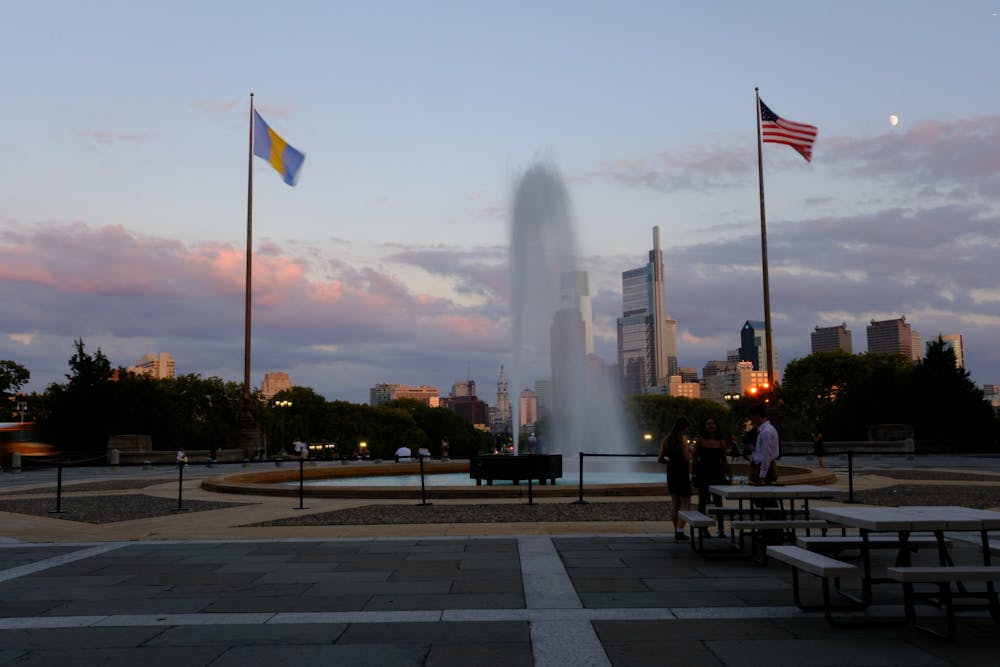
Just off the Benjamin Franklin Parkway, beside the Philadelphia Museum of Art, stands the Young Meher statue, dedicated on April 24, 1976, by Armenian Americans as a tribute to the spirit and sacrifice of their people during the nation’s Bicentennial. For nearly 50 years, it has stood quietly as both a thank you to the United States and a reminder of what Armenians lost before arriving here.
Now, as Philadelphia prepares to commemorate America’s semiquincentennial, the city has deepened that remembrance with the opening of the Armenian Heritage Walk on April 25. The new public space honors Armenian history, celebrates the community’s contributions, and memorializes the genocide that scattered survivors across the world. For generations, Armenian Americans have expressed deep gratitude to the U.S. for the sanctuary, freedom, and opportunity denied to their ancestors elsewhere. It is a fitting gesture in the birthplace of American liberty: a city marking 250 years of independence while honoring those who came here seeking the freedom they were denied elsewhere.
Many Penn students will pass these monuments without knowing what they represent. They will study in one of the world’s great universities while overlooking a history embedded in the city around them. That history begins 5,700 miles away, in a small country many may never have learned about: Armenia. For me though, Armenia is the center of my world. It is my homeland, the sanctuary of the Armenian people and the cradle of our culture.
Before 1915, Armenia was a flourishing civilization stretching from the shores of the Caspian to the waters of the Black and Mediterranean Seas. Its highlands gave rise to poets, scholars, merchants, architects, and warriors. But under Ottoman rule, Armenians were cast as enemies in their own native land, degraded, dispossessed, and marked for removal — a reminder that nationalism untethered from pluralism can become something far darker than pride. Beginning with the Hamidian massacres of the 1890s, the empire began a campaign of bloodshed that would soon become annihilation.
By 1915, the Armenian Genocide was fully underway. Ottoman Turks launched the first genocide of the twentieth century, murdering 1.5 million Armenians and destroying a people rooted in those lands for thousands of years. Its impunity would echo decades later, when Adolf Hitler infamously asked before invading Poland, “Who, after all, speaks today of the annihilation of the Armenians?”
Armenian men were separated and executed first. Women, children, and the elderly were driven from their homes and forced on death marches through Syria’s Deir ez-Zor desert, where starvation, disease, exposure, and mass violence claimed countless lives. Those who survived did not escape unscathed and carried trauma for the rest of their lives. Many concealed their names, language, and identity simply to endure.
They would never again see their home villages. The towns where they were born, the churches where they were baptized, the homes their families had built over generations were left behind forever. Today, those lands have been systematically stripped of their Armenian roots. Thousands of Armenian towns and geographic names have been changed under Turkification policies designed to erase the memory of the indigenous Armenian population. Churches became mosques or ruins. Crosses were torn down. Cemeteries were desecrated. Provinces that once rang with Armenian language, prayer, and song were forced into silence. The Turkish state, steadfast in its denial of the genocide, has spent generations attempting to remove not only Armenians from their homeland, but the evidence that they were ever there at all.
Yet Armenians endured. Survivors rebuilt communities in Lebanon, Syria, France, the U.S., and beyond. They carried little with them except grief, unwavering faith, language, and the steadfast refusal to disappear. Philadelphia, too, became a refuge, a proving ground, and a new home for survivors and their descendants. In the years following the genocide, Armenian families settled in West and North Philadelphia, opened churches, schools, and businesses, and helped shape the civic life of this city.
SEE MORE FROM SOSE HOVANNISIAN:
America is turning 250 this year. Penn must have forgotten.
A Penn education is meant to cultivate curiosity, historical literacy, and a sense of responsibility. Recognizing the Armenian Genocide should not require Armenian ancestry. It should require only a commitment to truth and an interest in the world beyond ourselves. Nor is this history confined to the past: Armenians in Artsakh are currently being ethnically cleansed and displaced yet again, reminding us that erasure and indifference did not end in 1915.
Students need not look far to begin. They can visit the new Armenian Heritage Walk, explore ancient Armenian texts and manuscripts in the Kislak Center, or support local institutions like Apricot Stone. In a city that has chosen to remember, Penn students should choose to do the same.
SOSE HOVANNISIAN is a College senior majoring in Communications and minoring in history and consumer psychology from Los Angeles, California. Her email is sosehova@sas.upenn.edu.
SEE MORE FROM SOSE HOVANNISIAN:
America is turning 250 this year. Penn must have forgotten.