

A coalition of student leaders at Penn is calling on “every student to defend” free expression on campus in response to the University’s draft Guidelines on Open Expression.
The response criticizes the “vague” language in the latest version of the guidelines and argues against the “consolidation of power” among administrators. Student leaders also shared feedback on the policies during an April 29 meeting of the University Council.
In a separate document outlining their concerns, student leaders wrote that “the act of protest is not a disruption of Penn’s educational mission — it is its fulfillment.”
“The Committee on Open Expression has fewer student seats, shorter student terms, and an appointment process that allows the administration to override student-elected nominees, weakening student power in the structure that affects students most,” the response read.
The student leaders also highlighted how the language of the draft “allows for loose definitions that could be applied without regard for actual harm or context, leaving enforcement to administrative discretion at every turn.”
The response also encourages students to sign a petition against the current state of the guidelines.
College junior and Student Committee on Undergraduate Education chair external Niheer Patel wrote in a statement to The Daily Pennsylvanian that “SCUE is proud to stand in solidarity with our fellow students.”
“We advocate that students troubled by the anti-speech directions of these guidelines sign the petition to express their disappointment, and we hope that the final version of the guidelines takes this student response seriously,” Patel added.
RELATED:
Penn-partnered high schools still set to close despite Philadelphia School District plan revisions
Penn organizations host student wellness events ahead of finals period
During the University Council Committees Chair Reports section of the meeting, Wharton professor and Chair of the 25-26 Committee on Open Expression Phil Nichols shared that “the committee was formed this month.” He added that the committee is preparing for "the heavy work” of consolidating responses from last week's listening sessions on the draft.
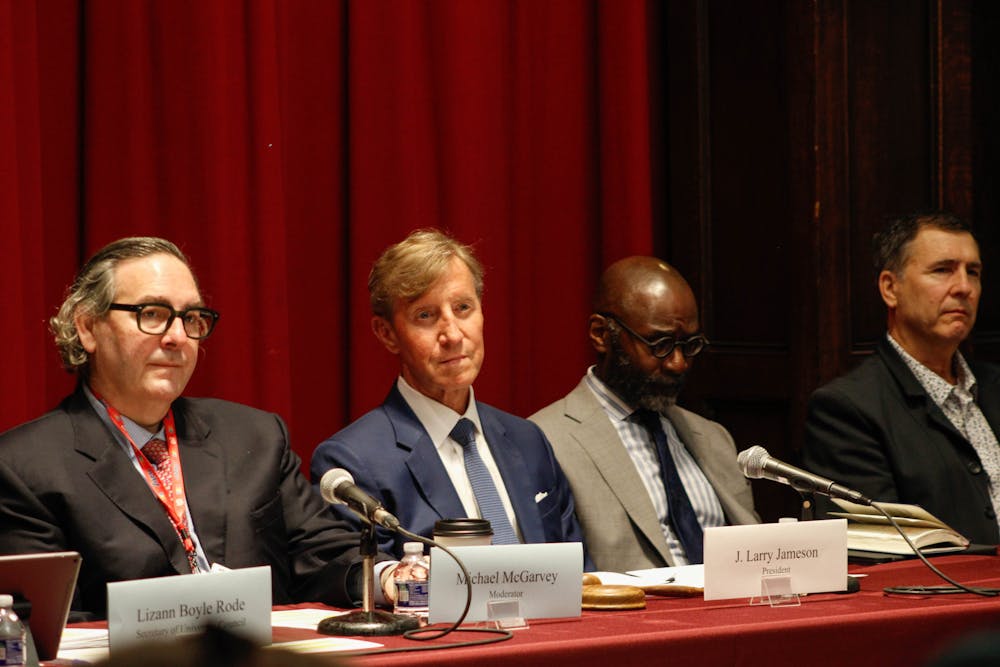
Following the presentation of the Council committee reports at the Wednesday meeting, student and faculty representatives also offered perspectives on the guidelines.
Undergraduate Assembly President Musab Chummun raised concerns about the lack of student “input.”
He also asked about the definition of the word “disruption.” Nichols answered that the committee has not addressed “any particular issue yet.”
Asian Pacific Student Coalition representative Kayuga De Guzman expressed concerns about the inaccessibility of the listening sessions.
“I was one of the only undergraduate students there because of the timing,” De Guzman said.
In a University-wide message sent on Wednesday, Provost John Jackson Jr. announced that the deadline for online feedback on the revisions would be extended from May 18 to May 29.
Nichols stated that the data was “still being assembled” and “parsed in a variety of ways.” When asked if the University would hold additional listening sessions, he stated he was “not aware of any plans” for feedback opportunities.
Other committees also discussed their end-of-year reports at the meeting.
Law professor and chair for the Committee on Academic and Related Affairs William Burke-White shared that the committee focused primarily on evaluating the impact of artificial intelligence on learning. Professor of Medicine and Chair for the Committee on Community and Equal Opportunity Horace DeLisser mentioned an amendment earlier this year to change the group’s name from the “Committee on Diversity and Equity.”
RELATED:
Penn-partnered high schools still set to close despite Philadelphia School District plan revisions
Penn organizations host student wellness events ahead of finals period
Senior reporter Kathryn Ye covers central administration and can be reached at ye@thedp.com. At Penn, she studies biochemistry and philosophy. Follow her on X @Kathryn__Ye.


