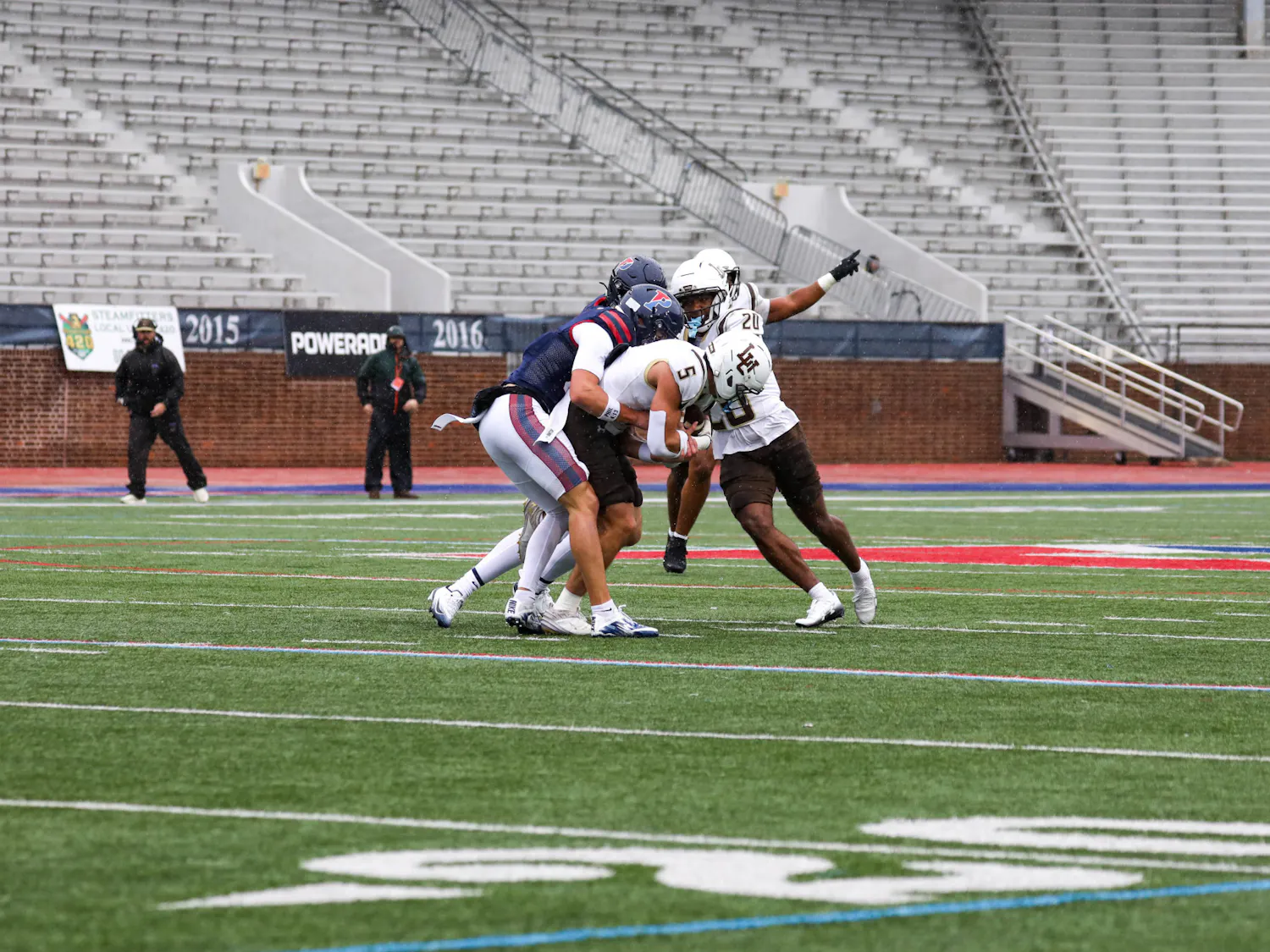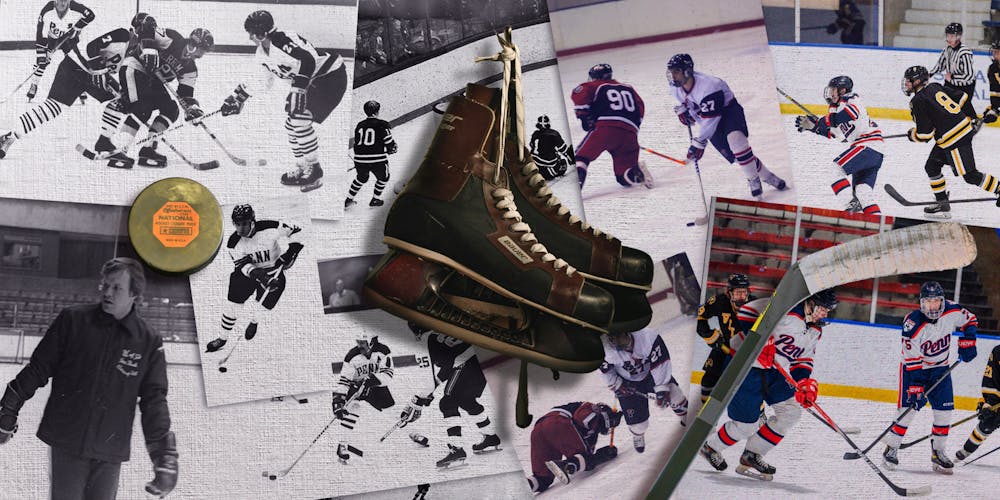
The Class of 1923 Arena looms over Walnut Street.
It comes up out of nowhere. The concrete building stands silent in daylight; few are seen entering at any time, if at all. To the average Penn student, the arena’s operations are seemingly sustained by internal socials and club sports. Penn club hockey battles it out on the ice. A figure skating club holds practices and small shows.
Not many Penn students know that the arena was originally built for Penn’s varsity hockey team, though the rink served its intended purpose for only seven of its 56 years. And not many know that the termination of the varsity program led to an almost four-day sit-in at College Hall in March 1978.
As the sport is having a moment, hockey at Penn has existed in one form or another for over 100 years.
Past
Hockey at Penn started in the late 19th century with a team that played other schools on the Schuylkill River during the winter freeze. An intercollegiate team contested its first official game in 1898.
The program didn’t have a linear rise. Over the next 50 years, schedules varied. Some years, the team played one game per season. Others, the team played up to 15. In the 1960s, ideas of a varsity team started becoming concrete as the team increased the difficulty of its schedule and eventually hired coach Jim Salfi in 1964.
Varsity hockey was introduced during the 1965-66 season. In fall 1967, then-freshman Bob Finke began his career at Penn. Ten years later, he would have either played with or coached every single varsity hockey player in the school’s history.
In 1968, during Finke’s sophomore year, a group of donors from the Class of 1923 — spearheaded by Howard Butcher III — made a donation for the University to build a state-of-the-art hockey rink. By the time he was a senior, the team played its first season at the Class of 1923 Arena.
“In this time, it was one of the best arenas around … it had that top area where you could walk around and stand and watch games,” Finke said. “It was kind of a precursor to a lot of the modern rinks.”
Robert Crocker took over in 1972 after Salfi left for Rensselaer Polytechnic Institute. The program was less successful under Crocker, but a 1973 report from the Task Force on University Athletic Policy still denoted hockey as one of four sports at Penn that were not counted as “minor sports.”
Finke eventually came back, first as an assistant coach in the 1974-75 season before taking over as head coach in 1976. He placed a great emphasis on recruiting, attempting to bring the team back to a more competitive level.
“When I was hired, Andy Geiger was the Athletic Director, and I’ll never forget, because it was fairly important to me, he said, ‘I think it’ll take you five years to get this program back to being a contending type of program,’” Finke said.
The Quakers started the 1977-78 season with a large group of new players. The team was made up of three seniors and 11 freshmen.
“Coach [Finke] sent me all this stuff on the rink, and it was a brand new rink,” Tom Bruch, one of the freshmen in the 1977-78 season, said. “I thought, ‘Why would they build a rink if they didn't have a commitment for a program?’ That was my whole thesis. I was like, ‘Oh, my God, they would never get rid of a five-year-old rink.’”
His thesis proved to be wrong.
Toward the end of Bruch’s freshman year, University administration decided to cut the hockey program, along with some other sports teams and a professional theater at the Annenberg Center for the Performing Arts, citing budget constraints.
Then-sophomore Thomas Cullity was one of the squad’s star players. He still remembers the day he found out that the program was cut.
“We skated around before practice, and quite honestly, everybody was looking around at each other, because it was just this weird, eerie feeling as we were skating around warming up … we actually all started looking around, going, ‘Geez, if something happened, did we have something terrible happen to one of our teammates or somebody die?’” Cullity said. “We had no idea, but you could have that feeling as you skated around the ice.”
“The coaches called us into the locker room and sat us down. … coach Finke addressed the team and was pretty much in tears, telling us that he had just gotten word from the school administration that they were going to drop the program and that we would not have a program after this current season,” he said.
On the administrative side, there were some discrepancies about how the news was communicated to the coaches, both in the moment and in the way it is recalled today.
Finke remembers sitting in his office when a reporter from The Daily Pennsylvanian walked in, asking him for a comment on the University’s decision to terminate hockey.
“He said, ‘Well, I just want to talk to you about the decision that they made last night, that they were going to drop hockey.’ So that’s how I found out about it,” Finke said.
The reporter, Danny Rosenbaum, offered a different version of that story in his February 1978 article for the DP. The termination had been decided at a budget session the previous night and was leaked to the DP. According to Rosenbaum’s article, Geiger had already informed Finke of the decision prior to him arriving in his office.
On March 9, 1978, Finke sent out an edition of the recurring “Friends of Hockey” newsletter addressing how he discovered hockey had been cut. After the newsletter was sent, Geiger received numerous complaints from concerned community members and University donors. In one of Geiger’s response letters, he claimed that he had informed Finke of the decision and the story was leaked to the DP.
The story of the program’s termination caught The New York Times’ attention. In an article published on March 3, 1978, the Times alleged that Finke and the team had first found out about the decision when reading about it in the DP.
The Times article also detailed that the athletic department ultimately decided to cut the hockey program to save $150,000. Over a year before the termination, meeting notes from the University Committee on Recreation and Intercollegiate Athletics stated that “… every effort would be made to maintain all 31 varsity sports.” In Penn’s archival material relating to hockey and athletics, no reference to the impending cut of the hockey program appeared prior to the decision being made.
The news led to public outcry from the broader University community. What was supposed to be a one-hour protest at College Hall on March 2, 1978, turned into an almost four-day sit-in as students voiced complaints about lack of involvement in the University’s decision-making.
Then-University President Martin Meyerson was forced to cut his vacation short to return to negotiations with student leaders, which included then-senior Marc Odette, the hockey team captain.
After countless rounds of negotiations, an agreement was reached between the administration and the students. This agreement mandated the reinstatement of every cut program except the hockey team.
The team’s demand to be reinstated had been dropped during negotiations since the termination of the program already had irreversible impacts on the incoming recruiting class. There was no future where the program could continue competitively.
Still, the University conceded that the president and the provost would “personally assist in arrangements for the transfer of undergraduate hockey players to the schools of their choice.” Archival records show that Meyerson personally reached out to admissions offices at a number of schools to advocate for transfer possibilities for players of the final varsity hockey team.
Meanwhile, the team decided to finish out its season, playing its last games in front of large crowds at the Class of 1923 Arena, although not under the Penn name.
“We decided as a team to skate for ourselves for the balance of the season, and somebody had some white satin things made up that we could put over the front of our shirts and cover up the name … so they look like blank shirts,” Cullity said.
Cullity was one of the players who decided to transfer, eventually heading to Vermont. Other members of the team ended up at Princeton, Brown, and Michigan, while an entire group went to Cornell. For them, the NCAA waived the rule stating that players had to sit out a full season after transferring.
Gary Prior, then a sophomore on the team, also transferred to Vermont. For him, “there was never any doubt.”
“For me, playing was just too important. I don’t think I would have been able to just stay there and study,” Prior said.
The players who left Penn for other schools to continue their hockey careers saw considerable success. Five of the players who transferred went to Cornell, a college hockey powerhouse. Cullity himself had two great years at Vermont, where he became known for his goal-scoring prowess. He was eventually inducted into the University of Vermont Athletic Hall of Fame.
But not all players left; some decided to stay at Penn even though that meant no longer playing hockey at the NCAA Division I level. Bruch was one of them. He and two of his former teammates, then-freshmen Jay Wisentaner and David Akre, played an instrumental role in creating the men’s club hockey team, and also helped build out the women’s side.
“There was a women’s team, but it wasn’t that built out yet. And they didn’t have any coaches, they had nothing. So I agreed to start the program or the club team on the men’s side, … build out the women’s side, and that was it,” Bruch said.
He spent most of his time with the club team as a player-coach and also coached the women’s team. Upon his graduation, he handed over the role to one of the younger players on the team.
“The first year was kind of rough, but by the time we were seniors, it was wonderful,” Bruch said.
The club team has continued to play since then, eventually moving away from the player-coach model and hiring a professional coach for the team. It switched from the Delaware Valley Collegiate Hockey Conference to the Mid-Atlantic Collegiate Hockey Association in 2000, and currently competes at the D-II level in the ACHA.
For those involved with the last varsity team, there are still mixed feelings about its termination 48 years later.
“I still haven’t gotten over the way they treated the players. … I mean, these guys are 18, 19 year-olds that were far from home and trusted all of us, and they didn’t treat them with much respect,” Finke said.
Present
It’s Jan. 30, 2026. Drexel men’s ACHA D-II club hockey is hosting a senior night faceoff against the Quakers. Despite the game being marketed as an away game, the Quakers and the Dragons share ice ownership at the Class of 1923 Arena during the club hockey season.
Sticks clash against the side of the wall, creating a percussive momentum before the first tip. Drexel notches an early goal off the Quakers. The lights dim until a navy blue wave descends over the audience. Top-tier theatrics for a non-varsity program, and the crowd loves every second.
Friends and family of Drexel seniors proudly display big-head cutouts of their favorite players. A group of Penn fans sit over the home benches, tossing Skittles over the bleachers while downing Natural Light beer. They break out into a fanfare inspired by Gary Glitter’s “Rock and Roll, Pt. 2” whenever the Red and Blue score.
By the end of the first period, the Quakers are up 5-1. They notch five more points over the next two periods, closing the game with a 10-2 victory.
“I regret to say this, this is my first time at Penn club hockey,” a Wharton freshman in the crowd said after the first third. “Fantastic experience. I will be back. 10 out of 10, five stars.”
“I would say the same,” a College freshman added. “[It’s my] first time, but [it’s the] best experience I’ve had yet. So ready for more.”
Penn men’s club hockey closed its season in the Colonial Cup semifinals with a 5-2 loss against West Chester. West Chester would go on to take the Colonial Cup title, which the Quakers most recently captured in 2024.
The Red and Blue will be back on the ice in August, running tryouts and recruiting prospective members like every other club sport on campus. Although the team doesn’t discriminate based on skill, the squad tends to skew toward former NCAA prospects with a competitive background. Some of these hockey hopefuls even pitch themselves to team members before they come to campus.
“I’ve had some younger guys message me on Instagram,” junior Chris Bugliosi, a defenseman, said. “That’s how I was like, ‘Oh yeah, we have hockey. Here’s what you can do.’”
Bugliosi learned how to love hockey from his dad, who grew up in Northern Minnesota. After years playing for travel teams, Bugliosi transferred to the Kent School for his sophomore year of high school. Despite tearing his labrum at the end of his junior year, Bugliosi served as senior captain for the Lions, garnering interest from teams in the North American Hockey League.
Instead of attempting to make it as a professional hockey player, Bugliosi decided to commit to Penn and embrace the club hockey environment. During the 2025-26 season, Bugliosi played in all but one game, leading the team with 25 points total.
Senior and outgoing president A.J. Moshyedi has a similar story. A Washington native, Moshyedi began playing hockey at age 5 after being enticed by a mid-game fight during a Washington Capitals game. Moshyedi transferred to a New England preparatory school before his junior year of high school to play at a high level and garner interest from NCAA programs.
The legacy allure of Penn ultimately won Moshyedi over. His dad played as an offensive tackle on the football team from 1985-89, ultimately earning the Penn Football Club Award in his senior season. Regular trips to Philadelphia for Homecoming made Moshyedi fall in love with Penn. A good club hockey program was just the cherry on top.
Although he’s departing the program when he graduates in May, Moshyedi believes that Penn club hockey has the potential to return to a Division I program.
“[Alumni have] recommended to stay the course, continue being competitive, continue advancing season after season,” Moshyedi said. “I think at some point, as long as the trend continues, [the administration] will eventually take notice and take action.”
This story is the first of a two-part series about hockey at Penn. The second part is linked here.