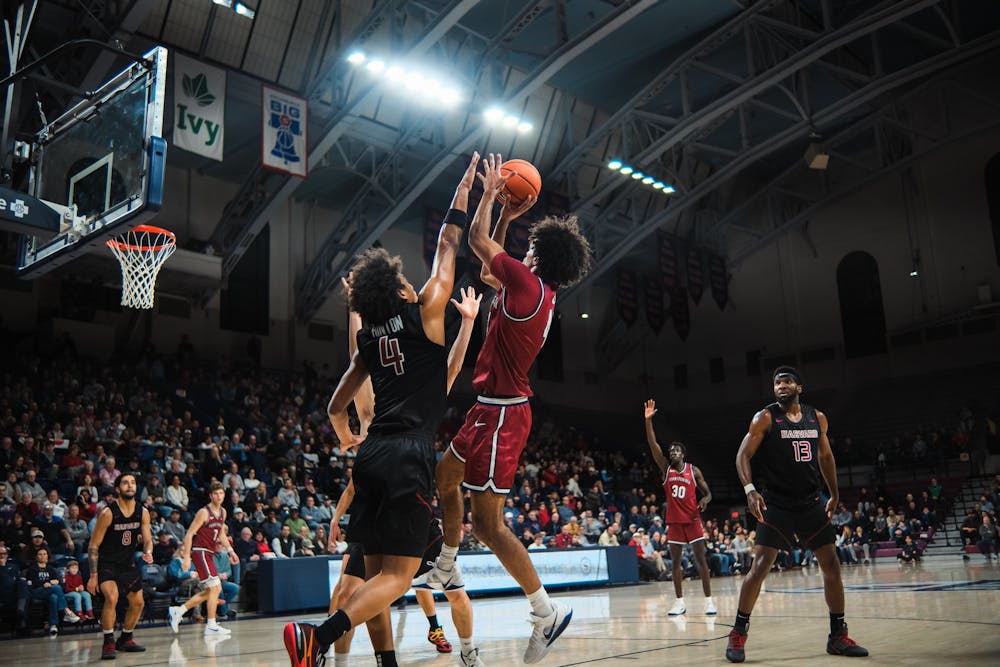
Penn men’s basketball is headed back to Ivy Madness for the first time since 2023. If its recent play is any indication, the Quakers aren’t going for a field trip.
Over the weekend, the Red and Blue secured the third seed in the upcoming Ancient Eight tournament, with a 2-0 stretch that included victories over Dartmouth and Harvard. The latter marked Penn’s first victory over one of the league’s top two teams, Yale and the Crimson, while the weekend as a whole showcased a resilient offensive attack — the kind that gives the Quakers a championship-level ceiling.
It’s rare that the outcome of a game can be attributed to the performance of a single player, but junior forward TJ Power’s performance against the Big Green on Friday night came close. The former five-star recruit has had several dominant halves for Penn this season, but never before had he dominated an entire game so summarily. The stat line speaks for itself: 38 points (fifth-most in program history) on 6-of-8 from three, along with 12 rebounds. But the tape also demonstrated the high-level skills that have made Power such a game-changing addition for the Quakers.
In a motion-heavy system, Power is one of the few players Penn coach Fran McCaffery trusts to generate most of his points in isolation. Standing at 6-foot-9 with a fluid handle and strong jumper, Power is a walking mismatch for Ivy League defenders.
Here, Power fakes at the elbow, losing one Big Green defender. As he drives in, Dartmouth forward Brandon Mitchell-Day is so afraid of Power’s bump that he hedges up, opening space for Power to spin by for a gorgeous lay-in.
Another thing that makes Power so dangerous is the dichotomy of his offensive pace — when he’s not bumping and wearing defenders down over the course of an extended one-on-one, he’s pulling up in the blink of an eye. Here, he spaces the floor on the fast break and uses the sliver of space to fire off a three.
“[Power’s] versatility was on full display tonight, and that’s what I wanted for him,” McCaffery said. “He can get it off the glass and bring it himself. We can isolate him at the elbow. We can clear aside for him. We can post him up. He’s got the ultimate green light. Pull from three. Shoot your pull up.”
Power finished with 47.5% of Penn’s points and was one of just two Quakers to shoot better than 50% from the field.
The following night could not have been more different, at least in the first half. Power went into halftime against Harvard with zero points and four turnovers, part of a season-low 21-point half for the Quakers as a whole. For comparison, in the first half of its Jan. 19 matchup with the Crimson, Penn scored 26 points, tied for their second lowest in a half this campaign.
Harvard, which led the league in opponent points per game, opponent field goal percentage, and opponent three-point percentage since the start of Ivy play, did an exceptional job of staying in front of Penn’s drives and rotating when necessary. Their main remedy for Power was guard Chandler Pigge, a stout, stocky 6-foot-5 stalwart capable of limiting Power’s physicality. Penn found itself repeatedly mired in stagnant sets, recording just two assists in the period and trailing by 10 at the break.
“We stood around a little bit in the first half — the ball stuck,” McCaffery said. “If you do that against [Harvard], they’re going to give you problems.”
Then, in the second half, the Quakers returned to the principles that have made them one of the league’s most efficient offenses: ball movement, penetration, and pace. Penn scored on its first four possessions of the second half, emphasizing quick decisions and transition opportunities to reignite a dormant attack.
Sophomore guard AJ Levine was pivotal in Penn’s resurgence. When Levine decides he’s going to the rim, he attacks with supreme speed and intensity. This can occasionally get him into trouble (he missed two contested looks at the basket in the first half), but on the whole, it’s a trait that has served both him and Penn’s offense well. Here, he sees a lane he likes and doesn’t hesitate to take it, knifing to the cup and using his smooth touch off the glass to finish the play.
“The way he played at the start of the second half changed everything,” McCaffery said of Levine.
Power rebounded from his early struggles with a perimeter barrage, connecting on 3-of-4 from beyond the arc in the second half. Here, both his and Levine’s strengths are in action — Levine penetrates, bringing Power’s defender out of his position, and when Levine dishes out, Power’s quick trigger is ready to fire.
All that said, senior guard/forward Ethan Roberts was the story of the night. Roberts, Penn’s leading scorer of the season, notched 19 points per game in the first seven games of Ivy play but had averaged just 11 in the five games prior to Saturday. That downturn has primarily been the product of the rugged attention he’s received from opposing defenses, but there have also been times in recent weeks where Roberts has been more passive than usual.
That was not the case against the Crimson. Roberts scored 17 of his 21 points after the break behind an attack-first mentality, targeting the close and intermediate areas of the floor with his signature change of speed.
Here, on one of the game’s most pivotal possessions, Roberts catches on the wing with the Dartmouth defense already scrambling after Levine corralled his own miss. Roberts doesn’t give them a second to breathe, freezing his defender with a ball fake and getting to the rack for a scooping finish.
“Just trying to be aggressive,” Roberts said of his second-half approach. “That’s it. Just trying and playing to win.”
There are only a handful of Ivy League players capable of taking over a game in that fashion. Two of them play for Penn. That alone gives the Quakers a legitimate chance at their first trip to March Madness since 2018.
With the tournament field set, Penn is guaranteed to see Harvard again when the teams face off in the first round on March 15. Clinching a spot in the conference dance was an emotional moment for a program that has made significant strides in one season under McCaffery. But when the ball tips off in Ithaca, N.Y. two weeks from now, the Quakers won’t be satisfied with playing for the conference crown. They have what it takes to claim it.
WALKER CARNATHAN is a College senior and former DP Sports editor from Harrisburg studying English and cinema and media studies. All comments should be directed to dpsports@thedp.com.