

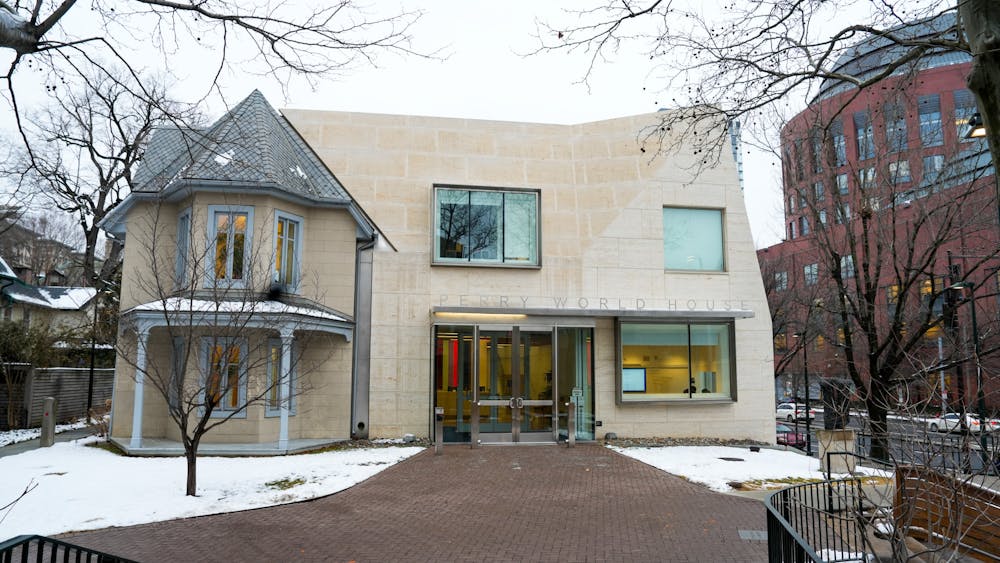
Perry World House hosted two experts on Holocaust studies for a Feb. 5 discussion about Israel’s policies in the Gaza Strip.
The event, titled “The Genocide Accusation against Israel: A Scholarly Exchange,” featured Brown University professor Omer Bartov and University of Florida professor Norman J.W. Goda. The panel — organized by the Katz Center for Advanced Judaic Studies — included 10-minute remarks by each speaker, followed by a moderated conversation and a series of audience questions.
In his speech, Bartov said that “there was no other way to describe what Israel was doing” than “as a genocidal operation.”
He also discussed the opinions of other experts on the crisis.
“The vast majority of both scholars of genocide and experts in international law have concluded that this was indeed a genocidal operation,” Bartov said.
Numerous human rights organizations and experts — including Amnesty International, Human Rights Watch, and the U.N. — have labeled the conflict as a “genocide” by Israel of the Palestinian people.
Goda, on the other hand, asserted South Africa’s claims that Israel was committing genocide in Gaza relied on “questionable evidence.” He also described similar allegations made by the United Nations Special Rapporteur to Palestine as “unbound by facts.”
In 2025, a U.N. report submitted, “publicly available material collected by South Africa, evidencing genocidal conduct by Israel against Palestinians in Gaza.”
RELATED:
Israel-Palestine discourse on Penn's campus has intensified over time, DP archival review finds
Penn hosts public opinion expert to discuss attitudes around Israel and Palestine
“I do not believe it will help us come to sober judgments in the years ahead,” he said, calling the use of the term genocide “corrosive” in this context.
During the moderated discussion, the speakers examined the history of the conflict, the legal implications of genocide allegations, and the relationship between such claims and antisemitism.
Bartov said that “the root of the issue” came about in 1948, when the Palestinians became a “refugee people.” He added Israel “refused to negotiate any sort of restitution or partial return.”
Goda said he agreed that the Israeli government “chafes at” domestic laws, but added that allegations about Israel’s conduct in Gaza have been “supercharged by the new technology of the internet.”
He emphasized that using the term genocide to describe Israel’s actions is not just a legal description, but "a political judgment concerning the nature of the Jewish state.”
"To say that none of this is antisemitism seems to defy reality,” Goda said.
Bartov expressed a different view, claiming that those who label criticisms of Israel’s actions in the Gaza Strip as “antisemitic” contribute to the “rise of antisemitism.”
“To say criticizing indefensible Israeli policies in Gaza is antisemitism is just stoking the fire of antisemitism,” Bartov said.
Klatt Family Director for Public Programs Charlotte Kiechel, who moderated the event, characterized the conversation as “too important to ignore.”
“We believe there is value in the respectful exchange of beliefs and views,” Kiechel said.
RELATED:
Israel-Palestine discourse on Penn's campus has intensified over time, DP archival review finds
Penn hosts public opinion expert to discuss attitudes around Israel and Palestine
Senior reporter Lavanya Mani covers legal affairs and can be reached at mani@thedp.com. At Penn, she studies comparative literature. Follow her on X @LavanyaMani_.





