

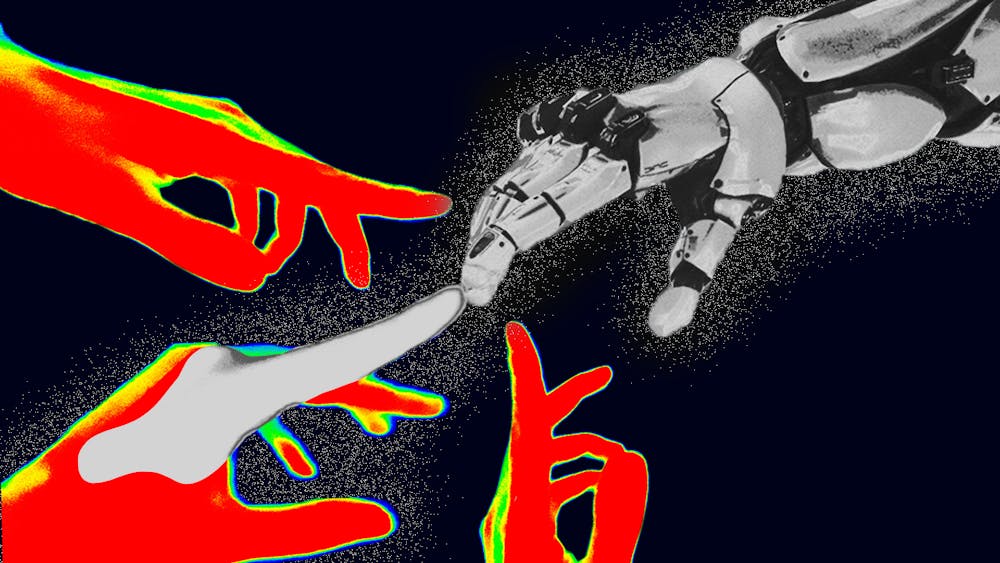
In 2024, Penn made history by becoming the first Ivy League school to launch a major in artificial intelligence. Gutting its systems engineering major, the University justified the replacement as a program that would “fit the AI-powered needs of the 21st century.” Since then, AI has become intertwined with obtaining a Penn education in completely unprecedented — and potentially dangerous — ways.
Our AI course offerings have exploded. Penn now offers 10 undergraduate programs, 21 graduate programs, and eight doctoral programs in the field. The University has also launched a new AI fellowship and invested millions of dollars in AI research, particularly within the field of education. In perhaps its strangest display of support for this technology, this April will mark the third annual AI Month at Penn, with a slate of events planned to “highlight work across AI in health, science, education, business and public life.”
In many ways, these changes make sense. In a world increasingly defined by AI, elite universities are doing whatever they can to keep from falling behind. By implementing AI into its education system, Penn aims to produce graduates who can succeed in a newly transformed job market, while retaining its dominance in technology, medicine, and business. Above all else, the University wants to prevent itself, along with the entire institution of higher education, from becoming obsolete. But as this pattern speeds up, Penn’s commitment to AI innovation seems less like an enhancement to our learning and more like a detriment to our critical thinking abilities. In its tireless support for AI, the University has essentially endorsed shortcuts and the outsourcing of academic thinking, threatening the very freedom of inquiry and open expression it claims to promote.
In spring 2024, a Student Committee on Undergraduate Education survey found that 83% of Penn undergraduates disclosed that they had used AI in an academic setting. Penn is caught up in a national trend — in 2025, 90% of American university students admitted to using AI academically and 75% said that their use has increased over the past year. Ask any student on campus, and they’ll give you an exhaustive list of all the AI programs they use — some to help, some to teach, and some to simply do the work for them.
While it may seem convenient to plug a problem set or 40-page reading into ChatGPT, the drawbacks of AI usage are widely documented and increasingly detrimental. Students develop an overreliance on AI, social interaction and communication are reduced, AI programs produce and reinforce biased and false information without any accountability, and critical thinking is inhibited. As Penn students, our purpose is to take advantage of our education, not give it away to an AI model while we sit by passively.
Despite Penn’s apparent focus on AI and its functions, there is no University-wide policy on how students can and can’t use it in the classroom. The only established statement from the University is a vague statement of “guidance,” offering suggestions and vague regulations on the use of AI. However those “guidelines” mostly favor the use of AI, stating that professors aren’t allowed to check students’ work for generative AI without their explicit permission and that all professors are given the reins to implement AI within their courses as they see fit. So, while some professors may strictly forbid AI in all its forms, others encourage us to generate practice problems or develop an argument with the help of AI. These vastly differing policies and ideologies leave students completely in the dark about potential consequences of AI usage in our education and with no consistency between class guidelines.
Penn’s lack of transparency on its AI policy combined with the University’s ever-increasing dedication to AI innovation teaches students an unexpected lesson: AI is no longer a tool with potential benefits, but a prerequisite for living. While elite institutions like Penn would never explicitly endorse the use of generative AI in schoolwork, they seem to welcome the technology in almost every other form and setting.
Through its countless new programs and AI-centered events, Penn has positioned AI as an inescapable future that we all must accept in order to achieve success. There is no doubt that AI is part of the current occupational landscape, and we will certainly encounter it long after we graduate. Nevertheless, we attend this institution to develop hard skills, question the world around us, solve problems, produce new ideas, and the ability to think for ourselves. With the University forcing AI into our learning every chance it gets, do we end up gaining knowledge or cheat codes?
Goldman Sachs reports that 300 million full-time jobs could be replaced by AI by 2030. Labor turnover is high and hiring has slowed. 71% of Americans worry that AI will cause permanent job loss. As young people about to enter the workforce for the first time, the fear of unemployment is understandable, but we cannot save ourselves with the very tool that is putting us at risk.
The irony is that as Penn pours endless money and energy into AI advancement in its attempt to get ahead, the University is only quickening its own demise. AI cannot coexist with education — it can only degrade it. As technology advances and workers are replaced by machines, schools are some of the only places we have left to explore and wrestle with human thought. With our own university leading the charge, AI is now corrupting those few sacred spaces and leaving us with nowhere to engage in true scholarship.
Editorials represent the majority view of members of The Daily Pennsylvanian Editorial Board who meet regularly to discuss issues relevant to the Penn community. This body is led by Editorial Board Chair Jack Lakis and is entirely separate from the newsroom. Questions or comments should be directed to letters@thedp.com.


