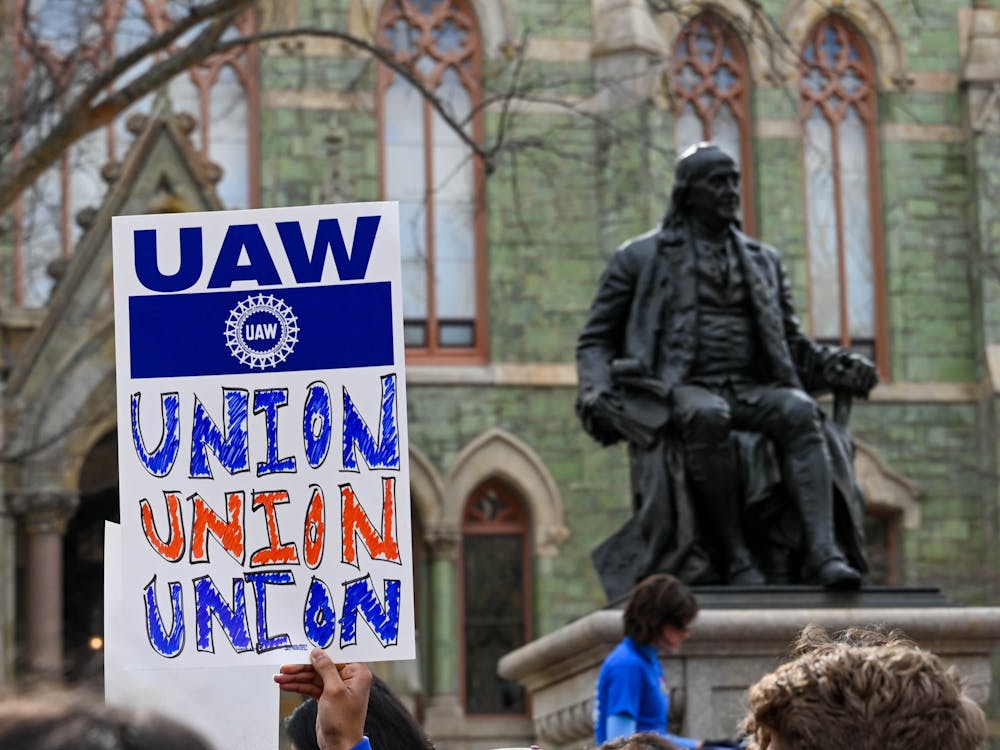
Under the tentative agreement reached by Penn and its graduate student union, the new minimum annual stipend for graduate workers now more closely matches funding offered by peer institutions.
On Feb. 17, Graduate Employees Together — University of Pennsylvania and Penn administrators agreed to a $49,000 minimum annual stipend and a minimum hourly rate of $25. The changes are set to take effect on April 1 and continue through the 2026-27 academic year.
“Penn has a long-standing commitment to its graduate students and value their contributions to Penn’s important missions,” a University spokesperson wrote to the DP. “We are grateful to all the members of the Penn community who helped us achieve this tentative agreement.”
Effective July 1, 2027, the minimum stipend and hourly wage will increase by 3% to $50,470 and $25.75, respectively. For students who already make more than the $49,000 minimum, their stipends will increase by 3% in both the first and second years of the contract.
The minimum salary outlined in the tentative agreement marks a 21% increase from the current stipend.
For comparison, The Daily Pennsylvanian analyzed graduate student stipends at 15 other private universities in the 2025-26 academic year.
RELATED:
Penn reaches three new tentative agreements with graduate student union ahead of strike deadline
Protests at Penn have evolved. So have the guidelines meant to regulate them
Under the new agreement, Penn’s minimum annual stipend of $49,000 ranks seventh out of the 16 universities analyzed. According to GET-UP, graduate students at Penn currently receive a minimum annual stipend of $40,608, which places Penn only above Georgetown University and Vanderbilt University among the selected institutions.
Minimum stipends at the listed institutions may be subject to increase — based on previously ratified contract provisions or upcoming bargaining sessions — for the 2026-27 academic year, when Penn’s tentative salary would take effect.
Earlier this week, GET-UP argued that the current pay offered by Penn falls “far behind” the stipends offered by “peer institutions located in cities with costs of living comparable to Philadelphia’s.” The seven universities listed ahead of Penn in the union’s social media post — the University of Chicago, Northwestern University, Cornell University, Johns Hopkins University, Yale University, Princeton University, and Brown University — offer minimum stipends ranging from $46,350 to $52,198 for the 2025-26 academic year.
Of the 16 universities analyzed, 14 have officially recognized graduate student unions that secured compensation through bargaining. The only universities without unionized graduate workers are Princeton and Vanderbilt.
Ezra Lebovitz, a GET-UP union member, spoke to the DP about the significance of increased compensation for graduate students.
“It’s tremendous,” Lebovitz, who is also a third-year Ph.D. student at the School of Arts and Sciences studying comparative literature, said. “I think it matters a lot, both in terms of people’s everyday life — like their ability to pay rent and groceries — and also for Penn, too, when they’re thinking about remaining competitive with peer institutions.”
He also described how action taken by graduate student unions at peer institutions influenced GET-UP’s bargaining process, including “practical” applications — such as “borrowing language from other contracts” — and “remembering that it’s possible.”
“So much of what we were able to win here came from looking at what our peers at other institutions were able to win and how they were able to win it,” Lebovitz said. “I think there’s a real relationship between our contract and the contract of other workers in higher ed.”
In addition to increased compensation, graduate workers won several other benefits in the tentative agreement, including full coverage of vision insurance premiums, 80% coverage of dental insurance premiums, an annual health care fund of $200,000 that will cover 50% of premium costs for dependents, up to six weeks of paid long-term medical leave, eight weeks of paid parental leave, and access to a retirement plan.
GET-UP is set to vote on the agreement during the week of Feb. 23 through an online, secret ballot. If a simple majority of voting graduate workers approve, the agreement will be ratified.
RELATED:
Penn reaches three new tentative agreements with graduate student union ahead of strike deadline
Protests at Penn have evolved. So have the guidelines meant to regulate them
Senior reporter James Wan leads administration reporting and can be reached at wan@thedp.com. At Penn, he studies communication and computer science. Follow him on X @JamesWan__.