When College senior Lily Heavey was 13, she fell in love with human anatomy. While other kids played video games, she spent her time poring over bone density and blood vessels, envisioning the day she’d put on a white coat. On her first day at Penn, Career Services gave her cautionary advice: “GPA is everything for medical school. Molecular biology is a safer course load.” Four years later, after slogging through organic chemistry, Lily is taking her first anatomy class as a senior.
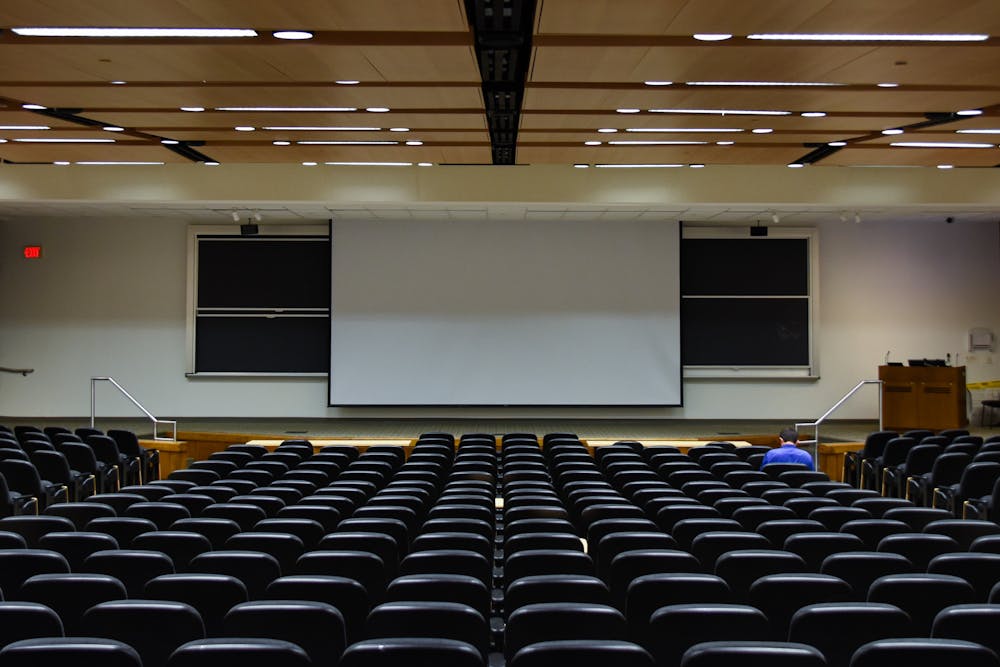
Engineering junior Viktor Wittner chose computer science because he enjoyed building things. But early on, he noticed something strange. Classrooms were half empty. Friends shrugged off any content that wouldn’t appear on the midterm. The real so-called “success” existed outside the classroom: LeetCode, GitHub portfolios, internships, and technical interview drills.
As course selection for the spring semester returns, Lily and Viktor joined me and thousands of Penn students in a ritual that now feels less like planning an education and more like risk management. We open Penn Course Review and scan for two numbers: difficulty and workload ratings, which are out of 4.0. Anything above a 3.0 fades into the background until our final selection of courses feels more like damage control than discovery.
It leaves me with a sticky sense of unease as I think of the bright-eyed girl who once arrived on campus with the kind of idealism only an 18-year-old can summon. I wanted to be challenged, to learn anything and everything under the sun. Then, I watched artificial intelligence slowly swallow skills I had once taken pride in. It wasn’t just coding; it was creating writing, music, and art. So I clung to the metric I could still control: my GPA. If that number stayed high, surely I was still capable? Capable enough to bypass the first filtering round and shift my attention to the next checkpoints: building projects, mass applying to internships, and chasing club leadership positions.
In a recent column in The Daily Pennsylvanian, Penn professor Daniel Hopkins proposed imposing mandatory grade deflation, arguing that inflated grades weaken Penn’s reputation for rigor in the eyes of employers and graduate schools. Crucially, he believes that tightened grading would force employers to take transcripts seriously again, thereby alleviating the student pressure to chase endless external signals. His concerns echo larger national conversations, including recent moves at Harvard University to reconsider stricter grading practices.
I don’t disagree with the diagnosis, but as a student, I do question the proposed cure. Both Hopkins and Harvard assume that if grades were tighter, the employer market would return to treating transcripts as its primary measure of talent. But the market is not waiting for universities to get tougher; it is simply looking elsewhere. According to the 2026 Job Outlook survey by the National Association of Colleges and Employers, nearly 70% of employers now prioritize skills-based hiring, with a focus on “experiential learning and/or work during college.” In every internship application I write, it feels overwhelmingly clear that beyond my grades, experiences outside the classroom — prior internships, clubs, and personal projects — are held in high importance. Beyond acting as an initial filter, GPA has lost its credibility for reasons deeper than grade inflation: The world now rewards agency, and merely being a passive student is not enough. All this, coupled with recruiting that now begins as early as sophomore year and the continual fears of AI industry disruptions, has created a student culture of chronic self-doubt and an employment culture that will not revert to valuing transcripts simply because grading gets harsher.
The bigger question, then, is not how to preserve old academic standards, but how to allow academia to adapt without surrendering its core values. Rather than blaming students for chasing security with a safer course load, we should eliminate the GPA penalty for curiosity. What students need now is the freedom to experiment with ideas and disciplines without the looming threat of a professor who only allots a fixed quota of “A” grades or assessment questions designed to trap students rather than teach. We should give them space to love learning without forcing them to choose between intellectual risk and professional survival.
Some of my most formative classes have been so-called “easy-As,” in which grades reflected attendance, preparation, and active discussion rather than high-stakes competition. And yet, their demand to think publicly, connect ideas across readings, and engage actively pushed me to consider topics in new, unique, interdisciplinary ways. I wouldn’t have had this experience in courses where I sat in a room drenched in fluorescent light, trying to outsmart a midterm designed to trick me. Courses that prioritize rigor through aspects like reflection, participation, and synthesis offer a different and yet equally rewarding form of intellectual labor.
None of this is to serve as an argument against rigor, and I do still believe that conceptually “hard” classes are important to build grit. But true discipline in learning should emerge from depth and genuine engagement, not from fear of a grade. As more students grow dependent on AI to complete their assignments, academia must evolve to respond by rewarding interdisciplinary courses and original thoughts. Only then can we reinflate the spirit of learning and protect what makes the university classroom a place worth returning to.
DIYA CHOKSEY is a College sophomore from Mumbai, India studying cognitive science. Her email is dchoksey@sas.upenn.edu.

Diya Choksey is a College junior studying cognitive science from Mumbai, India. Her column focuses on student culture and identity. She can be reached at dchoksey@sas.upenn.edu.